{"title":"Biodegradable fluorescent protein chromophore nanoparticles for hypoxic two-photon photodynamic therapy†","authors":"Wan Feng and Ying Qian","doi":"10.1039/D4BM01162G","DOIUrl":null,"url":null,"abstract":"<p >In this paper, biodegradable red fluorescent protein (RFP) chromophore analogue DPFP-SS-FA nanoparticles were synthesized for hypoxic two-photon photodynamic therapy. The maximum emission wavelength of DPFP-SS-FA is in the red-to-near-infrared region at 674 nm. Interestingly, these DPFP-SS-FA nanoparticles remain stable under physiological conditions, but deplete glutathione and disintegrate into the RFP chromophore analogue monomer in the tumor microenvironment. Meanwhile, electron paramagnetic resonance data have shown that DPFP-SS-FA produced enhanced <small><sup>1</sup></small>O<small><sub>2</sub></small>/O<small><sub>2</sub></small>˙<small><sup>−</sup></small> signals after glutathione depletion causing an enhanced PDT effect. DPFP-SS-FA has negligible cell dark toxicity and high phototoxicity in hypoxic environments, indicating the outstanding hypoxia-overcoming ability of DPFP-SS-FA. In addition, due to its folic acid receptor and lysosome dual-targeting ability, DPFP-SS-FA is highly enriched in A-549 tumor cells. In particular, the hypoxic two-photon photodynamic therapy mediated by DPFP-SS-FA nanoparticles was validated in a zebrafish tumor model. Under 800 nm two-photon excitation, DPFP-SS-FA enabled bright two-photon fluorescence imaging and significantly inhibited the growth of tumor cells in zebrafish. The biodegradable DPFP-SS-FA nanoparticles reasonably constructed in this study can serve as excellent candidates for efficient hypoxic two-photon photosensitizers to treat deep tumor tissues.</p>","PeriodicalId":65,"journal":{"name":"Biomaterials Science","volume":" 23","pages":" 6123-6135"},"PeriodicalIF":5.7000,"publicationDate":"2024-10-23","publicationTypes":"Journal Article","fieldsOfStudy":null,"isOpenAccess":false,"openAccessPdf":"","citationCount":"0","resultStr":null,"platform":"Semanticscholar","paperid":null,"PeriodicalName":"Biomaterials Science","FirstCategoryId":"5","ListUrlMain":"https://pubs.rsc.org/en/content/articlelanding/2024/bm/d4bm01162g","RegionNum":3,"RegionCategory":"医学","ArticlePicture":[],"TitleCN":null,"AbstractTextCN":null,"PMCID":null,"EPubDate":"","PubModel":"","JCR":"Q1","JCRName":"MATERIALS SCIENCE, BIOMATERIALS","Score":null,"Total":0}
引用次数: 0
Abstract
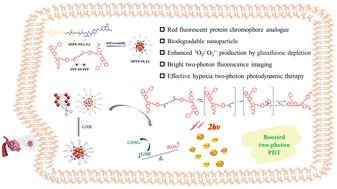
In this paper, biodegradable red fluorescent protein (RFP) chromophore analogue DPFP-SS-FA nanoparticles were synthesized for hypoxic two-photon photodynamic therapy. The maximum emission wavelength of DPFP-SS-FA is in the red-to-near-infrared region at 674 nm. Interestingly, these DPFP-SS-FA nanoparticles remain stable under physiological conditions, but deplete glutathione and disintegrate into the RFP chromophore analogue monomer in the tumor microenvironment. Meanwhile, electron paramagnetic resonance data have shown that DPFP-SS-FA produced enhanced 1O2/O2˙− signals after glutathione depletion causing an enhanced PDT effect. DPFP-SS-FA has negligible cell dark toxicity and high phototoxicity in hypoxic environments, indicating the outstanding hypoxia-overcoming ability of DPFP-SS-FA. In addition, due to its folic acid receptor and lysosome dual-targeting ability, DPFP-SS-FA is highly enriched in A-549 tumor cells. In particular, the hypoxic two-photon photodynamic therapy mediated by DPFP-SS-FA nanoparticles was validated in a zebrafish tumor model. Under 800 nm two-photon excitation, DPFP-SS-FA enabled bright two-photon fluorescence imaging and significantly inhibited the growth of tumor cells in zebrafish. The biodegradable DPFP-SS-FA nanoparticles reasonably constructed in this study can serve as excellent candidates for efficient hypoxic two-photon photosensitizers to treat deep tumor tissues.
期刊介绍:
Biomaterials Science is an international high impact journal exploring the science of biomaterials and their translation towards clinical use. Its scope encompasses new concepts in biomaterials design, studies into the interaction of biomaterials with the body, and the use of materials to answer fundamental biological questions.



 京公网安备 11010802042870号
京ICP备2023020795号-1
京公网安备 11010802042870号
京ICP备2023020795号-1

 分享
分享
 求助内容:
求助内容: 应助结果提醒方式:
 扫码关注我们
