{"title":"Zn2+ ions improve the fidelity of metal-mediated primer extension while suppressing intrinsic and Mn2+-induced mutagenic effects by DNA polymerases†","authors":"Tatsuya Funai , Natsumi Tanaka , Riyo Sugimachi , Shun-ichi Wada , Hidehito Urata","doi":"10.1039/d4ob01433b","DOIUrl":null,"url":null,"abstract":"<div><div>While Mn<sup>2+</sup> ions are well-established for reducing the fidelity of DNA polymerases, leading to the misincorporation of nucleotides, our investigation of the effects of metal ions revealed a contrasting role of Zn<sup>2+</sup>. Here, we demonstrate that Zn<sup>2+</sup> ions enhance the fidelity of DNA polymerases (the 3′ → 5′ exonuclease-deficient Klenow fragment and Taq DNA polymerase) by suppressing misincorporation during primer extension reactions. Remarkably, Zn<sup>2+</sup> ions inhibit both intrinsic misincorporation and Mn<sup>2+</sup>-induced misincorporation of nucleotides. Furthermore, Zn<sup>2+</sup> ions also effectively suppressed misincorporation during metal-mediated primer extension reactions, which involved forming Ag<sup>+</sup> and Hg<sup>2+</sup> ion-mediated base pairs. These findings suggest that Zn<sup>2+</sup> ions inhibit both intrinsic and Mn<sup>2+</sup>-induced mismatched base pair formation. Consequently, the combined use of Mn<sup>2+</sup> and Zn<sup>2+</sup> ions may offer a strategy for precisely regulating the fidelity of DNA polymerases. Remarkably, Zn<sup>2+</sup> ions even suppress misincorporation in primer extension reactions that rely on metal-mediated base pairs, and conversely, this suggests that DNA polymerases recognize metal-mediated base pairs such as T-Hg<sup>2+</sup>-T, C-Ag<sup>+</sup>-A, and C-Ag<sup>+</sup>-T as relatively stable base pairs. These results imply that Zn<sup>2+</sup> ions may also enhance the fidelity of DNA polymerases when incorporating non-canonical nucleobases, potentially paving the way for the expansion of the genetic alphabet.</div></div>","PeriodicalId":96,"journal":{"name":"Organic & Biomolecular Chemistry","volume":"22 46","pages":"Pages 9094-9100"},"PeriodicalIF":2.7000,"publicationDate":"2024-10-16","publicationTypes":"Journal Article","fieldsOfStudy":null,"isOpenAccess":false,"openAccessPdf":"","citationCount":"0","resultStr":null,"platform":"Semanticscholar","paperid":null,"PeriodicalName":"Organic & Biomolecular Chemistry","FirstCategoryId":"92","ListUrlMain":"https://www.sciencedirect.com/org/science/article/pii/S1477052024009285","RegionNum":3,"RegionCategory":"化学","ArticlePicture":[],"TitleCN":null,"AbstractTextCN":null,"PMCID":null,"EPubDate":"","PubModel":"","JCR":"Q1","JCRName":"CHEMISTRY, ORGANIC","Score":null,"Total":0}
引用次数: 0
Abstract
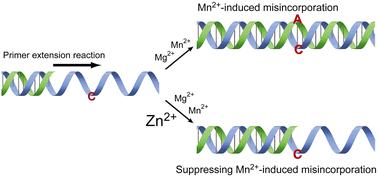
While Mn2+ ions are well-established for reducing the fidelity of DNA polymerases, leading to the misincorporation of nucleotides, our investigation of the effects of metal ions revealed a contrasting role of Zn2+. Here, we demonstrate that Zn2+ ions enhance the fidelity of DNA polymerases (the 3′ → 5′ exonuclease-deficient Klenow fragment and Taq DNA polymerase) by suppressing misincorporation during primer extension reactions. Remarkably, Zn2+ ions inhibit both intrinsic misincorporation and Mn2+-induced misincorporation of nucleotides. Furthermore, Zn2+ ions also effectively suppressed misincorporation during metal-mediated primer extension reactions, which involved forming Ag+ and Hg2+ ion-mediated base pairs. These findings suggest that Zn2+ ions inhibit both intrinsic and Mn2+-induced mismatched base pair formation. Consequently, the combined use of Mn2+ and Zn2+ ions may offer a strategy for precisely regulating the fidelity of DNA polymerases. Remarkably, Zn2+ ions even suppress misincorporation in primer extension reactions that rely on metal-mediated base pairs, and conversely, this suggests that DNA polymerases recognize metal-mediated base pairs such as T-Hg2+-T, C-Ag+-A, and C-Ag+-T as relatively stable base pairs. These results imply that Zn2+ ions may also enhance the fidelity of DNA polymerases when incorporating non-canonical nucleobases, potentially paving the way for the expansion of the genetic alphabet.
期刊介绍:
Organic & Biomolecular Chemistry is an international journal using integrated research in chemistry-organic chemistry. Founded in 2003 by the Royal Society of Chemistry, the journal is published in Semimonthly issues and has been indexed by SCIE, a leading international database. The journal focuses on the key research and cutting-edge progress in the field of chemistry-organic chemistry, publishes and reports the research results in this field in a timely manner, and is committed to becoming a window and platform for rapid academic exchanges among peers in this field. The journal's impact factor in 2023 is 2.9, and its CiteScore is 5.5.



 京公网安备 11010802042870号
京ICP备2023020795号-1
京公网安备 11010802042870号
京ICP备2023020795号-1

 分享
分享
 求助内容:
求助内容: 应助结果提醒方式:
 扫码关注我们
