Shanshan Suo, Rong Feng Fu, Albert Qin, Zonghong Shao, Jie Bai, Hu Zhou, Na Xu, Suning Chen, Xuelan Zuo, Xin Du, Minghui Duan, Li Wang, Pei Li, Xuhan Zhang, Sujiang Zhang, Daoxiang Wu, Jingjing Zhang, Zhijian Xiao, Lei Zhang, Jie Jin
{"title":"Molecular remission uncoupled with complete haematological response in polycythaemia vera treatment with ropeginterferon alfa-2b","authors":"Shanshan Suo, Rong Feng Fu, Albert Qin, Zonghong Shao, Jie Bai, Hu Zhou, Na Xu, Suning Chen, Xuelan Zuo, Xin Du, Minghui Duan, Li Wang, Pei Li, Xuhan Zhang, Sujiang Zhang, Daoxiang Wu, Jingjing Zhang, Zhijian Xiao, Lei Zhang, Jie Jin","doi":"10.1111/bjh.19846","DOIUrl":null,"url":null,"abstract":"<p>Polycythaemia vera (PV), a common type of BCR/ABL-negative myeloproliferative neoplasm, is associated with an overproduction of red blood cells and a risk of developing thromboembolic (TE) events, post-PV myelofibrosis, and even acute leukaemia.<span><sup>1, 2</sup></span> Phlebotomy-free, blood parameter control as measured by complete haematological response (CHR, i.e. haematocrit <45% without phlebotomy, a platelet count ≤400 × 10<sup>9</sup>/L, and a white blood cell count <10 × 10<sup>9</sup>/L) is an accepted efficacy end-point for PV treatment and is crucial in reducing the risk of TE.<span><sup>3, 4</sup></span> Patients with PV usually carry at least one mutation in the Janus kinase 2 gene (<i>JAK2</i>), with the <i>JAK2</i><sup>V617F</sup> mutation being the most commonly identified.<span><sup>2</sup></span> <i>JAK2</i><sup>V617F</sup> is not the sole driver mutation in PV as other mutations such as <i>JAK2</i> exon 12 mutations can also function with coexisting mutations and epigenetic changes to contribute to the occurrence and progression of PV. However, it is a reliable marker associated with neoplastic cells that drive the disease in patients carrying it.<span><sup>2, 5, 6</sup></span> Ropeginterferon alfa-2b (ropeg), a novel polyethylene glycol-conjugated interferon (IFN)-based therapy that can be dosed once every 2–4 weeks, has demonstrated clinical efficacy and tolerability in multiple studies.<span><sup>7-10</sup></span> It is approved for the treatment of PV in many countries and regions at an initiating dose of 100 μg (50 μg if receiving hydroxyurea [HU]) with 50 μg dose titrations every 2 weeks to a maximum dose of 500 μg. In addition, ropeg has been assessed at a higher initiating-dose and simpler titration regimen, that is, starting at 250 μg at week 0 titrating to 350 μg at week 2 and subsequently 500 μg from week 4 onward every 2 weeks, if tolerated. This dosing regimen was well tolerated and helped patients achieve greater and more rapid CHR and molecular response,<span><sup>11-14</sup></span> and has been recently approved in China for PV treatment. Here, we report our findings regarding the significant anti-neoplastic effects of ropeg under the higher initiating-dose regimen, that is, a high level of complete molecular remission (CMR) after 2 years of treatment, continued decrease in <i>JAK2</i><sup>V617F</sup> allele burden over time despite CHR reaching high levels without further increase, and favourable safety.</p><p>This single-arm, open-label study enrolled adult patients diagnosed with PV from 15 major hospitals in China according to the World Health Organization (WHO) 2016 diagnostic criteria. The patients received ropeg at an initiating dose of 250 μg at week 0, followed by 350 μg at week 2, and subsequently 500 μg from week 4 thereafter, if tolerated. The rationale for using this dosing regimen has been previously described.<span><sup>11, 12</sup></span> In this study, patients were either not previously treated with IFN or were negative for anti-ropeg-binding antibodies at screening. Patients had a neutrophil count ≥1.5 × 10<sup>9</sup>/L and adequate hepatic and kidney functions, for example, total bilirubin ≤1.5 × upper limit of normal (ULN), international normalized ratio ≤1.5 × ULN, albumin 3.5 g/dL, alanine aminotransferase (ALT) ≤2.0 × ULN, and aspartate aminotransferase (AST) ≤2.0 × ULN at screening.<span><sup>11</sup></span> The dose of ropeg could be adjusted according to tolerability and safety. After 52 weeks, eligible patients without disease progression continued to receive treatment for the extended study.</p><p>A total of 49 patients with a median age of 56 years were enrolled. All patients harboured the <i>JAK2</i><sup>V617F</sup> mutation and had a history of HU intolerance. The mean and median allele burden or variant allele frequency (VAF) of <i>JAK2</i><sup>V617F</sup> at baseline was 58.5% and 61.2%, respectively. In total, 46 patients completed the first-year study,<span><sup>14</sup></span> and 44 patients joined the extension phase because two declined consent for personal reasons. One patient discontinued the study because of an adverse event of grade 2 myasthenia gravis, which was judged as unrelated to the treatment. In contrast to the first year, in which ropeg was administered once every 2 weeks, more than half of the patients (61.4%) were administered ropeg every 3–5 weeks with an average treatment interval of 22.6 days in the extension phase. CHR was achieved in 34/44 (77.3%), 37/44 (84.1%), 36/44 (81.8%), and 33/44 patients (75%) at 15, 18, 21, and 24 months, respectively (Figure 1A). The results indicated that the CHR rate increased over the first 12 months from the baseline and remained high during the extension phase. Over the entire 24 months of treatment, 46 of the 49 patients (93.9%) achieved at least one CHR. The median duration of CHR was not reached at 24 months (Figure 1B), indicating a robust, durable response to the treatment.</p><p>All patients, except one, showed a reduction in <i>JAK2</i><sup>V617F</sup> VAF. The median <i>JAK2</i><sup>V617F</sup> VAF continuously declined from 61.2% at baseline to 7.8% at 24 months, as measured every 6 months with a minimal assay sensitivity of VAF 1% by the central laboratory (Figure 1A). At 18 and 24 months, <i>JAK2</i><sup>V617F</sup> VAF was reduced to less than 10% in 19/44 (43.2%) and 23/44 patients (52.3%), respectively. According to the 2009 European LeukemiaNet (ELN) criteria,<span><sup>15</sup></span> CMR, which was defined as a reduction in <i>JAK2</i><sup>V617F</sup> VAF to undetectable levels, was achieved in 6/44 (13.6%) and 11/44 (25.0%) patients at 18 and 24 months respectively, as shown in Figure 1C. <i>JAK2</i><sup>V617F</sup> in one patient decreased from a high VAF of 83.9% to undetectable levels at 24 months. Previously, CMR was observed in 18/92 (19.6%) patients with PV at 5 years (60 months) of ropeg treatment under the slow-dose titration regimen in the PROUD-PV/CONTINUATION-PV study.<span><sup>10</sup></span> In the current study, the molecular response including both CMR and partial molecular response, which was defined as a reduction of ≥50% in patients with <50% <i>JAK2</i><sup>V617F</sup> VAF, or a reduction of ≥25% in patients with >50% VAF, was observed in 35/44 (79.5%) and 36/44 patients (81.8%) at 18 and 24 months, respectively.</p><p>The safety data of all patients were assessed in the extension study. The incidences of treatment-emergent adverse events (TEAEs) and serious adverse events (SAEs) were notably lower than those observed in the first year. No grade 4 or 5 TEAEs were observed. TEAEs occurred in 37/44 patients (84.1%), with six patients (13.6%) experiencing grade 3 TEAEs. Only two grade 3 TEAEs (4.5%) were reported to be possibly related to the study drug. The most common TEAEs (>10%) were decreased white blood cell count, elevated ALT and AST, and hyperuricaemia (Table 1). Almost all TEAEs were easily managed and resolved. Four patients had an SAE not related to the treatment. No TE event, disease progression to myelofibrosis or acute leukaemia, or death was reported over 24 months of treatment.</p><p>Our findings indicate that ropeg treatment at a higher initiating-dose regimen exerts a strong anti-neoplastic effect by effectively depleting <i>JAK2</i><sup>V617F</sup>-carrying neoplastic cells in patients with PV. Despite the CHR rate reaching a plateau, the <i>JAK2</i><sup>V617F</sup> VAF or allele burden continued to decline, indicating that the treatment continuously eradicated the neoplastic clones. Our results suggest that a higher initiating-dose regimen, with the flexibility of dose schedule adjustment from biweekly to monthly, i.e., once every 3–5 weeks, after the CHR is stabilized with 1 year of ropeg treatment is associated with a high chance of neoplastic cell clearance and robust clinical benefits including a durable CHR and no disease progression, with a favourable safety profile in patients with PV. Whether the remarkable molecular response and clinical benefits observed over the 2 years of treatment correlated with prolonged patient survival remains to be examined over the long term.</p><p>All authors contributed to the work and approved the manuscript for publication. J. Jin, A. Qin, D. Wu, J. Zhang, Z. Xiao, L. Zhang, S. Suo, and R. F. Fu designed the study. A. Qin, D. Wu, L. Zhang, and J. Jin wrote the initial draft of the manuscript. S. Suo, R. F. Fu, Z. Shao, J. Bai, S. Chen, M. Duan, H. Zhou, N. Xu, S. Zhang, X. Zuo, X. Du, L. Wang, P. Li, X. Zhang, Z. Xiao, and J. Jin enrolled and treated patients in the study.</p><p>The study was sponsored and supported by PharmaEssentia Corporation. Wiley Editing Services provided English editing for the manuscript and PharmaEssentia provided funding for the editing.</p><p>S. Suo, R. F. Fu, Z. Shao, J. Bai, S. Chen, M. Duan, H. Zhou, N. Xu, S. Zhang, X. Zuo, X. Du, L. Wang, P. Li, X. Zhang, Z. Xiao, L. Zhang, and J. Jin declare no conflicts of interest. A. Qin serves as the Chief Medical Officer of the PharmaEssentia Corporation. D. Wu and J. Zhang are employees of PharmaEssentia Biotech Ltd. (Beijing).</p><p>This study was conducted in compliance with the ethical standards of the institution responsible for human subjects as well as with the Declaration of Helsinki. The study was approved by the ethics committee or independent review board (IRB) of participating institutions including The First Affiliated Hospital, Zhejiang University School of Medicine; Institute of Haematology and Blood Diseases Hospital, Chinese Academy of Medical Sciences and Peking Union Medical College; The Second Hospital of Tianjin Medical University; The First Affiliated Hospital of Soochow University; Peking Union Medical College Hospital, Chinese Academy of Medical Sciences and Peking Union Medical College; Affiliated Cancer Hospital of Zhengzhou University and Henan Cancer Hospital; Nanfang Hospital of Southern Medical University; Ruijin Hospital, Shanghai Jiaotong University School of Medicine; Zhongnan Hospital, Wuhan University; Shenzhen Second People's Hospital; The First Affiliated Hospital of Chongqing Medical University; Huashan Hospital of Fudan University; and The First Affiliated Hospital of USTC, Division of Life Sciences and Medicine, University of Science and Technology of China.</p><p>Written informed consent was obtained from all participating patients.</p><p>The study was registered at ClinicalTrials.gov (identifier: NCT05485948) and in China (China National Medical Products Administration registration number: CTR20211664).</p>","PeriodicalId":135,"journal":{"name":"British Journal of Haematology","volume":"205 6","pages":"2510-2514"},"PeriodicalIF":3.8000,"publicationDate":"2024-10-27","publicationTypes":"Journal Article","fieldsOfStudy":null,"isOpenAccess":false,"openAccessPdf":"https://www.ncbi.nlm.nih.gov/pmc/articles/PMC11637735/pdf/","citationCount":"0","resultStr":null,"platform":"Semanticscholar","paperid":null,"PeriodicalName":"British Journal of Haematology","FirstCategoryId":"3","ListUrlMain":"https://onlinelibrary.wiley.com/doi/10.1111/bjh.19846","RegionNum":2,"RegionCategory":"医学","ArticlePicture":[],"TitleCN":null,"AbstractTextCN":null,"PMCID":null,"EPubDate":"","PubModel":"","JCR":"Q1","JCRName":"HEMATOLOGY","Score":null,"Total":0}
引用次数: 0
Abstract
Polycythaemia vera (PV), a common type of BCR/ABL-negative myeloproliferative neoplasm, is associated with an overproduction of red blood cells and a risk of developing thromboembolic (TE) events, post-PV myelofibrosis, and even acute leukaemia.1, 2 Phlebotomy-free, blood parameter control as measured by complete haematological response (CHR, i.e. haematocrit <45% without phlebotomy, a platelet count ≤400 × 109/L, and a white blood cell count <10 × 109/L) is an accepted efficacy end-point for PV treatment and is crucial in reducing the risk of TE.3, 4 Patients with PV usually carry at least one mutation in the Janus kinase 2 gene (JAK2), with the JAK2V617F mutation being the most commonly identified.2JAK2V617F is not the sole driver mutation in PV as other mutations such as JAK2 exon 12 mutations can also function with coexisting mutations and epigenetic changes to contribute to the occurrence and progression of PV. However, it is a reliable marker associated with neoplastic cells that drive the disease in patients carrying it.2, 5, 6 Ropeginterferon alfa-2b (ropeg), a novel polyethylene glycol-conjugated interferon (IFN)-based therapy that can be dosed once every 2–4 weeks, has demonstrated clinical efficacy and tolerability in multiple studies.7-10 It is approved for the treatment of PV in many countries and regions at an initiating dose of 100 μg (50 μg if receiving hydroxyurea [HU]) with 50 μg dose titrations every 2 weeks to a maximum dose of 500 μg. In addition, ropeg has been assessed at a higher initiating-dose and simpler titration regimen, that is, starting at 250 μg at week 0 titrating to 350 μg at week 2 and subsequently 500 μg from week 4 onward every 2 weeks, if tolerated. This dosing regimen was well tolerated and helped patients achieve greater and more rapid CHR and molecular response,11-14 and has been recently approved in China for PV treatment. Here, we report our findings regarding the significant anti-neoplastic effects of ropeg under the higher initiating-dose regimen, that is, a high level of complete molecular remission (CMR) after 2 years of treatment, continued decrease in JAK2V617F allele burden over time despite CHR reaching high levels without further increase, and favourable safety.
This single-arm, open-label study enrolled adult patients diagnosed with PV from 15 major hospitals in China according to the World Health Organization (WHO) 2016 diagnostic criteria. The patients received ropeg at an initiating dose of 250 μg at week 0, followed by 350 μg at week 2, and subsequently 500 μg from week 4 thereafter, if tolerated. The rationale for using this dosing regimen has been previously described.11, 12 In this study, patients were either not previously treated with IFN or were negative for anti-ropeg-binding antibodies at screening. Patients had a neutrophil count ≥1.5 × 10⁹/L and adequate hepatic and kidney functions, for example, total bilirubin ≤1.5 × upper limit of normal (ULN), international normalized ratio ≤1.5 × ULN, albumin 3.5 g/dL, alanine aminotransferase (ALT) ≤2.0 × ULN, and aspartate aminotransferase (AST) ≤2.0 × ULN at screening.11 The dose of ropeg could be adjusted according to tolerability and safety. After 52 weeks, eligible patients without disease progression continued to receive treatment for the extended study.
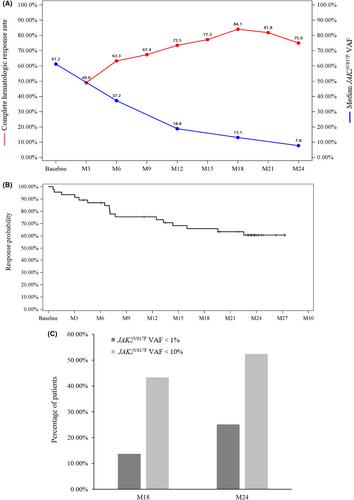
A total of 49 patients with a median age of 56 years were enrolled. All patients harboured the JAK2V617F mutation and had a history of HU intolerance. The mean and median allele burden or variant allele frequency (VAF) of JAK2V617F at baseline was 58.5% and 61.2%, respectively. In total, 46 patients completed the first-year study,14 and 44 patients joined the extension phase because two declined consent for personal reasons. One patient discontinued the study because of an adverse event of grade 2 myasthenia gravis, which was judged as unrelated to the treatment. In contrast to the first year, in which ropeg was administered once every 2 weeks, more than half of the patients (61.4%) were administered ropeg every 3–5 weeks with an average treatment interval of 22.6 days in the extension phase. CHR was achieved in 34/44 (77.3%), 37/44 (84.1%), 36/44 (81.8%), and 33/44 patients (75%) at 15, 18, 21, and 24 months, respectively (Figure 1A). The results indicated that the CHR rate increased over the first 12 months from the baseline and remained high during the extension phase. Over the entire 24 months of treatment, 46 of the 49 patients (93.9%) achieved at least one CHR. The median duration of CHR was not reached at 24 months (Figure 1B), indicating a robust, durable response to the treatment.
All patients, except one, showed a reduction in JAK2V617F VAF. The median JAK2V617F VAF continuously declined from 61.2% at baseline to 7.8% at 24 months, as measured every 6 months with a minimal assay sensitivity of VAF 1% by the central laboratory (Figure 1A). At 18 and 24 months, JAK2V617F VAF was reduced to less than 10% in 19/44 (43.2%) and 23/44 patients (52.3%), respectively. According to the 2009 European LeukemiaNet (ELN) criteria,15 CMR, which was defined as a reduction in JAK2V617F VAF to undetectable levels, was achieved in 6/44 (13.6%) and 11/44 (25.0%) patients at 18 and 24 months respectively, as shown in Figure 1C. JAK2V617F in one patient decreased from a high VAF of 83.9% to undetectable levels at 24 months. Previously, CMR was observed in 18/92 (19.6%) patients with PV at 5 years (60 months) of ropeg treatment under the slow-dose titration regimen in the PROUD-PV/CONTINUATION-PV study.10 In the current study, the molecular response including both CMR and partial molecular response, which was defined as a reduction of ≥50% in patients with <50% JAK2V617F VAF, or a reduction of ≥25% in patients with >50% VAF, was observed in 35/44 (79.5%) and 36/44 patients (81.8%) at 18 and 24 months, respectively.
The safety data of all patients were assessed in the extension study. The incidences of treatment-emergent adverse events (TEAEs) and serious adverse events (SAEs) were notably lower than those observed in the first year. No grade 4 or 5 TEAEs were observed. TEAEs occurred in 37/44 patients (84.1%), with six patients (13.6%) experiencing grade 3 TEAEs. Only two grade 3 TEAEs (4.5%) were reported to be possibly related to the study drug. The most common TEAEs (>10%) were decreased white blood cell count, elevated ALT and AST, and hyperuricaemia (Table 1). Almost all TEAEs were easily managed and resolved. Four patients had an SAE not related to the treatment. No TE event, disease progression to myelofibrosis or acute leukaemia, or death was reported over 24 months of treatment.
Our findings indicate that ropeg treatment at a higher initiating-dose regimen exerts a strong anti-neoplastic effect by effectively depleting JAK2V617F-carrying neoplastic cells in patients with PV. Despite the CHR rate reaching a plateau, the JAK2V617F VAF or allele burden continued to decline, indicating that the treatment continuously eradicated the neoplastic clones. Our results suggest that a higher initiating-dose regimen, with the flexibility of dose schedule adjustment from biweekly to monthly, i.e., once every 3–5 weeks, after the CHR is stabilized with 1 year of ropeg treatment is associated with a high chance of neoplastic cell clearance and robust clinical benefits including a durable CHR and no disease progression, with a favourable safety profile in patients with PV. Whether the remarkable molecular response and clinical benefits observed over the 2 years of treatment correlated with prolonged patient survival remains to be examined over the long term.
All authors contributed to the work and approved the manuscript for publication. J. Jin, A. Qin, D. Wu, J. Zhang, Z. Xiao, L. Zhang, S. Suo, and R. F. Fu designed the study. A. Qin, D. Wu, L. Zhang, and J. Jin wrote the initial draft of the manuscript. S. Suo, R. F. Fu, Z. Shao, J. Bai, S. Chen, M. Duan, H. Zhou, N. Xu, S. Zhang, X. Zuo, X. Du, L. Wang, P. Li, X. Zhang, Z. Xiao, and J. Jin enrolled and treated patients in the study.
The study was sponsored and supported by PharmaEssentia Corporation. Wiley Editing Services provided English editing for the manuscript and PharmaEssentia provided funding for the editing.
S. Suo, R. F. Fu, Z. Shao, J. Bai, S. Chen, M. Duan, H. Zhou, N. Xu, S. Zhang, X. Zuo, X. Du, L. Wang, P. Li, X. Zhang, Z. Xiao, L. Zhang, and J. Jin declare no conflicts of interest. A. Qin serves as the Chief Medical Officer of the PharmaEssentia Corporation. D. Wu and J. Zhang are employees of PharmaEssentia Biotech Ltd. (Beijing).
This study was conducted in compliance with the ethical standards of the institution responsible for human subjects as well as with the Declaration of Helsinki. The study was approved by the ethics committee or independent review board (IRB) of participating institutions including The First Affiliated Hospital, Zhejiang University School of Medicine; Institute of Haematology and Blood Diseases Hospital, Chinese Academy of Medical Sciences and Peking Union Medical College; The Second Hospital of Tianjin Medical University; The First Affiliated Hospital of Soochow University; Peking Union Medical College Hospital, Chinese Academy of Medical Sciences and Peking Union Medical College; Affiliated Cancer Hospital of Zhengzhou University and Henan Cancer Hospital; Nanfang Hospital of Southern Medical University; Ruijin Hospital, Shanghai Jiaotong University School of Medicine; Zhongnan Hospital, Wuhan University; Shenzhen Second People's Hospital; The First Affiliated Hospital of Chongqing Medical University; Huashan Hospital of Fudan University; and The First Affiliated Hospital of USTC, Division of Life Sciences and Medicine, University of Science and Technology of China.
Written informed consent was obtained from all participating patients.
The study was registered at ClinicalTrials.gov (identifier: NCT05485948) and in China (China National Medical Products Administration registration number: CTR20211664).
期刊介绍:
The British Journal of Haematology publishes original research papers in clinical, laboratory and experimental haematology. The Journal also features annotations, reviews, short reports, images in haematology and Letters to the Editor.



 京公网安备 11010802042870号
京ICP备2023020795号-1
京公网安备 11010802042870号
京ICP备2023020795号-1

 分享
分享
 求助内容:
求助内容: 应助结果提醒方式:
 扫码关注我们
