Leah Abrams, Nora Brower, Mikko Myrskylä, Neil Mehta
{"title":"Pervasive stagnation: flat and increasing cardiovascular disease mortality rates after 2010 across US states and counties.","authors":"Leah Abrams, Nora Brower, Mikko Myrskylä, Neil Mehta","doi":"10.1093/aje/kwae414","DOIUrl":null,"url":null,"abstract":"<p><p>Since 2010, the United States has experienced adverse trends in cardiovascular disease (CVD) mortality rates that have dramatically slowed long-standing life expectancy improvements. The extent to which the national trend in CVD mortality masks heterogeneity in trends across states and counties is poorly understood. A detailed accounting of post-2010 trends in CVD mortality by US state and county is provided to understand how features of place relate to trends. We compared trends during 2010-2019 with that of 2000-2009. We observed flattening declines in CVD mortality rates in nearly every state at both midlife (ages 40-64 years) and old age (ages 65-84 years) across the 2 decades. Many states had increases in midlife CVD mortality in 2010-2019. Old-age CVD mortality was still declining in most states after 2010, although the decline was much slower compared with the previous decade. States in the Southeast recorded some of the fastest post-2010 declines in CVD mortality at old age. County-level median household income was associated with level of CVD mortality, but all income deciles, even in the wealthiest counties, experienced stagnating declines in CVD mortality. Findings highlight the ubiquitous nature of CVD stagnation, pointing to the need to identify risk factor affecting trends across regions and socioeconomic strata across the United States.</p>","PeriodicalId":7472,"journal":{"name":"American journal of epidemiology","volume":" ","pages":"2261-2269"},"PeriodicalIF":4.8000,"publicationDate":"2025-08-05","publicationTypes":"Journal Article","fieldsOfStudy":null,"isOpenAccess":false,"openAccessPdf":"https://www.ncbi.nlm.nih.gov/pmc/articles/PMC12342862/pdf/","citationCount":"0","resultStr":null,"platform":"Semanticscholar","paperid":null,"PeriodicalName":"American journal of epidemiology","FirstCategoryId":"3","ListUrlMain":"https://doi.org/10.1093/aje/kwae414","RegionNum":2,"RegionCategory":"医学","ArticlePicture":[],"TitleCN":null,"AbstractTextCN":null,"PMCID":null,"EPubDate":"","PubModel":"","JCR":"Q1","JCRName":"PUBLIC, ENVIRONMENTAL & OCCUPATIONAL HEALTH","Score":null,"Total":0}
引用次数: 0
Abstract
Since 2010, the United States has experienced adverse trends in cardiovascular disease (CVD) mortality rates that have dramatically slowed long-standing life expectancy improvements. The extent to which the national trend in CVD mortality masks heterogeneity in trends across states and counties is poorly understood. A detailed accounting of post-2010 trends in CVD mortality by US state and county is provided to understand how features of place relate to trends. We compared trends during 2010-2019 with that of 2000-2009. We observed flattening declines in CVD mortality rates in nearly every state at both midlife (ages 40-64 years) and old age (ages 65-84 years) across the 2 decades. Many states had increases in midlife CVD mortality in 2010-2019. Old-age CVD mortality was still declining in most states after 2010, although the decline was much slower compared with the previous decade. States in the Southeast recorded some of the fastest post-2010 declines in CVD mortality at old age. County-level median household income was associated with level of CVD mortality, but all income deciles, even in the wealthiest counties, experienced stagnating declines in CVD mortality. Findings highlight the ubiquitous nature of CVD stagnation, pointing to the need to identify risk factor affecting trends across regions and socioeconomic strata across the United States.
期刊介绍:
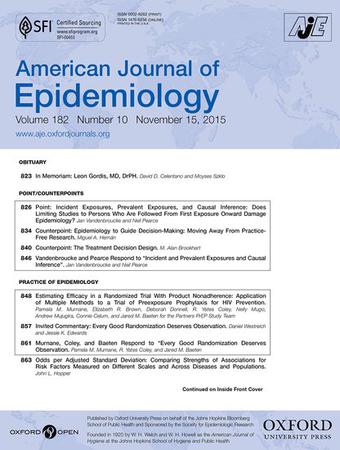
The American Journal of Epidemiology is the oldest and one of the premier epidemiologic journals devoted to the publication of empirical research findings, opinion pieces, and methodological developments in the field of epidemiologic research.
It is a peer-reviewed journal aimed at both fellow epidemiologists and those who use epidemiologic data, including public health workers and clinicians.



 京公网安备 11010802042870号
京ICP备2023020795号-1
京公网安备 11010802042870号
京ICP备2023020795号-1

 分享
分享
 求助内容:
求助内容: 应助结果提醒方式:
 扫码关注我们
