{"title":"Accuracy and Efficiency of the Surgical-Guide-Assisted Fiber Post Removal Technique for Anterior Teeth: An Ex Vivo Study.","authors":"Ryota Ito, Satoshi Watanabe, Kazuhisa Satake, Ryuma Saito, Takashi Okiji","doi":"10.3390/dj12100333","DOIUrl":null,"url":null,"abstract":"<p><strong>Background/objectives: </strong>This study compared the accuracy and efficiency of different surgical-guide (SG)-assisted and freehand drilling techniques for removing fiber posts from maxillary anterior teeth performed by differently experienced operators.</p><p><strong>Methods: </strong>A fiber post was bonded to the root canal of 54 extracted maxillary anterior teeth. After mounting the teeth in the jaw models, SGs were designed by integrating cone-beam computed tomography (CBCT) and intraoral scanner data. Each SG included a custom sleeve. An experienced or inexperienced operator drilled the post using three different techniques: (i) SG-assisted incremental drilling at 2-3 mm (SG1), (ii) SG-assisted one-time drilling to a predetermined depth (SG2), and (iii) freehand incremental drilling without SG (FH; n = 9 in each group). Deviations in coronal, sagittal, and horizontal planes and the angle of deviation were measured.</p><p><strong>Results: </strong>The SG1 and SG2 groups showed significantly smaller sagittal and horizontal deviations than the FH group, regardless of the operator's experience. The SG2 group had a significantly shorter working time than the SG1 and FH groups. In the FH group, the experienced operator required a significantly shorter working time than the inexperienced operator.</p><p><strong>Conclusions: </strong>SG-assisted drilling techniques enhanced the accuracy and efficiency of removing fiber posts from the anterior teeth, irrespective of the operator's experience.</p>","PeriodicalId":11269,"journal":{"name":"Dentistry Journal","volume":"12 10","pages":""},"PeriodicalIF":3.1000,"publicationDate":"2024-10-18","publicationTypes":"Journal Article","fieldsOfStudy":null,"isOpenAccess":false,"openAccessPdf":"https://www.ncbi.nlm.nih.gov/pmc/articles/PMC11506639/pdf/","citationCount":"0","resultStr":null,"platform":"Semanticscholar","paperid":null,"PeriodicalName":"Dentistry Journal","FirstCategoryId":"1085","ListUrlMain":"https://doi.org/10.3390/dj12100333","RegionNum":0,"RegionCategory":null,"ArticlePicture":[],"TitleCN":null,"AbstractTextCN":null,"PMCID":null,"EPubDate":"","PubModel":"","JCR":"Q2","JCRName":"DENTISTRY, ORAL SURGERY & MEDICINE","Score":null,"Total":0}
引用次数: 0
Abstract
Background/objectives: This study compared the accuracy and efficiency of different surgical-guide (SG)-assisted and freehand drilling techniques for removing fiber posts from maxillary anterior teeth performed by differently experienced operators.
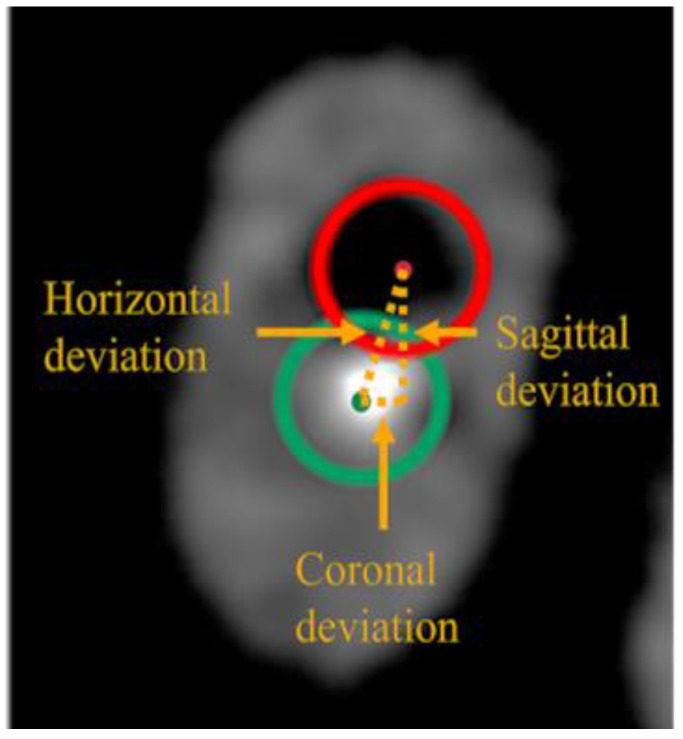
Methods: A fiber post was bonded to the root canal of 54 extracted maxillary anterior teeth. After mounting the teeth in the jaw models, SGs were designed by integrating cone-beam computed tomography (CBCT) and intraoral scanner data. Each SG included a custom sleeve. An experienced or inexperienced operator drilled the post using three different techniques: (i) SG-assisted incremental drilling at 2-3 mm (SG1), (ii) SG-assisted one-time drilling to a predetermined depth (SG2), and (iii) freehand incremental drilling without SG (FH; n = 9 in each group). Deviations in coronal, sagittal, and horizontal planes and the angle of deviation were measured.
Results: The SG1 and SG2 groups showed significantly smaller sagittal and horizontal deviations than the FH group, regardless of the operator's experience. The SG2 group had a significantly shorter working time than the SG1 and FH groups. In the FH group, the experienced operator required a significantly shorter working time than the inexperienced operator.
Conclusions: SG-assisted drilling techniques enhanced the accuracy and efficiency of removing fiber posts from the anterior teeth, irrespective of the operator's experience.






 京公网安备 11010802042870号
京ICP备2023020795号-1
京公网安备 11010802042870号
京ICP备2023020795号-1

 分享
分享
 求助内容:
求助内容: 应助结果提醒方式:
 扫码关注我们
