{"title":"Associations Between Developmental Stability, Canalization, and Phenotypic Plasticity in Response to Heterogeneous Experience","authors":"Shu Wang, Ragan M. Callaway","doi":"10.1002/ece3.70436","DOIUrl":null,"url":null,"abstract":"<p>The processes of developmental stability, canalization, and phenotypic plasticity have ecological and evolutionary significance, and been studied extensively, but mostly separately and thus the relationships between them are not straightforward. Our objective was to better integrate these processes in the context of temporally heterogeneous environments. We did this by investigating the effects of early experience with temporal heterogeneity in water availability on associations between developmental stability, canalization, and phenotypic plasticity. We subjected eight plant species to a first round of alternating inundation and drought vs. constantly moderate water treatments (heterogeneous experience) and a second round of water conditions (to test plasticity). We measured fluctuating asymmetry (FA) in leaf size, intra- and inter-individual variation (CV<sub>intra</sub> and CV<sub>inter</sub>), and plasticity (PI) in traits and analyzed correlations between these variables across all species. Results showed little correlations between FA, CV<sub>intra</sub> and PI, several positive correlations between FA and CV<sub>inter</sub> in more stressful conditions, especially in as well as positive correlations between CV<sub>inter</sub> and PI initially and negative correlations between them later. These suggested the complexity of these relationships, which can depend on whether plasticity occurs. Greater inter-individual variation will more likely cooperate with plasticity before or during plastic response, whereas higher canalization may reflect phenotypic convergence. Both higher FA and CV<sub>intra</sub> can reflect faster growth, while CV<sub>intra</sub> may also reflect plant growth stage, and the two mechanisms should cooperate in response to environmental challenges. The complexity of these relationships suggests plants deal with environmental variation in elaborate and integrative ways which can be affected by many factors.</p>","PeriodicalId":11467,"journal":{"name":"Ecology and Evolution","volume":"14 10","pages":""},"PeriodicalIF":2.3000,"publicationDate":"2024-10-22","publicationTypes":"Journal Article","fieldsOfStudy":null,"isOpenAccess":false,"openAccessPdf":"https://www.ncbi.nlm.nih.gov/pmc/articles/PMC11494154/pdf/","citationCount":"0","resultStr":null,"platform":"Semanticscholar","paperid":null,"PeriodicalName":"Ecology and Evolution","FirstCategoryId":"99","ListUrlMain":"https://onlinelibrary.wiley.com/doi/10.1002/ece3.70436","RegionNum":2,"RegionCategory":"生物学","ArticlePicture":[],"TitleCN":null,"AbstractTextCN":null,"PMCID":null,"EPubDate":"","PubModel":"","JCR":"Q2","JCRName":"ECOLOGY","Score":null,"Total":0}
引用次数: 0
Abstract
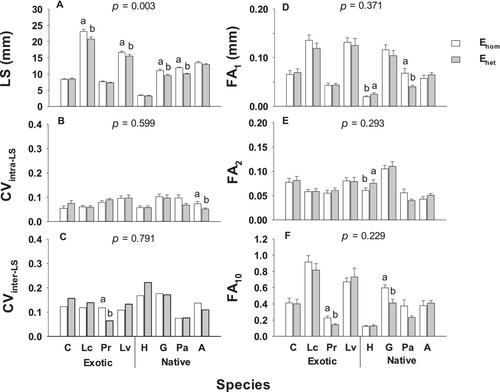
The processes of developmental stability, canalization, and phenotypic plasticity have ecological and evolutionary significance, and been studied extensively, but mostly separately and thus the relationships between them are not straightforward. Our objective was to better integrate these processes in the context of temporally heterogeneous environments. We did this by investigating the effects of early experience with temporal heterogeneity in water availability on associations between developmental stability, canalization, and phenotypic plasticity. We subjected eight plant species to a first round of alternating inundation and drought vs. constantly moderate water treatments (heterogeneous experience) and a second round of water conditions (to test plasticity). We measured fluctuating asymmetry (FA) in leaf size, intra- and inter-individual variation (CVintra and CVinter), and plasticity (PI) in traits and analyzed correlations between these variables across all species. Results showed little correlations between FA, CVintra and PI, several positive correlations between FA and CVinter in more stressful conditions, especially in as well as positive correlations between CVinter and PI initially and negative correlations between them later. These suggested the complexity of these relationships, which can depend on whether plasticity occurs. Greater inter-individual variation will more likely cooperate with plasticity before or during plastic response, whereas higher canalization may reflect phenotypic convergence. Both higher FA and CVintra can reflect faster growth, while CVintra may also reflect plant growth stage, and the two mechanisms should cooperate in response to environmental challenges. The complexity of these relationships suggests plants deal with environmental variation in elaborate and integrative ways which can be affected by many factors.
期刊介绍:
Ecology and Evolution is the peer reviewed journal for rapid dissemination of research in all areas of ecology, evolution and conservation science. The journal gives priority to quality research reports, theoretical or empirical, that develop our understanding of organisms and their diversity, interactions between them, and the natural environment.
Ecology and Evolution gives prompt and equal consideration to papers reporting theoretical, experimental, applied and descriptive work in terrestrial and aquatic environments. The journal will consider submissions across taxa in areas including but not limited to micro and macro ecological and evolutionary processes, characteristics of and interactions between individuals, populations, communities and the environment, physiological responses to environmental change, population genetics and phylogenetics, relatedness and kin selection, life histories, systematics and taxonomy, conservation genetics, extinction, speciation, adaption, behaviour, biodiversity, species abundance, macroecology, population and ecosystem dynamics, and conservation policy.



 京公网安备 11010802042870号
京ICP备2023020795号-1
京公网安备 11010802042870号
京ICP备2023020795号-1

 分享
分享
 求助内容:
求助内容: 应助结果提醒方式:
 扫码关注我们
