Marina D. Rodriguez, Susan M. Bailey, Paul F. Doherty Jr., Kathryn P. Huyvaert
{"title":"Increased Reproductive Output and Telomere Shortening Following Calcium Supplementation in a Wild Songbird","authors":"Marina D. Rodriguez, Susan M. Bailey, Paul F. Doherty Jr., Kathryn P. Huyvaert","doi":"10.1002/ece3.70483","DOIUrl":null,"url":null,"abstract":"<p>Life history theory predicts increased parental investment comes with fitness costs, often expressed as negative effects on survival and future reproduction. To better understand the costs of reproduction and life history trade-offs, we evaluated calcium supplementation at a high-elevation site in Colorado as a novel approach to experimentally alter reproductive investment in nesting female <i>Tachycineta bicolor</i> (tree swallow). Calcium is a nutrient critical to avian reproduction as the intake of natural calcium is essential for egg production, embryo development, and nestling growth. Altering calcium availability exclusively during the breeding season allowed examination of individual biological responses to experimental modification of reproduction, as well as the reproductive costs associated with egg production and laying an entire clutch. As a functional endpoint and proxy for fitness and longevity, telomere length was measured at the beginning and end of each breeding season. Telomeres—protective “caps” at the ends of chromosomes—have been shown to shorten with aging and a variety of stressors, including higher reproductive output. Results demonstrate that tree swallow mothers supplemented with calcium during the breeding season experience higher reproductive output and produce offspring with longer telomeres, which came at the cost of relatively shorter telomeres during the reproductive season. These findings provide additional support for reproductive trade-offs, and also challenge previous calcium supplementation studies that suggest excess calcium reduces the cost of reproduction.</p>","PeriodicalId":11467,"journal":{"name":"Ecology and Evolution","volume":"14 10","pages":""},"PeriodicalIF":2.3000,"publicationDate":"2024-10-27","publicationTypes":"Journal Article","fieldsOfStudy":null,"isOpenAccess":false,"openAccessPdf":"https://www.ncbi.nlm.nih.gov/pmc/articles/PMC11512736/pdf/","citationCount":"0","resultStr":null,"platform":"Semanticscholar","paperid":null,"PeriodicalName":"Ecology and Evolution","FirstCategoryId":"99","ListUrlMain":"https://onlinelibrary.wiley.com/doi/10.1002/ece3.70483","RegionNum":2,"RegionCategory":"生物学","ArticlePicture":[],"TitleCN":null,"AbstractTextCN":null,"PMCID":null,"EPubDate":"","PubModel":"","JCR":"Q2","JCRName":"ECOLOGY","Score":null,"Total":0}
引用次数: 0
Abstract
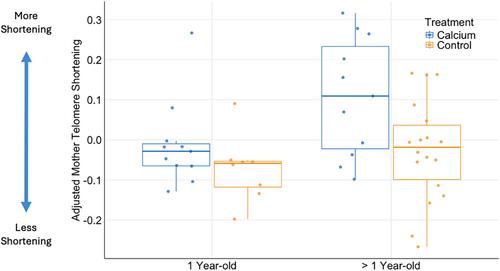
Life history theory predicts increased parental investment comes with fitness costs, often expressed as negative effects on survival and future reproduction. To better understand the costs of reproduction and life history trade-offs, we evaluated calcium supplementation at a high-elevation site in Colorado as a novel approach to experimentally alter reproductive investment in nesting female Tachycineta bicolor (tree swallow). Calcium is a nutrient critical to avian reproduction as the intake of natural calcium is essential for egg production, embryo development, and nestling growth. Altering calcium availability exclusively during the breeding season allowed examination of individual biological responses to experimental modification of reproduction, as well as the reproductive costs associated with egg production and laying an entire clutch. As a functional endpoint and proxy for fitness and longevity, telomere length was measured at the beginning and end of each breeding season. Telomeres—protective “caps” at the ends of chromosomes—have been shown to shorten with aging and a variety of stressors, including higher reproductive output. Results demonstrate that tree swallow mothers supplemented with calcium during the breeding season experience higher reproductive output and produce offspring with longer telomeres, which came at the cost of relatively shorter telomeres during the reproductive season. These findings provide additional support for reproductive trade-offs, and also challenge previous calcium supplementation studies that suggest excess calcium reduces the cost of reproduction.
期刊介绍:
Ecology and Evolution is the peer reviewed journal for rapid dissemination of research in all areas of ecology, evolution and conservation science. The journal gives priority to quality research reports, theoretical or empirical, that develop our understanding of organisms and their diversity, interactions between them, and the natural environment.
Ecology and Evolution gives prompt and equal consideration to papers reporting theoretical, experimental, applied and descriptive work in terrestrial and aquatic environments. The journal will consider submissions across taxa in areas including but not limited to micro and macro ecological and evolutionary processes, characteristics of and interactions between individuals, populations, communities and the environment, physiological responses to environmental change, population genetics and phylogenetics, relatedness and kin selection, life histories, systematics and taxonomy, conservation genetics, extinction, speciation, adaption, behaviour, biodiversity, species abundance, macroecology, population and ecosystem dynamics, and conservation policy.



 京公网安备 11010802042870号
京ICP备2023020795号-1
京公网安备 11010802042870号
京ICP备2023020795号-1

 分享
分享
 求助内容:
求助内容: 应助结果提醒方式:
 扫码关注我们
