{"title":"Life History Strategies Drive Meso-Scale Distribution Patterns in Coastal Benthic Macroinvertebrates","authors":"Molline Natanah C. Gusha, Christopher D. McQuaid","doi":"10.1002/ece3.70461","DOIUrl":null,"url":null,"abstract":"<p>The environment shapes the spatial distribution of species, but species also comprise suites of traits which may indicate their adaptability to a specific environment. This forms the basis of trait biogeography studies. We thus examined how a species distribution is not only influenced by its environment and traits, but by interactions among its traits. Trait information was collected for 150 intertidal macroinvertebrates along a 3000 km environmental and biogeographic gradient on the South African coast. This information was analysed, as functional entities (FEs) were species performing similar functions that have the same trait values and were further condensed into two trait domains (Reproduction and Lifestyle). We then defined Life History Strategies (LHS) as specific combinations of Lifestyle and Reproduction FEs. Seven combinations of Lifestyle and Reproduction formed LHS that dominated total biomass. Some of these LHS were ubiquitous, while others showed geographic patterns across our west-east environmental gradient. For Lifestyle, filter-feeders exhibited high abundances on the East (subtropical, oligotrophic) and West (cool-temperate, eutrophic) extremes of the biogeographic gradient, but differed between the two in size at reproductive maturity and larval development type. This similarity in functionality of feeding mechanism and mobility with different reproductive strategies suggests a trait trade–off (investment in one trait reduces resources for others) between the Reproduction and Lifestyle domains. Within the Reproduction domain, gonochoristic, annual planktotrophic reproduction was common across bioregions, reflecting spin-offs (investment in one trait facilitates another trait) among these traits. Gonochoristic investment in less frequent episodic reproduction is another trade-off, with investment in large size and delayed maturation being a trade–off for many reproductive cycles. Overall, although our data supports the habitat templet model (i.e., the importance of environmental drivers), it further indicates that species distribution patterns observed along the South African coast reflect strong trait interactions and biomass patterns related to their LHS.</p>","PeriodicalId":11467,"journal":{"name":"Ecology and Evolution","volume":"14 10","pages":""},"PeriodicalIF":2.3000,"publicationDate":"2024-10-25","publicationTypes":"Journal Article","fieldsOfStudy":null,"isOpenAccess":false,"openAccessPdf":"https://www.ncbi.nlm.nih.gov/pmc/articles/PMC11502938/pdf/","citationCount":"0","resultStr":null,"platform":"Semanticscholar","paperid":null,"PeriodicalName":"Ecology and Evolution","FirstCategoryId":"99","ListUrlMain":"https://onlinelibrary.wiley.com/doi/10.1002/ece3.70461","RegionNum":2,"RegionCategory":"生物学","ArticlePicture":[],"TitleCN":null,"AbstractTextCN":null,"PMCID":null,"EPubDate":"","PubModel":"","JCR":"Q2","JCRName":"ECOLOGY","Score":null,"Total":0}
引用次数: 0
Abstract
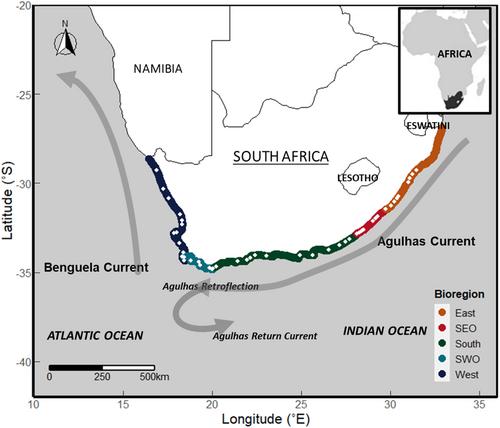
The environment shapes the spatial distribution of species, but species also comprise suites of traits which may indicate their adaptability to a specific environment. This forms the basis of trait biogeography studies. We thus examined how a species distribution is not only influenced by its environment and traits, but by interactions among its traits. Trait information was collected for 150 intertidal macroinvertebrates along a 3000 km environmental and biogeographic gradient on the South African coast. This information was analysed, as functional entities (FEs) were species performing similar functions that have the same trait values and were further condensed into two trait domains (Reproduction and Lifestyle). We then defined Life History Strategies (LHS) as specific combinations of Lifestyle and Reproduction FEs. Seven combinations of Lifestyle and Reproduction formed LHS that dominated total biomass. Some of these LHS were ubiquitous, while others showed geographic patterns across our west-east environmental gradient. For Lifestyle, filter-feeders exhibited high abundances on the East (subtropical, oligotrophic) and West (cool-temperate, eutrophic) extremes of the biogeographic gradient, but differed between the two in size at reproductive maturity and larval development type. This similarity in functionality of feeding mechanism and mobility with different reproductive strategies suggests a trait trade–off (investment in one trait reduces resources for others) between the Reproduction and Lifestyle domains. Within the Reproduction domain, gonochoristic, annual planktotrophic reproduction was common across bioregions, reflecting spin-offs (investment in one trait facilitates another trait) among these traits. Gonochoristic investment in less frequent episodic reproduction is another trade-off, with investment in large size and delayed maturation being a trade–off for many reproductive cycles. Overall, although our data supports the habitat templet model (i.e., the importance of environmental drivers), it further indicates that species distribution patterns observed along the South African coast reflect strong trait interactions and biomass patterns related to their LHS.
期刊介绍:
Ecology and Evolution is the peer reviewed journal for rapid dissemination of research in all areas of ecology, evolution and conservation science. The journal gives priority to quality research reports, theoretical or empirical, that develop our understanding of organisms and their diversity, interactions between them, and the natural environment.
Ecology and Evolution gives prompt and equal consideration to papers reporting theoretical, experimental, applied and descriptive work in terrestrial and aquatic environments. The journal will consider submissions across taxa in areas including but not limited to micro and macro ecological and evolutionary processes, characteristics of and interactions between individuals, populations, communities and the environment, physiological responses to environmental change, population genetics and phylogenetics, relatedness and kin selection, life histories, systematics and taxonomy, conservation genetics, extinction, speciation, adaption, behaviour, biodiversity, species abundance, macroecology, population and ecosystem dynamics, and conservation policy.



 京公网安备 11010802042870号
京ICP备2023020795号-1
京公网安备 11010802042870号
京ICP备2023020795号-1

 分享
分享
 求助内容:
求助内容: 应助结果提醒方式:
 扫码关注我们
