Vittoria Todisco, Marc M. Hauber, Michael T. Brett, Charlotte Axén, Kjetil Hindar, Petter Tibblin, Samuel Hylander
{"title":"The Implications of Atlantic Salmon (Salmo salar L.) Fatty Acid Profiles for Their Thiamine Status","authors":"Vittoria Todisco, Marc M. Hauber, Michael T. Brett, Charlotte Axén, Kjetil Hindar, Petter Tibblin, Samuel Hylander","doi":"10.1002/ece3.70478","DOIUrl":null,"url":null,"abstract":"<p>Thiamine deficiency is an ongoing issue across the Northern Hemisphere, causing reproductive failure in multiple salmonid populations. In the Baltic Sea, a large brackish water system in northern Europe, previous research has suggested that this deficiency is associated with lipid-rich diets with a high proportion of docosahexaenoic acid (DHA, 22:6n-3). The mechanism proposed is that a diet abundant in highly unsaturated fatty acids, such as DHA, depletes thiamine as an antioxidant defense in adult salmonids, rather than allocating thiamine to the offspring. In light of this existing hypothesis, we here explore the relationship between diet history and the related fatty acid (FA), profiles, and thiamine status of Atlantic salmon (<i>Salmo salar</i> L.) in three systems: the Baltic Sea, the North Atlantic Ocean, and Lake Vänern. Atlantic salmon inhabiting each system is known to have unique feeding histories and thiamine status. Our results showed that despite extensive sampling effort and distinct FA profiles, indicative of their diverse diets, there were no correlations between any FAs, including DHA, and the thiamine status of these populations. This finding does not support the above-mentioned hypothesis that diets rich in easily oxidized FAs would lead to lower thiamine concentrations in salmon tissues. Additionally, we found that changes in the salmon FA profiles throughout their life cycle are consistent for both low-thiamine populations from the Baltic Sea and medium-thiamine populations from North Atlantic Ocean, suggesting that these changes might not be involved in thiamine deficiency development.</p>","PeriodicalId":11467,"journal":{"name":"Ecology and Evolution","volume":"14 10","pages":""},"PeriodicalIF":2.3000,"publicationDate":"2024-10-25","publicationTypes":"Journal Article","fieldsOfStudy":null,"isOpenAccess":false,"openAccessPdf":"https://www.ncbi.nlm.nih.gov/pmc/articles/PMC11511624/pdf/","citationCount":"0","resultStr":null,"platform":"Semanticscholar","paperid":null,"PeriodicalName":"Ecology and Evolution","FirstCategoryId":"99","ListUrlMain":"https://onlinelibrary.wiley.com/doi/10.1002/ece3.70478","RegionNum":2,"RegionCategory":"生物学","ArticlePicture":[],"TitleCN":null,"AbstractTextCN":null,"PMCID":null,"EPubDate":"","PubModel":"","JCR":"Q2","JCRName":"ECOLOGY","Score":null,"Total":0}
引用次数: 0
Abstract
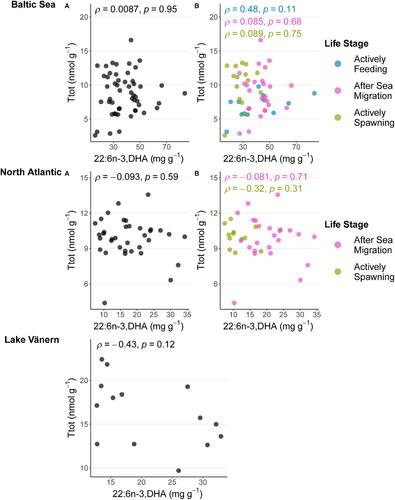
Thiamine deficiency is an ongoing issue across the Northern Hemisphere, causing reproductive failure in multiple salmonid populations. In the Baltic Sea, a large brackish water system in northern Europe, previous research has suggested that this deficiency is associated with lipid-rich diets with a high proportion of docosahexaenoic acid (DHA, 22:6n-3). The mechanism proposed is that a diet abundant in highly unsaturated fatty acids, such as DHA, depletes thiamine as an antioxidant defense in adult salmonids, rather than allocating thiamine to the offspring. In light of this existing hypothesis, we here explore the relationship between diet history and the related fatty acid (FA), profiles, and thiamine status of Atlantic salmon (Salmo salar L.) in three systems: the Baltic Sea, the North Atlantic Ocean, and Lake Vänern. Atlantic salmon inhabiting each system is known to have unique feeding histories and thiamine status. Our results showed that despite extensive sampling effort and distinct FA profiles, indicative of their diverse diets, there were no correlations between any FAs, including DHA, and the thiamine status of these populations. This finding does not support the above-mentioned hypothesis that diets rich in easily oxidized FAs would lead to lower thiamine concentrations in salmon tissues. Additionally, we found that changes in the salmon FA profiles throughout their life cycle are consistent for both low-thiamine populations from the Baltic Sea and medium-thiamine populations from North Atlantic Ocean, suggesting that these changes might not be involved in thiamine deficiency development.
期刊介绍:
Ecology and Evolution is the peer reviewed journal for rapid dissemination of research in all areas of ecology, evolution and conservation science. The journal gives priority to quality research reports, theoretical or empirical, that develop our understanding of organisms and their diversity, interactions between them, and the natural environment.
Ecology and Evolution gives prompt and equal consideration to papers reporting theoretical, experimental, applied and descriptive work in terrestrial and aquatic environments. The journal will consider submissions across taxa in areas including but not limited to micro and macro ecological and evolutionary processes, characteristics of and interactions between individuals, populations, communities and the environment, physiological responses to environmental change, population genetics and phylogenetics, relatedness and kin selection, life histories, systematics and taxonomy, conservation genetics, extinction, speciation, adaption, behaviour, biodiversity, species abundance, macroecology, population and ecosystem dynamics, and conservation policy.



 京公网安备 11010802042870号
京ICP备2023020795号-1
京公网安备 11010802042870号
京ICP备2023020795号-1

 分享
分享
 求助内容:
求助内容: 应助结果提醒方式:
 扫码关注我们
