Hagar Cohen, Nahawand Bahash, Bruria Raccah, Ilan Matok, Dana Ekstein, Lee Goldstein, Yosef Kalish, Sara Eyal
{"title":"The level is in the details: Why differences between direct-acting oral anticoagulants should be considered in the treatment of patients with epilepsy","authors":"Hagar Cohen, Nahawand Bahash, Bruria Raccah, Ilan Matok, Dana Ekstein, Lee Goldstein, Yosef Kalish, Sara Eyal","doi":"10.1111/epi.18144","DOIUrl":null,"url":null,"abstract":"<p>Direct oral anticoagulants (DOACs) have become the preferred choice for stroke prevention in patients with atrial fibrillation<span><sup>1, 2</sup></span> and for treating patients with venous thromboembolism.<span><sup>3</sup></span> Recommendations are based on the improved efficacy/safety ratio of DOACs compared to vitamin K antagonists such as warfarin.<span><sup>4, 5</sup></span> However, DOAC efficacy and safety can be affected by concomitantly administered drugs, including antiseizure medications (ASMs). All DOACs are substrates of the efflux transporter P-glycoprotein (P-gp) and some are cytochrome P450 (CYP)3A4 substrates (Table 1). DOACs are prone to drug-drug interactions with ASMs because approximately one third of ASMs induce CYP3A4 activity,<span><sup>26-30</sup></span> and cannabidiol, everolimus, and valproate are weak CYP3A4 inhibitors (Table 2).<span><sup>29, 31, 33, 34, 37</sup></span> Unlikcnt P-gp induction by ASMs is scarce.</p><p>Pharmacokinetic and labeling data are available mostly for combinations of DOACs with CYP3A4/P-gp inhibitors and with rifampin (Table S1), but no recommendation in DOAC labeling relates to weak-to-moderate enzyme inducers.<span><sup>6-9, 38-41</sup></span> This gap in knowledge has led to prescribing of warfarin for many patients treated with ASMs. Other are treated with ASM-DOAC combinations that could put them at risk.<span><sup>5, 42</sup></span> A recent study found no increased risk of thromboembolic events with enzyme-inducing ASM-DOAC combinations.<span><sup>43</sup></span> However, ASM and DOAC doses (and dose adjustments) were not reported, and the authors stated in the supplemental materials that “provider awareness of potential DDIs between EI-ASMs and DOACs could have led to differences in care, monitoring, or outcome diagnosis in the exposed versus referent groups.” Indeed, the incidence of other anticoagulant use was higher among patients exposed to enzyme-inducing ASMs than in controls (19.2% exposed to ASMs vs. 13.8%, respectively) and was marked as an important imbalance. This could have led to an underestimation of the risk for thromboembolic events when DOACs were combined with ASMs.</p><p>Despite the aforementioned absence of direct evidence we suggest that careful selection of DOACs and P-gp-inducing ASM combinations and appropriate monitoring can allow the safe use of DOACs by patients with epilepsy, based on the principles described below.</p><p>DOACs vary in the dependence of their pharmacokinetics on CYP3A4 versus P-gp (Table 1). Rivaroxaban and apixaban are relatively CYP3A4-dependent. Dabigatran and edoxaban are only minimally metabolized by CYP3A4 and their pharmacokinetics are P-gp-driven. The elimination of edoxaban's active metabolite M4 also depends on organic anion transporting polypeptide (OATP)1B1 (Table 1).</p><p>P-gp and CYP3A4 are coregulated by nuclear receptors such as the pregnane xenobiotic receptor (PXR),<span><sup>44-46</sup></span> but the magnitude of interaction associated with P-gp induction has been suggested to be lower than that of CYP3A.<span><sup>47-49</sup></span> Lutz et al. established quantitative relationships between CYP3A and P-gp induction based on a study with escalating rifampin doses.<span><sup>48</sup></span> In that study, the magnitude of change in the area under the concentration–time curve (AUC) of oral midazolam, a CYP3A4 sensitive substrate, predicted the AUC changes for substrates of enzymes and transporters coinduced with CYP3A4 via the PXR pathway. A subsequent study confirmed the association for 600 mg/day carbamazepine and for 300 mg/day rifabutin.<span><sup>49</sup></span> In both analyses, the P-gp substrate was dabigatran etexilate. Together, these studies provided excellent tools for predicting the AUC ratio (AUCR) of dabigatran upon treatment with CYP3A-inducing ASMs.</p><p>The extent of CYP3A4 induction has been established for many ASMs.<span><sup>31</sup></span> In addition, various magnitudes of PXR activation have been demonstrated for carbamazepine, phenytoin, oxcarbazepine, topiramate, and rufinamide.<span><sup>50, 51</sup></span> Here, these data were obtained through a systematic review and served for a computational-based prediction of dabigatran exposure (Data S1). For that matter, we applied the rate constants and equations for oral midazolam and dabigatran etexilate<span><sup>48</sup></span> to the AUCR values reported for ASM–midazolam interactions.<span><sup>31</sup></span> We also extended the analysis to ASMs that have been studied with CYP3A4 sensitive substrates other than midazolam, because the magnitude of induction by a given drug is expected to be similar across sensitive substrates.<span><sup>52</sup></span> In addition, we conducted a back-interpolation for topiramate (whose effect on P-gp activity in humans was studied with digoxin),<span><sup>53</sup></span> given the comparable effects of the P-gp inducer rifampin on digoxin and on dabigatran.<span><sup>18, 54</sup></span></p><p>Figure 1 presents the interpolated dabigatran AUCR values, the values observed for 600 mg/day carbamazepine–dabigatran,<span><sup>49</sup></span> the magnitude of the eslicarbazepine–digoxin interaction,<span><sup>55</sup></span> and the interpolated CYP3A induction by topiramate. The predicted dabigatran AUCR for 150 mg/day brivaracetam, 100 mg/day cenobamate, 40 mg/day clobazam, 900 mg/day oxcarbazepine, 6 mg/day perampanel, and 800 mg/day rufinamide were mostly above the 80% lower boundary for generic substitutions of dabigatran etexilate mesylate preparations.<span><sup>56</sup></span> However, the interpolated dabigatran AUCR values for 200 mg/day cenobamate (.68 and .64) approached those of carbamazepine. It should also be noted that cenobamate and the other ASMs (clobazam excepted) were not studied at their maximal daily doses.</p><p>It is currently unknown whether eslicarbazepine induces CYP3A via PXR activation. However, the eslicarbazepine–digoxin<span><sup>53</sup></span> and eslicarbazepine–simvastatin<span><sup>57</sup></span> studies demonstrated weaker P-gp than CYP3A induction<span><sup>31</sup></span> despite higher eslicarbazepine acetate dosage in the P-gp study (1200 mg/day vs. 800 mg/day, respectively). For topiramate, only a mean AUCR was available.<span><sup>53</sup></span> The lower 90% confidence interval likely extends to weak P-gp induction. Accordingly, topiramate at ≥200 mg/day might be considered a CYP3A moderate inducer, in line with its effects on oral contraceptives.<span><sup>58, 59</sup></span></p><p>The aforementioned simulations suggest that even dabigatran etexilate, which is the “worst case scenario” in terms of rifampin effect on DOACs (Table 1, Figure 2A), may be prescribed to patients treated with clobazam, perampanel, oxcarbazepine, rufinamide, and topiramate up to the ASM doses for which data are available. However, the predictions do not consider the confidence intervals of the induction rate constants. Therefore, a better choice could be edoxaban, which additionally has an active major metabolite that can partially compensate for the reduced exposure to the parent compound.</p><p>Despite its relative advantage, at the moment edoxaban cannot be recommended for patients who use CYP3A strong inducers and for those treated with >100 mg/day cenobamate. When edoxaban was combined with rifampin, an increase in systemic exposure to the active metabolite M4 made up for the loss in total systemic exposure (AUC), but this was driven by an increase in M4 maximal concentration (Cmax). By the end of the interdosing interval, exposure to edoxaban and M4 (combined) was approximately 80% lower.<span><sup>60</sup></span> Dividing the edoxaban daily dose might theoretically minimize this issue, but there are no data to support this strategy. A safety study with 20 mg rivaroxaban and a chronically used strong enzyme inducer in persons representative of the intended patient population was requested by the US Food and Drug Administration (FDA) for rivaroxaban to formulate appropriate dosing recommendations in such populations.<span><sup>61</sup></span> However, such a study has not been conducted so far for any DOAC. Therefore, an increased DOAC dose cannot be recommended either.</p><p>Given this complexity, decisions regarding anticoagulation in patients treated with strong enzyme inducers or cenobamate >100 mg/day should be made by a multidisciplinary team that includes an epileptologist, a hematologist, and a clinical pharmacologist or a clinical pharmacist. For these patients, the preferred DOAC is edoxaban. The DOAC activity should be monitored as described below. Trough DOAC levels can be supportive, as they represent the end-of-dose levels. A switch of carbamazepine to eslicarbazepine acetate (under the supervision of an epileptologist, and with selection of concomitant non-CYP3A4 substrate medications such as statins) may be considered. In patients with newly diagnosed epilepsy who are already treated with a DOAC, carbamazepine, phenytoin, phenobarbital, and primidone should be avoided, and cenobamate treatment should preferably be limited to 100 mg/day. The doses of other enzyme-inducing ASMs should not exceed the values described above.</p><p>Therapeutic monitoring of DOACs given with enzyme-inducing ASMs should measure their activity, because monitoring the Cmax of DOACs underestimates the change in AUC (Table 1).<span><sup>42, 62</sup></span> Calibrated chromogenic anti-Xa assays should be used for monitoring Xa inhibitors. The recommended assay for dabigatran is calibrated diluted thrombin time.<span><sup>62</sup></span></p><p>The majority of ASMs are not CYP3A4 or P-gp inhibitors (Table 1).<span><sup>26, 29, 63, 64</sup></span> Stiripentol inhibited P-gp<span><sup>65</sup></span> and CYP3A4<span><sup>66</sup></span> in vitro but increased the AUC of saquinavir, a CYP3A4 sensitive substrate and a P-gp substrate, by only 17% (Table 1, Figure 2B).<span><sup>35</sup></span> Everolimus at 10 mg/day enhanced the exposure to oral midazolam by 30%.<span><sup>31</sup></span> Cannabidiol increased midazolam AUCR by 1.56-fold<span><sup>37</sup></span> or did not affect it,<span><sup>67, 68</sup></span> but elevated the AUC of everolimus (a P-gp and CYP3A4 sensitive substrate) by 2.5-fold (Figure 2B).<span><sup>36</sup></span> According to Epidiolex labeling, the interaction could be due to inhibition of intestinal P-gp. This indirect comparison places cannabidiol as the most probable perpetrator in CYP3A4/P-gp inhibition-based interactions with DOACs.</p><p>Given the increased incidence of major bleeding events when DOACs were combined with amiodarone (a weak CYP3A4 inhibitor),<span><sup>69-71</sup></span> special caution and DOAC monitoring are required with cannabidiol–DOAC combinations. In addition, physicians and pharmacists should actively inquire about the use of cannabidiol-containing cannabis products when DOACs are considered. Monitoring of DOAC concentrations is also recommended in patients treated with everolimus and possibly stiripentol.<span><sup>31</sup></span> Edoxaban or apixaban appear to be less affected by CYP3A4/P-gp inhibition (Figure 2B) and might be preferable over dabigatran or rivaroxaban for patients treated with CYP3A4/P-gp-inhibiting ASMs.</p><p>The above-described recommendations relate only to pharmacokinetic interactions in which ASMs are the perpetrators. ASMs (e.g., valproate, carbamazepine) can affect platelet function<span><sup>5</sup></span> and levetiracetam and valproate may increase the risk of thromboembolism via a yet unknown mechanism<span><sup>72-74</sup></span> (valproate was shown to induce P-gp activity in preclinical models<span><sup>42, 75</sup></span>). Brivaracetam is unlikely to affect the exposure to DOACs (Figure 1), but an effect on their activity similar to that of levetiracetam cannot be ruled out. DOACs may be combined with CYP3A4/P-gp-inhibiting ASMs in patients with impaired renal function, but the DOAC dose should be adjusted based on the FDA recommendations, and careful DOAC monitoring is required.</p><p>DOACs are unlikely to affect the pharmacokinetics of ASMs that are primarity eliminated by CYP-mediated metabolism (Table S1), yet less is known about their effect on glucuronidation. Therefore, concentrations and clinical effect of lamotrigine and oxcarbazepine/eslicarbazepine may be monitored in patients treated with such combinations.</p><p>The current gaps in knowledge required extrapolations across CYP3A and P-gp substrates. Yet most predictions were conducted based on studies with midazolam, for which clinical data are availble.<span><sup>48, 49</sup></span> Unfortunately, inhibition data were even scarcer. In addition, we did not estimate confidence intervals for the predictions. However, we referred to “worst-case scenarios” using the lower boundaries of the equations developed by Lutz et al.<span><sup>48, 49</sup></span> An important strength of the current analysis is the ability to predict the effects of CYP3A-inducing ASMs on dabigatran AUC using the data gathered through our recent systematic review.<span><sup>31</sup></span></p><p>Our findings provide data that will hopefully relieve concerns related to the combination of DOACs with several ASMs that are not considered in current labeling. Based on the available information and the analyses presented above, the DOAC of choice for patients treated with mild-to-moderate CYP3A-inducing ASMs and with CYP3A4/P-gp-inhibiting ASMs is edoxaban. Clinical decisions regarding anticoagulation in patients treated with strong CYP3A-inducing ASMs or with >100 mg/day cenobamate should involve a multidisciplinary team that includes an epileptologist, a hematologist, and a clinical pharmacologist or a clinical pharmacist. Cannabidiol is the CYP3A4/P-gp-inhibiting ASMs most likely to increase the risk of bleeding in DOAC-treated patients, and its combination with DOACs requires special caution. Until more experience is gained with ASM-DOAC combinations, appropriate monitoring of DOAC activity is recommended for all ASM-treated patients. Finally, this is yet another reason to refrain from strong CYP3A-inducing ASMs, especially in older patients and patients with cardiovascular diseases.</p><p>Hagar Cohen and Sara Eyal conceived and designed the work. Hagar Cohen, Nahawand Bahash, and Sara Eyal acquired, analyzed, and interpreted the data. Hagar Cohen and Sara Eyal drafted the work. All authors revised the work critically.</p><p>S.E. has served as a consultant for Biopass, TrueMed, and Dexcel, Israel. None of the other authors has any conflict of interest to disclose. We confirm that we have read the Journal's position on issues involved in ethical publication and affirm that this report is consistent with those guidelines.</p>","PeriodicalId":11768,"journal":{"name":"Epilepsia","volume":"65 12","pages":"3474-3483"},"PeriodicalIF":6.6000,"publicationDate":"2024-10-26","publicationTypes":"Journal Article","fieldsOfStudy":null,"isOpenAccess":false,"openAccessPdf":"https://onlinelibrary.wiley.com/doi/epdf/10.1111/epi.18144","citationCount":"0","resultStr":null,"platform":"Semanticscholar","paperid":null,"PeriodicalName":"Epilepsia","FirstCategoryId":"3","ListUrlMain":"https://onlinelibrary.wiley.com/doi/10.1111/epi.18144","RegionNum":1,"RegionCategory":"医学","ArticlePicture":[],"TitleCN":null,"AbstractTextCN":null,"PMCID":null,"EPubDate":"","PubModel":"","JCR":"Q1","JCRName":"CLINICAL NEUROLOGY","Score":null,"Total":0}
引用次数: 0
Abstract
Direct oral anticoagulants (DOACs) have become the preferred choice for stroke prevention in patients with atrial fibrillation1, 2 and for treating patients with venous thromboembolism.3 Recommendations are based on the improved efficacy/safety ratio of DOACs compared to vitamin K antagonists such as warfarin.4, 5 However, DOAC efficacy and safety can be affected by concomitantly administered drugs, including antiseizure medications (ASMs). All DOACs are substrates of the efflux transporter P-glycoprotein (P-gp) and some are cytochrome P450 (CYP)3A4 substrates (Table 1). DOACs are prone to drug-drug interactions with ASMs because approximately one third of ASMs induce CYP3A4 activity,26-30 and cannabidiol, everolimus, and valproate are weak CYP3A4 inhibitors (Table 2).29, 31, 33, 34, 37 Unlikcnt P-gp induction by ASMs is scarce.
Pharmacokinetic and labeling data are available mostly for combinations of DOACs with CYP3A4/P-gp inhibitors and with rifampin (Table S1), but no recommendation in DOAC labeling relates to weak-to-moderate enzyme inducers.6-9, 38-41 This gap in knowledge has led to prescribing of warfarin for many patients treated with ASMs. Other are treated with ASM-DOAC combinations that could put them at risk.5, 42 A recent study found no increased risk of thromboembolic events with enzyme-inducing ASM-DOAC combinations.43 However, ASM and DOAC doses (and dose adjustments) were not reported, and the authors stated in the supplemental materials that “provider awareness of potential DDIs between EI-ASMs and DOACs could have led to differences in care, monitoring, or outcome diagnosis in the exposed versus referent groups.” Indeed, the incidence of other anticoagulant use was higher among patients exposed to enzyme-inducing ASMs than in controls (19.2% exposed to ASMs vs. 13.8%, respectively) and was marked as an important imbalance. This could have led to an underestimation of the risk for thromboembolic events when DOACs were combined with ASMs.
Despite the aforementioned absence of direct evidence we suggest that careful selection of DOACs and P-gp-inducing ASM combinations and appropriate monitoring can allow the safe use of DOACs by patients with epilepsy, based on the principles described below.
DOACs vary in the dependence of their pharmacokinetics on CYP3A4 versus P-gp (Table 1). Rivaroxaban and apixaban are relatively CYP3A4-dependent. Dabigatran and edoxaban are only minimally metabolized by CYP3A4 and their pharmacokinetics are P-gp-driven. The elimination of edoxaban's active metabolite M4 also depends on organic anion transporting polypeptide (OATP)1B1 (Table 1).
P-gp and CYP3A4 are coregulated by nuclear receptors such as the pregnane xenobiotic receptor (PXR),44-46 but the magnitude of interaction associated with P-gp induction has been suggested to be lower than that of CYP3A.47-49 Lutz et al. established quantitative relationships between CYP3A and P-gp induction based on a study with escalating rifampin doses.48 In that study, the magnitude of change in the area under the concentration–time curve (AUC) of oral midazolam, a CYP3A4 sensitive substrate, predicted the AUC changes for substrates of enzymes and transporters coinduced with CYP3A4 via the PXR pathway. A subsequent study confirmed the association for 600 mg/day carbamazepine and for 300 mg/day rifabutin.49 In both analyses, the P-gp substrate was dabigatran etexilate. Together, these studies provided excellent tools for predicting the AUC ratio (AUCR) of dabigatran upon treatment with CYP3A-inducing ASMs.
The extent of CYP3A4 induction has been established for many ASMs.31 In addition, various magnitudes of PXR activation have been demonstrated for carbamazepine, phenytoin, oxcarbazepine, topiramate, and rufinamide.50, 51 Here, these data were obtained through a systematic review and served for a computational-based prediction of dabigatran exposure (Data S1). For that matter, we applied the rate constants and equations for oral midazolam and dabigatran etexilate48 to the AUCR values reported for ASM–midazolam interactions.31 We also extended the analysis to ASMs that have been studied with CYP3A4 sensitive substrates other than midazolam, because the magnitude of induction by a given drug is expected to be similar across sensitive substrates.52 In addition, we conducted a back-interpolation for topiramate (whose effect on P-gp activity in humans was studied with digoxin),53 given the comparable effects of the P-gp inducer rifampin on digoxin and on dabigatran.18, 54
Figure 1 presents the interpolated dabigatran AUCR values, the values observed for 600 mg/day carbamazepine–dabigatran,49 the magnitude of the eslicarbazepine–digoxin interaction,55 and the interpolated CYP3A induction by topiramate. The predicted dabigatran AUCR for 150 mg/day brivaracetam, 100 mg/day cenobamate, 40 mg/day clobazam, 900 mg/day oxcarbazepine, 6 mg/day perampanel, and 800 mg/day rufinamide were mostly above the 80% lower boundary for generic substitutions of dabigatran etexilate mesylate preparations.56 However, the interpolated dabigatran AUCR values for 200 mg/day cenobamate (.68 and .64) approached those of carbamazepine. It should also be noted that cenobamate and the other ASMs (clobazam excepted) were not studied at their maximal daily doses.
It is currently unknown whether eslicarbazepine induces CYP3A via PXR activation. However, the eslicarbazepine–digoxin53 and eslicarbazepine–simvastatin57 studies demonstrated weaker P-gp than CYP3A induction31 despite higher eslicarbazepine acetate dosage in the P-gp study (1200 mg/day vs. 800 mg/day, respectively). For topiramate, only a mean AUCR was available.53 The lower 90% confidence interval likely extends to weak P-gp induction. Accordingly, topiramate at ≥200 mg/day might be considered a CYP3A moderate inducer, in line with its effects on oral contraceptives.58, 59
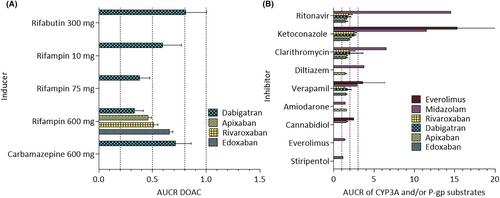
The aforementioned simulations suggest that even dabigatran etexilate, which is the “worst case scenario” in terms of rifampin effect on DOACs (Table 1, Figure 2A), may be prescribed to patients treated with clobazam, perampanel, oxcarbazepine, rufinamide, and topiramate up to the ASM doses for which data are available. However, the predictions do not consider the confidence intervals of the induction rate constants. Therefore, a better choice could be edoxaban, which additionally has an active major metabolite that can partially compensate for the reduced exposure to the parent compound.
Despite its relative advantage, at the moment edoxaban cannot be recommended for patients who use CYP3A strong inducers and for those treated with >100 mg/day cenobamate. When edoxaban was combined with rifampin, an increase in systemic exposure to the active metabolite M4 made up for the loss in total systemic exposure (AUC), but this was driven by an increase in M4 maximal concentration (Cmax). By the end of the interdosing interval, exposure to edoxaban and M4 (combined) was approximately 80% lower.60 Dividing the edoxaban daily dose might theoretically minimize this issue, but there are no data to support this strategy. A safety study with 20 mg rivaroxaban and a chronically used strong enzyme inducer in persons representative of the intended patient population was requested by the US Food and Drug Administration (FDA) for rivaroxaban to formulate appropriate dosing recommendations in such populations.61 However, such a study has not been conducted so far for any DOAC. Therefore, an increased DOAC dose cannot be recommended either.
Given this complexity, decisions regarding anticoagulation in patients treated with strong enzyme inducers or cenobamate >100 mg/day should be made by a multidisciplinary team that includes an epileptologist, a hematologist, and a clinical pharmacologist or a clinical pharmacist. For these patients, the preferred DOAC is edoxaban. The DOAC activity should be monitored as described below. Trough DOAC levels can be supportive, as they represent the end-of-dose levels. A switch of carbamazepine to eslicarbazepine acetate (under the supervision of an epileptologist, and with selection of concomitant non-CYP3A4 substrate medications such as statins) may be considered. In patients with newly diagnosed epilepsy who are already treated with a DOAC, carbamazepine, phenytoin, phenobarbital, and primidone should be avoided, and cenobamate treatment should preferably be limited to 100 mg/day. The doses of other enzyme-inducing ASMs should not exceed the values described above.
Therapeutic monitoring of DOACs given with enzyme-inducing ASMs should measure their activity, because monitoring the Cmax of DOACs underestimates the change in AUC (Table 1).42, 62 Calibrated chromogenic anti-Xa assays should be used for monitoring Xa inhibitors. The recommended assay for dabigatran is calibrated diluted thrombin time.62
The majority of ASMs are not CYP3A4 or P-gp inhibitors (Table 1).26, 29, 63, 64 Stiripentol inhibited P-gp65 and CYP3A466 in vitro but increased the AUC of saquinavir, a CYP3A4 sensitive substrate and a P-gp substrate, by only 17% (Table 1, Figure 2B).35 Everolimus at 10 mg/day enhanced the exposure to oral midazolam by 30%.31 Cannabidiol increased midazolam AUCR by 1.56-fold37 or did not affect it,67, 68 but elevated the AUC of everolimus (a P-gp and CYP3A4 sensitive substrate) by 2.5-fold (Figure 2B).36 According to Epidiolex labeling, the interaction could be due to inhibition of intestinal P-gp. This indirect comparison places cannabidiol as the most probable perpetrator in CYP3A4/P-gp inhibition-based interactions with DOACs.
Given the increased incidence of major bleeding events when DOACs were combined with amiodarone (a weak CYP3A4 inhibitor),69-71 special caution and DOAC monitoring are required with cannabidiol–DOAC combinations. In addition, physicians and pharmacists should actively inquire about the use of cannabidiol-containing cannabis products when DOACs are considered. Monitoring of DOAC concentrations is also recommended in patients treated with everolimus and possibly stiripentol.31 Edoxaban or apixaban appear to be less affected by CYP3A4/P-gp inhibition (Figure 2B) and might be preferable over dabigatran or rivaroxaban for patients treated with CYP3A4/P-gp-inhibiting ASMs.
The above-described recommendations relate only to pharmacokinetic interactions in which ASMs are the perpetrators. ASMs (e.g., valproate, carbamazepine) can affect platelet function5 and levetiracetam and valproate may increase the risk of thromboembolism via a yet unknown mechanism72-74 (valproate was shown to induce P-gp activity in preclinical models42, 75). Brivaracetam is unlikely to affect the exposure to DOACs (Figure 1), but an effect on their activity similar to that of levetiracetam cannot be ruled out. DOACs may be combined with CYP3A4/P-gp-inhibiting ASMs in patients with impaired renal function, but the DOAC dose should be adjusted based on the FDA recommendations, and careful DOAC monitoring is required.
DOACs are unlikely to affect the pharmacokinetics of ASMs that are primarity eliminated by CYP-mediated metabolism (Table S1), yet less is known about their effect on glucuronidation. Therefore, concentrations and clinical effect of lamotrigine and oxcarbazepine/eslicarbazepine may be monitored in patients treated with such combinations.
The current gaps in knowledge required extrapolations across CYP3A and P-gp substrates. Yet most predictions were conducted based on studies with midazolam, for which clinical data are availble.48, 49 Unfortunately, inhibition data were even scarcer. In addition, we did not estimate confidence intervals for the predictions. However, we referred to “worst-case scenarios” using the lower boundaries of the equations developed by Lutz et al.48, 49 An important strength of the current analysis is the ability to predict the effects of CYP3A-inducing ASMs on dabigatran AUC using the data gathered through our recent systematic review.31
Our findings provide data that will hopefully relieve concerns related to the combination of DOACs with several ASMs that are not considered in current labeling. Based on the available information and the analyses presented above, the DOAC of choice for patients treated with mild-to-moderate CYP3A-inducing ASMs and with CYP3A4/P-gp-inhibiting ASMs is edoxaban. Clinical decisions regarding anticoagulation in patients treated with strong CYP3A-inducing ASMs or with >100 mg/day cenobamate should involve a multidisciplinary team that includes an epileptologist, a hematologist, and a clinical pharmacologist or a clinical pharmacist. Cannabidiol is the CYP3A4/P-gp-inhibiting ASMs most likely to increase the risk of bleeding in DOAC-treated patients, and its combination with DOACs requires special caution. Until more experience is gained with ASM-DOAC combinations, appropriate monitoring of DOAC activity is recommended for all ASM-treated patients. Finally, this is yet another reason to refrain from strong CYP3A-inducing ASMs, especially in older patients and patients with cardiovascular diseases.
Hagar Cohen and Sara Eyal conceived and designed the work. Hagar Cohen, Nahawand Bahash, and Sara Eyal acquired, analyzed, and interpreted the data. Hagar Cohen and Sara Eyal drafted the work. All authors revised the work critically.
S.E. has served as a consultant for Biopass, TrueMed, and Dexcel, Israel. None of the other authors has any conflict of interest to disclose. We confirm that we have read the Journal's position on issues involved in ethical publication and affirm that this report is consistent with those guidelines.
期刊介绍:
Epilepsia is the leading, authoritative source for innovative clinical and basic science research for all aspects of epilepsy and seizures. In addition, Epilepsia publishes critical reviews, opinion pieces, and guidelines that foster understanding and aim to improve the diagnosis and treatment of people with seizures and epilepsy.



 京公网安备 11010802042870号
京ICP备2023020795号-1
京公网安备 11010802042870号
京ICP备2023020795号-1

 分享
分享
 求助内容:
求助内容: 应助结果提醒方式:
 扫码关注我们
