Marisa R. DeLuca BS , Bilal Ali MD , Yasir Tarabichi MD , Beni R. Verma MD, MPH , Saima Karim DO, FHRS
{"title":"Catheter ablation vs antiarrhythmic therapy for atrial fibrillation in heart failure with preserved ejection fraction","authors":"Marisa R. DeLuca BS , Bilal Ali MD , Yasir Tarabichi MD , Beni R. Verma MD, MPH , Saima Karim DO, FHRS","doi":"10.1016/j.hrthm.2024.10.034","DOIUrl":null,"url":null,"abstract":"<div><h3>Background</h3><div><span>Clinical outcomes of patients with atrial fibrillation (AF) and </span>heart failure with preserved ejection fraction<span><span> (HFpEF) treated with catheter ablation (CA) vs </span>antiarrhythmic therapy (AAT) are not well known.</span></div></div><div><h3>Objective</h3><div>This study compared morbidity and mortality of patients with AF and HFpEF treated with CA vs AAT.</div></div><div><h3>Methods</h3><div>AF and HFpEF patients from January 2017 to June 2023 were identified in TriNetX, a large global population-based database. Patients with prior diagnosis of heart failure with reduced ejection fraction<span> (HFrEF) or crossover between AAT and CA were excluded. Baseline characteristics including age, sex, body mass index<span>, type of AF, comorbidities, and cardiovascular medications were compared. The 2 groups were 1:1 propensity score matched for outcomes analysis. All-cause mortality, cerebrovascular accident/transient ischemic attack, and acute heart failure were compared with Kaplan-Meier curves.</span></span></div></div><div><h3>Results</h3><div>Patients treated with CA (n = 1959) and AAT (n = 7689) were 1:1 propensity score matched, yielding 3632 patients with no significant differences in baseline characteristics. Compared with AAT, CA was associated with decreased mortality (9.2% vs 20.5%; hazard ratio [HR], 0.431; 95% confidence interval [CI], 0.359–0.518; <em>P</em> < .001). In addition, CA was associated with reduced HFpEF (HR, 0.638; 95% CI, 0.550–0.741; <em>P</em> < .001) and acute HFrEF (HR, 0.645; 95% CI, 0.452–0.920; <em>P</em> = .015). There was no difference in composite of cerebrovascular accident/transient ischemic attack (HR, 0.935; 95% CI, 0.725–1.207; <em>P</em> = .607).</div></div><div><h3>Conclusion</h3><div>In this retrospective study of patients with AF and HFpEF, CA was associated with lower mortality and risk of acute heart failure compared with AAT.</div></div>","PeriodicalId":12886,"journal":{"name":"Heart rhythm","volume":"22 9","pages":"Pages 2218-2223"},"PeriodicalIF":5.7000,"publicationDate":"2025-09-01","publicationTypes":"Journal Article","fieldsOfStudy":null,"isOpenAccess":false,"openAccessPdf":"","citationCount":"0","resultStr":null,"platform":"Semanticscholar","paperid":null,"PeriodicalName":"Heart rhythm","FirstCategoryId":"3","ListUrlMain":"https://www.sciencedirect.com/science/article/pii/S154752712403460X","RegionNum":2,"RegionCategory":"医学","ArticlePicture":[],"TitleCN":null,"AbstractTextCN":null,"PMCID":null,"EPubDate":"","PubModel":"","JCR":"Q1","JCRName":"CARDIAC & CARDIOVASCULAR SYSTEMS","Score":null,"Total":0}
引用次数: 0
Abstract
Background
Clinical outcomes of patients with atrial fibrillation (AF) and heart failure with preserved ejection fraction (HFpEF) treated with catheter ablation (CA) vs antiarrhythmic therapy (AAT) are not well known.
Objective
This study compared morbidity and mortality of patients with AF and HFpEF treated with CA vs AAT.
Methods
AF and HFpEF patients from January 2017 to June 2023 were identified in TriNetX, a large global population-based database. Patients with prior diagnosis of heart failure with reduced ejection fraction (HFrEF) or crossover between AAT and CA were excluded. Baseline characteristics including age, sex, body mass index, type of AF, comorbidities, and cardiovascular medications were compared. The 2 groups were 1:1 propensity score matched for outcomes analysis. All-cause mortality, cerebrovascular accident/transient ischemic attack, and acute heart failure were compared with Kaplan-Meier curves.
Results
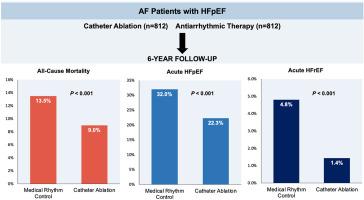
Patients treated with CA (n = 1959) and AAT (n = 7689) were 1:1 propensity score matched, yielding 3632 patients with no significant differences in baseline characteristics. Compared with AAT, CA was associated with decreased mortality (9.2% vs 20.5%; hazard ratio [HR], 0.431; 95% confidence interval [CI], 0.359–0.518; P < .001). In addition, CA was associated with reduced HFpEF (HR, 0.638; 95% CI, 0.550–0.741; P < .001) and acute HFrEF (HR, 0.645; 95% CI, 0.452–0.920; P = .015). There was no difference in composite of cerebrovascular accident/transient ischemic attack (HR, 0.935; 95% CI, 0.725–1.207; P = .607).
Conclusion
In this retrospective study of patients with AF and HFpEF, CA was associated with lower mortality and risk of acute heart failure compared with AAT.
期刊介绍:
HeartRhythm, the official Journal of the Heart Rhythm Society and the Cardiac Electrophysiology Society, is a unique journal for fundamental discovery and clinical applicability.
HeartRhythm integrates the entire cardiac electrophysiology (EP) community from basic and clinical academic researchers, private practitioners, engineers, allied professionals, industry, and trainees, all of whom are vital and interdependent members of our EP community.
The Heart Rhythm Society is the international leader in science, education, and advocacy for cardiac arrhythmia professionals and patients, and the primary information resource on heart rhythm disorders. Its mission is to improve the care of patients by promoting research, education, and optimal health care policies and standards.



 京公网安备 11010802042870号
京ICP备2023020795号-1
京公网安备 11010802042870号
京ICP备2023020795号-1

 分享
分享
 求助内容:
求助内容: 应助结果提醒方式:
 扫码关注我们
