{"title":"Do adolescents with hearing loss use social media and the internet differently from their hearing peers?","authors":"Deniz Tuz, Busra Altın, Merve Ozbal Batuk","doi":"10.1017/S002221512400149X","DOIUrl":null,"url":null,"abstract":"<p><strong>Objective: </strong>The aim of this study was to compare the internet and social media use of teenagers with hearing loss with that of their normal hearing peers.</p><p><strong>Methods: </strong>The study included 27 hearing-impaired and 27 normal-hearing peers (12-18 years). The Social Media Attitude Scale, the Internet Use Purposes Scale, University of California, Los Angeles Loneliness Scale and the Problematic Internet Use Scale were used to compare hearing-loss and normal-hearing groups.</p><p><strong>Results: </strong>The social isolation subscale and Social Media Attitude Scale total score differed between groups (<i>p</i> = 0.001 and <i>p</i> = 0.048, respectively). Internet Use Purposes Scale education subscale differences were statistically significant (<i>p</i> = 0.042). Negative consequences (<i>p</i> = 0.007), excessive use (<i>p</i> = 0.021) and Problematic Internet Use Scale total score (<i>p</i> = 0.005) differed significantly. The University of California, Los Angeles Loneliness Scale had a moderate negative connection with the Problematic Internet Use Scale's social benefit/comfort subscale and total score (<i>r</i> = 0.369, <i>p</i> = 0.006 and <i>r</i> = -0.309, <i>p</i> = 0.023, respectively).</p><p><strong>Conclusion: </strong>While adolescents with hearing loss have limited online educational resources, problematic internet use is a concern. When overused, the internet can reduce loneliness, but it can also have harmful consequences.</p>","PeriodicalId":16293,"journal":{"name":"Journal of Laryngology and Otology","volume":" ","pages":"217-223"},"PeriodicalIF":0.8000,"publicationDate":"2025-03-01","publicationTypes":"Journal Article","fieldsOfStudy":null,"isOpenAccess":false,"openAccessPdf":"https://www.ncbi.nlm.nih.gov/pmc/articles/PMC12092167/pdf/","citationCount":"0","resultStr":null,"platform":"Semanticscholar","paperid":null,"PeriodicalName":"Journal of Laryngology and Otology","FirstCategoryId":"3","ListUrlMain":"https://doi.org/10.1017/S002221512400149X","RegionNum":4,"RegionCategory":"医学","ArticlePicture":[],"TitleCN":null,"AbstractTextCN":null,"PMCID":null,"EPubDate":"","PubModel":"","JCR":"Q3","JCRName":"OTORHINOLARYNGOLOGY","Score":null,"Total":0}
引用次数: 0
Abstract
Objective: The aim of this study was to compare the internet and social media use of teenagers with hearing loss with that of their normal hearing peers.
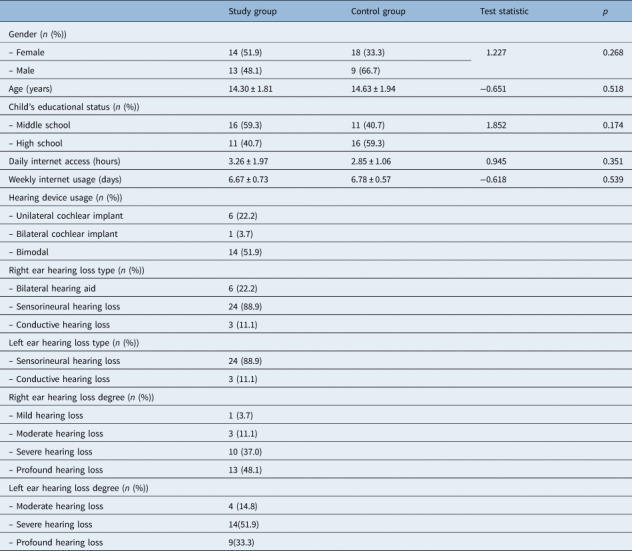
Methods: The study included 27 hearing-impaired and 27 normal-hearing peers (12-18 years). The Social Media Attitude Scale, the Internet Use Purposes Scale, University of California, Los Angeles Loneliness Scale and the Problematic Internet Use Scale were used to compare hearing-loss and normal-hearing groups.
Results: The social isolation subscale and Social Media Attitude Scale total score differed between groups (p = 0.001 and p = 0.048, respectively). Internet Use Purposes Scale education subscale differences were statistically significant (p = 0.042). Negative consequences (p = 0.007), excessive use (p = 0.021) and Problematic Internet Use Scale total score (p = 0.005) differed significantly. The University of California, Los Angeles Loneliness Scale had a moderate negative connection with the Problematic Internet Use Scale's social benefit/comfort subscale and total score (r = 0.369, p = 0.006 and r = -0.309, p = 0.023, respectively).
Conclusion: While adolescents with hearing loss have limited online educational resources, problematic internet use is a concern. When overused, the internet can reduce loneliness, but it can also have harmful consequences.
期刊介绍:
The Journal of Laryngology & Otology (JLO) is a leading, monthly journal containing original scientific articles and clinical records in otology, rhinology, laryngology and related specialties. Founded in 1887, JLO is absorbing reading for ENT specialists and trainees. The journal has an international outlook with contributions from around the world, relevant to all specialists in this area regardless of the country in which they practise. JLO contains main articles (original, review and historical), case reports and short reports as well as radiology, pathology or oncology in focus, a selection of abstracts, book reviews, letters to the editor, general notes and calendar, operative surgery techniques, and occasional supplements. It is fully illustrated and has become a definitive reference source in this fast-moving subject area. Published monthly an annual subscription is excellent value for money. Included in the subscription is access to the JLO interactive web site with searchable abstract database of the journal archive back to 1887.




 京公网安备 11010802042870号
京ICP备2023020795号-1
京公网安备 11010802042870号
京ICP备2023020795号-1

 分享
分享
 求助内容:
求助内容: 应助结果提醒方式:
 扫码关注我们
