Koshiro Sakai MD, PhD , Doosup Shin MD , Mandeep Singh BS , Sarah Malik MD , Ali Dakroub MD , Zainab Sami BS , Jonathan Weber MPH , J. Jane Cao MD, MPH , Roosha Parikh MD , Lu Chen MD , Fernando Sosa MS, MBA , David J. Cohen MD, MSc , Jeffrey W. Moses MD , Richard A. Shlofmitz MD , Carlos Collet MD, PhD , Evan Shlofmitz DO , Allen Jeremias MD, MSc , Omar K. Khalique MD , Ziad A. Ali MD, DPhil
{"title":"Diagnostic Performance and Clinical Impact of Photon-Counting Detector Computed Tomography in Coronary Artery Disease","authors":"Koshiro Sakai MD, PhD , Doosup Shin MD , Mandeep Singh BS , Sarah Malik MD , Ali Dakroub MD , Zainab Sami BS , Jonathan Weber MPH , J. Jane Cao MD, MPH , Roosha Parikh MD , Lu Chen MD , Fernando Sosa MS, MBA , David J. Cohen MD, MSc , Jeffrey W. Moses MD , Richard A. Shlofmitz MD , Carlos Collet MD, PhD , Evan Shlofmitz DO , Allen Jeremias MD, MSc , Omar K. Khalique MD , Ziad A. Ali MD, DPhil","doi":"10.1016/j.jacc.2024.10.069","DOIUrl":null,"url":null,"abstract":"<div><h3>Background</h3><div>Photon-counting detector–computed tomography (PCD-CT) has emerged as a promising technology, offering improved spatial resolution.</div></div><div><h3>Objectives</h3><div>This study aimed to evaluate the clinical impact and diagnostic performance of PCD-CT vs conventional energy-integrating detector computed tomography (EID-CT) for obstructive coronary artery disease (CAD).</div></div><div><h3>Methods</h3><div>From 2022 to 2023, we retrospectively identified 7,833 consecutive patients who underwent clinically indicated coronary computed tomography angiography (CCTA) at a single center, with either PCD-CT (n = 3,876; NAEOTOM Alpha [Siemens Healthineers]) or EID-CT (n = 3,957; Revolution Apex 256 [GE HealthCare] or Aquilion ONE ViSION 320 [Canon Medical Systems]) scanners. Subsequent invasive coronary angiography (ICA) and percutaneous or surgical revascularization were performed as part of routine clinical care. Among those referred for ICA after coronary CTA, the presence of obstructive CAD in each vessel was determined by coronary CTA (severe stenosis on visual assessment per the Coronary Artery Disease Reporting and Data System) and ICA (≥50% diameter stenosis on quantitative coronary angiography) in a blinded fashion. The diagnostic performance of EID-CT and PCD-CT was compared by using quantitative coronary angiography as the reference standard.</div></div><div><h3>Results</h3><div>Patients who underwent PCD-CT were less frequently referred to subsequent ICA than those undergoing EID-CT (9.9% vs 13.1%; <em>P</em> < 0.001). Among those who underwent ICA, revascularization was more frequently performed in the PCD-CT group than in the EID-CT group (43.4% vs 35.5%; <em>P</em> = 0.02). In the vessel-level analysis (n = 1,686), specificity (98.0% vs 93.0%; <em>P</em> < 0.001), positive predictive value (83.3% vs 63.0%; <em>P</em> = 0.002), and diagnostic accuracy (97.2% vs 92.8%; <em>P</em> < 0.001) were improved by PCD-CT. Sensitivity (90.9% vs 90.7%; <em>P</em> = 0.95) and negative predictive value (98.9% vs 98.7%; <em>P</em> = 0.83) for obstructive CAD were similar between the PCD-CT and EID-CT groups, respectively.</div></div><div><h3>Conclusions</h3><div>PCD-CT exhibited excellent diagnostic performance for detecting obstructive CAD. Compared with patients undergoing conventional EID-CT, fewer patients were referred to ICA after PCD-CT, but those referred were more likely to undergo revascularization.</div></div>","PeriodicalId":17187,"journal":{"name":"Journal of the American College of Cardiology","volume":"85 4","pages":"Pages 339-348"},"PeriodicalIF":22.3000,"publicationDate":"2025-02-04","publicationTypes":"Journal Article","fieldsOfStudy":null,"isOpenAccess":false,"openAccessPdf":"","citationCount":"0","resultStr":null,"platform":"Semanticscholar","paperid":null,"PeriodicalName":"Journal of the American College of Cardiology","FirstCategoryId":"3","ListUrlMain":"https://www.sciencedirect.com/science/article/pii/S073510972409956X","RegionNum":1,"RegionCategory":"医学","ArticlePicture":[],"TitleCN":null,"AbstractTextCN":null,"PMCID":null,"EPubDate":"2024/10/28 0:00:00","PubModel":"Epub","JCR":"Q1","JCRName":"CARDIAC & CARDIOVASCULAR SYSTEMS","Score":null,"Total":0}
引用次数: 0
Abstract
Background
Photon-counting detector–computed tomography (PCD-CT) has emerged as a promising technology, offering improved spatial resolution.
Objectives
This study aimed to evaluate the clinical impact and diagnostic performance of PCD-CT vs conventional energy-integrating detector computed tomography (EID-CT) for obstructive coronary artery disease (CAD).
Methods
From 2022 to 2023, we retrospectively identified 7,833 consecutive patients who underwent clinically indicated coronary computed tomography angiography (CCTA) at a single center, with either PCD-CT (n = 3,876; NAEOTOM Alpha [Siemens Healthineers]) or EID-CT (n = 3,957; Revolution Apex 256 [GE HealthCare] or Aquilion ONE ViSION 320 [Canon Medical Systems]) scanners. Subsequent invasive coronary angiography (ICA) and percutaneous or surgical revascularization were performed as part of routine clinical care. Among those referred for ICA after coronary CTA, the presence of obstructive CAD in each vessel was determined by coronary CTA (severe stenosis on visual assessment per the Coronary Artery Disease Reporting and Data System) and ICA (≥50% diameter stenosis on quantitative coronary angiography) in a blinded fashion. The diagnostic performance of EID-CT and PCD-CT was compared by using quantitative coronary angiography as the reference standard.
Results
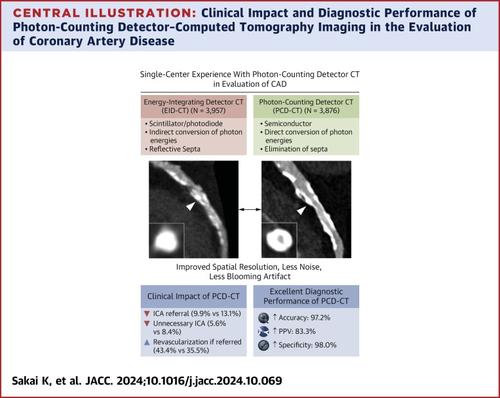
Patients who underwent PCD-CT were less frequently referred to subsequent ICA than those undergoing EID-CT (9.9% vs 13.1%; P < 0.001). Among those who underwent ICA, revascularization was more frequently performed in the PCD-CT group than in the EID-CT group (43.4% vs 35.5%; P = 0.02). In the vessel-level analysis (n = 1,686), specificity (98.0% vs 93.0%; P < 0.001), positive predictive value (83.3% vs 63.0%; P = 0.002), and diagnostic accuracy (97.2% vs 92.8%; P < 0.001) were improved by PCD-CT. Sensitivity (90.9% vs 90.7%; P = 0.95) and negative predictive value (98.9% vs 98.7%; P = 0.83) for obstructive CAD were similar between the PCD-CT and EID-CT groups, respectively.
Conclusions
PCD-CT exhibited excellent diagnostic performance for detecting obstructive CAD. Compared with patients undergoing conventional EID-CT, fewer patients were referred to ICA after PCD-CT, but those referred were more likely to undergo revascularization.
期刊介绍:
The Journal of the American College of Cardiology (JACC) publishes peer-reviewed articles highlighting all aspects of cardiovascular disease, including original clinical studies, experimental investigations with clear clinical relevance, state-of-the-art papers and viewpoints.
Content Profile:
-Original Investigations
-JACC State-of-the-Art Reviews
-JACC Review Topics of the Week
-Guidelines & Clinical Documents
-JACC Guideline Comparisons
-JACC Scientific Expert Panels
-Cardiovascular Medicine & Society
-Editorial Comments (accompanying every Original Investigation)
-Research Letters
-Fellows-in-Training/Early Career Professional Pages
-Editor’s Pages from the Editor-in-Chief or other invited thought leaders



 京公网安备 11010802042870号
京ICP备2023020795号-1
京公网安备 11010802042870号
京ICP备2023020795号-1

 分享
分享
 求助内容:
求助内容: 应助结果提醒方式:
 扫码关注我们
