{"title":"Boosting succinic acid production of Yarrowia lipolytica at low pH through enhancing product tolerance and glucose metabolism.","authors":"Yutao Zhong, Changyu Shang, Huilin Tao, Jin Hou, Zhiyong Cui, Qingsheng Qi","doi":"10.1186/s12934-024-02565-0","DOIUrl":null,"url":null,"abstract":"<p><strong>Background: </strong>Succinic acid (SA) is an important bio-based C4 platform chemical with versatile applications, including the production of 1,4-butanediol, tetrahydrofuran, and γ-butyrolactone. The non-conventional yeast Yarrowia lipolytica has garnered substantial interest as a robust cell factory for SA production at low pH. However, the high concentrations of SA, especially under acidic conditions, can impose significant stress on microbial cells, leading to reduced glucose metabolism viability and compromised production performance. Therefore, it is important to develop Y. lipolytica strains with enhanced SA tolerance for industrial-scale SA production.</p><p><strong>Results: </strong>An SA-tolerant Y. lipolytica strain E501 with improved SA production was obtained through adaptive laboratory evolution (ALE). In a 5-L bioreactor, the evolved strain E501 produced 89.62 g/L SA, representing a 7.2% increase over the starting strain Hi-SA2. Genome resequencing and transcriptome analysis identified a mutation in the 26S proteasome regulatory subunit Rpn1, as well as genes involved in transmembrane transport, which may be associated with enhanced SA tolerance. By further fine-tuning the glycolytic pathway flux, the highest SA titer of 112.54 g/L to date at low pH was achieved, with a yield of 0.67 g/g glucose and a productivity of 2.08 g/L/h.</p><p><strong>Conclusion: </strong>This study provided a robust engineered Y. lipolytica strain capable of efficiently producing SA at low pH, thereby reducing the cost of industrial SA fermentation.</p>","PeriodicalId":18582,"journal":{"name":"Microbial Cell Factories","volume":"23 1","pages":"291"},"PeriodicalIF":4.9000,"publicationDate":"2024-10-24","publicationTypes":"Journal Article","fieldsOfStudy":null,"isOpenAccess":false,"openAccessPdf":"https://www.ncbi.nlm.nih.gov/pmc/articles/PMC11515616/pdf/","citationCount":"0","resultStr":null,"platform":"Semanticscholar","paperid":null,"PeriodicalName":"Microbial Cell Factories","FirstCategoryId":"5","ListUrlMain":"https://doi.org/10.1186/s12934-024-02565-0","RegionNum":2,"RegionCategory":"生物学","ArticlePicture":[],"TitleCN":null,"AbstractTextCN":null,"PMCID":null,"EPubDate":"","PubModel":"","JCR":"Q1","JCRName":"BIOTECHNOLOGY & APPLIED MICROBIOLOGY","Score":null,"Total":0}
引用次数: 0
Abstract
Background: Succinic acid (SA) is an important bio-based C4 platform chemical with versatile applications, including the production of 1,4-butanediol, tetrahydrofuran, and γ-butyrolactone. The non-conventional yeast Yarrowia lipolytica has garnered substantial interest as a robust cell factory for SA production at low pH. However, the high concentrations of SA, especially under acidic conditions, can impose significant stress on microbial cells, leading to reduced glucose metabolism viability and compromised production performance. Therefore, it is important to develop Y. lipolytica strains with enhanced SA tolerance for industrial-scale SA production.
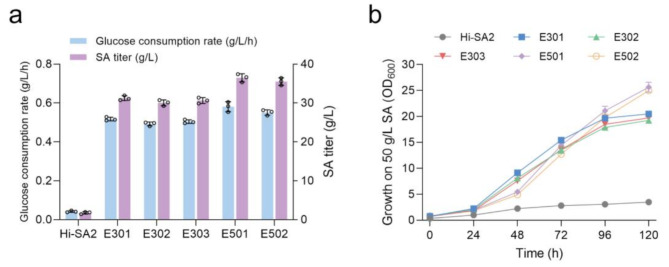
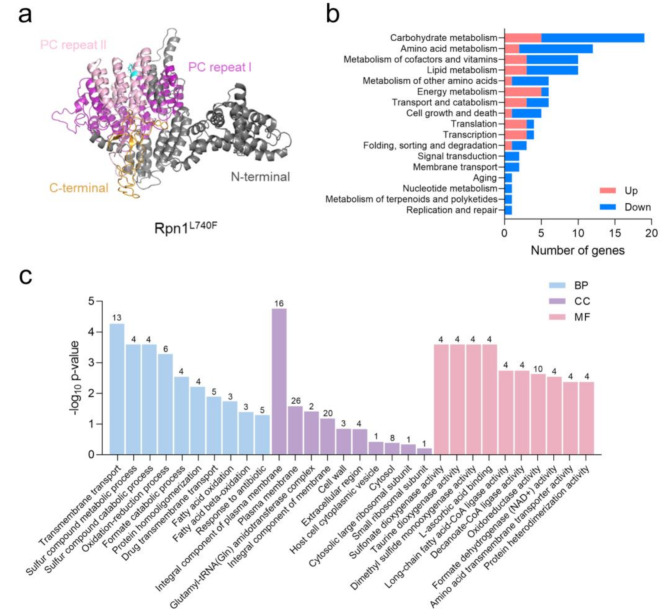
Results: An SA-tolerant Y. lipolytica strain E501 with improved SA production was obtained through adaptive laboratory evolution (ALE). In a 5-L bioreactor, the evolved strain E501 produced 89.62 g/L SA, representing a 7.2% increase over the starting strain Hi-SA2. Genome resequencing and transcriptome analysis identified a mutation in the 26S proteasome regulatory subunit Rpn1, as well as genes involved in transmembrane transport, which may be associated with enhanced SA tolerance. By further fine-tuning the glycolytic pathway flux, the highest SA titer of 112.54 g/L to date at low pH was achieved, with a yield of 0.67 g/g glucose and a productivity of 2.08 g/L/h.
Conclusion: This study provided a robust engineered Y. lipolytica strain capable of efficiently producing SA at low pH, thereby reducing the cost of industrial SA fermentation.
期刊介绍:
Microbial Cell Factories is an open access peer-reviewed journal that covers any topic related to the development, use and investigation of microbial cells as producers of recombinant proteins and natural products, or as catalyzers of biological transformations of industrial interest. Microbial Cell Factories is the world leading, primary research journal fully focusing on Applied Microbiology.
The journal is divided into the following editorial sections:
-Metabolic engineering
-Synthetic biology
-Whole-cell biocatalysis
-Microbial regulations
-Recombinant protein production/bioprocessing
-Production of natural compounds
-Systems biology of cell factories
-Microbial production processes
-Cell-free systems





 京公网安备 11010802042870号
京ICP备2023020795号-1
京公网安备 11010802042870号
京ICP备2023020795号-1

 分享
分享
 求助内容:
求助内容: 应助结果提醒方式:
 扫码关注我们
