{"title":"Development and validation of an electronic frailty index in a national health maintenance organization.","authors":"Fabienne Hershkowitz Sikron, Rony Schenker, Yishay Koom, Galit Segal, Orit Shahar, Idit Wolf, Bawkat Mazengya, Maor Lewis, Irit Laxer, Dov Albukrek","doi":"10.18632/aging.206141","DOIUrl":null,"url":null,"abstract":"<p><strong>Background: </strong>Frailty constitutes a major factor that puts the elderly at risk of health and functional deterioration.</p><p><strong>Objectives: </strong>To develop and validate an Electronic Frailty Index based on electronic data routinely collected in the HMO.</p><p><strong>Study design and setting: </strong>A retrospective cohort of the HMO members.</p><p><strong>Participants: </strong>120,986 patients, aged 65 years and over at the beginning of 2023.</p><p><strong>Predictors: </strong>A cumulative frailty index including 36 medical, functional, and social deficits.</p><p><strong>Outcomes: </strong>One-year all-cause mortality or hospitalization.</p><p><strong>Statistical analysis: </strong>One-year hazard ratios were estimated for composite outcome of mortality or hospitalization using multivariable hierarchical Cox regression.</p><p><strong>Results: </strong>The mean EFI score increased with the Social Security Nursing Benefit. Compared to fit patients, mild, moderate, and severe frailty patients had 2.07, 3.35, and 4.4-fold increased risks of mortality or hospitalization, after controlling for covariates.</p><p><strong>Conclusions: </strong>The findings showed that the Electronic Frailty Index version we created is valid in predicting mortality or hospitalization. In addition, the Electronic Frailty Index converged with an independent measurement produced by National Social Security.</p>","PeriodicalId":55547,"journal":{"name":"Aging-Us","volume":"null ","pages":"13025-13038"},"PeriodicalIF":3.9000,"publicationDate":"2024-10-24","publicationTypes":"Journal Article","fieldsOfStudy":null,"isOpenAccess":false,"openAccessPdf":"https://www.ncbi.nlm.nih.gov/pmc/articles/PMC11552639/pdf/","citationCount":"0","resultStr":null,"platform":"Semanticscholar","paperid":null,"PeriodicalName":"Aging-Us","FirstCategoryId":"3","ListUrlMain":"https://doi.org/10.18632/aging.206141","RegionNum":3,"RegionCategory":"医学","ArticlePicture":[],"TitleCN":null,"AbstractTextCN":null,"PMCID":null,"EPubDate":"","PubModel":"","JCR":"Q2","JCRName":"CELL BIOLOGY","Score":null,"Total":0}
引用次数: 0
Abstract
Background: Frailty constitutes a major factor that puts the elderly at risk of health and functional deterioration.
Objectives: To develop and validate an Electronic Frailty Index based on electronic data routinely collected in the HMO.
Study design and setting: A retrospective cohort of the HMO members.
Participants: 120,986 patients, aged 65 years and over at the beginning of 2023.
Predictors: A cumulative frailty index including 36 medical, functional, and social deficits.
Outcomes: One-year all-cause mortality or hospitalization.
Statistical analysis: One-year hazard ratios were estimated for composite outcome of mortality or hospitalization using multivariable hierarchical Cox regression.
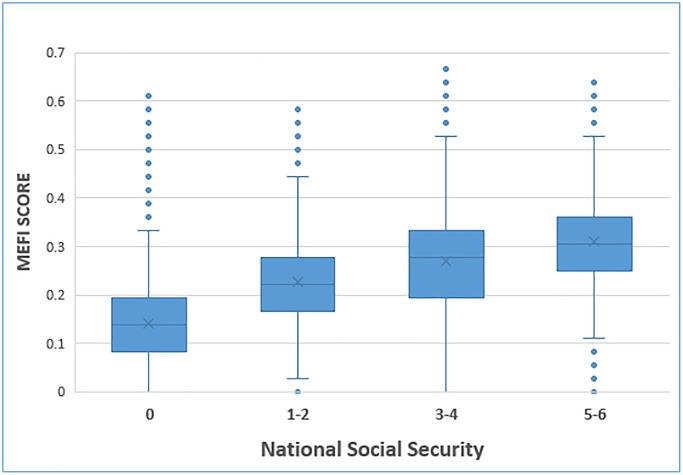
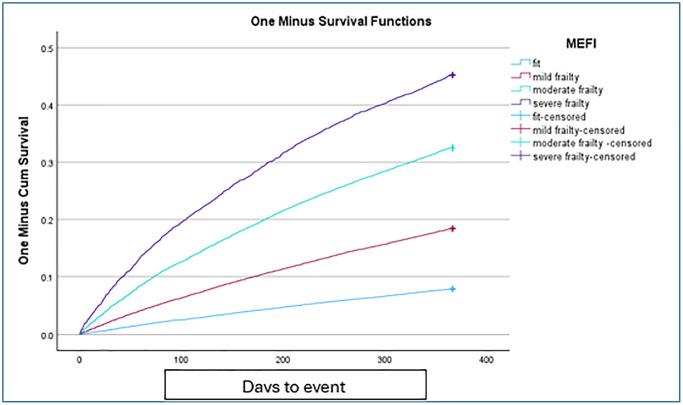
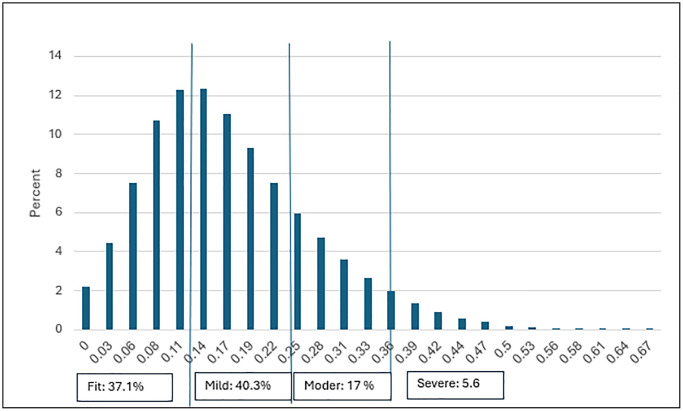
Results: The mean EFI score increased with the Social Security Nursing Benefit. Compared to fit patients, mild, moderate, and severe frailty patients had 2.07, 3.35, and 4.4-fold increased risks of mortality or hospitalization, after controlling for covariates.
Conclusions: The findings showed that the Electronic Frailty Index version we created is valid in predicting mortality or hospitalization. In addition, the Electronic Frailty Index converged with an independent measurement produced by National Social Security.





 京公网安备 11010802042870号
京ICP备2023020795号-1
京公网安备 11010802042870号
京ICP备2023020795号-1

 分享
分享
 求助内容:
求助内容: 应助结果提醒方式:
 扫码关注我们
