Lakshmanan Kumaresan, Govindasamy Palanisamy and Jintae Lee
{"title":"Cost-effective synthesis of rGO/CeNiO3 perovskite nanocomposites for enhanced and stable supercapacitors and oxygen evolution reaction catalysts†","authors":"Lakshmanan Kumaresan, Govindasamy Palanisamy and Jintae Lee","doi":"10.1039/D4TC03159H","DOIUrl":null,"url":null,"abstract":"<p >The main goal of this study is to make a nanocomposite electrode and electrocatalyst that combines the high conductivity of reduced rGO with CeNiO<small><sub>3</sub></small> nanoparticles to improve the OER and supercapacitors’ performance. This nanocomposite, rGO/CeNiO<small><sub>3</sub></small>, was designed to improve energy storage capacity and catalytic efficiency. To synthesize the rGO/CeNiO<small><sub>3</sub></small> nanocomposite, reduced graphene oxide was produced using a straightforward hammer modification method with a milling process, while cerium perovskite nanoparticles and composites were obtained through coprecipitation and ultrasonication techniques. The produced nanoparticle's shape, oxidation states, and crystal structure were all determined by the many characterizations that were carried out. The electrochemical performance tests compared the behavior of CeO<small><sub>2</sub></small>, CeNiO<small><sub>3</sub></small>, and rGO/CeNiO<small><sub>3</sub></small> electrodes to evaluate their potential in supercapacitors. The rGO/CeNiO<small><sub>3</sub></small> nanocomposite exhibited impressive pseudocapacitive properties, with a specific capacitance of 1208.7 F g<small><sup>−1</sup></small> at a current density of 1 A g<small><sup>−1</sup></small>. The material's cycling stability was remarkable; it maintained 91% of its initial capacitance even after 6000 charge discharge. Additionally, the rGO/CeNiO<small><sub>3</sub></small> composite exhibited superior and consistent electrocatalytic performance. To reach a current density of 10 mA cm<small><sup>−2</sup></small> during the oxygen evolution process, an overpotential of just 227 mV was needed. These results suggest that graphene and perovskite-based nanocomposites have significant potential for supercapacitors and reliable electrocatalysts.</p>","PeriodicalId":84,"journal":{"name":"Journal of Materials Chemistry C","volume":" 41","pages":" 16916-16934"},"PeriodicalIF":5.1000,"publicationDate":"2024-09-19","publicationTypes":"Journal Article","fieldsOfStudy":null,"isOpenAccess":false,"openAccessPdf":"","citationCount":"0","resultStr":null,"platform":"Semanticscholar","paperid":null,"PeriodicalName":"Journal of Materials Chemistry C","FirstCategoryId":"1","ListUrlMain":"https://pubs.rsc.org/en/content/articlelanding/2024/tc/d4tc03159h","RegionNum":2,"RegionCategory":"材料科学","ArticlePicture":[],"TitleCN":null,"AbstractTextCN":null,"PMCID":null,"EPubDate":"","PubModel":"","JCR":"Q2","JCRName":"MATERIALS SCIENCE, MULTIDISCIPLINARY","Score":null,"Total":0}
引用次数: 0
Abstract
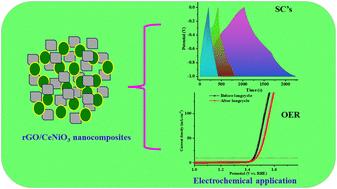
The main goal of this study is to make a nanocomposite electrode and electrocatalyst that combines the high conductivity of reduced rGO with CeNiO3 nanoparticles to improve the OER and supercapacitors’ performance. This nanocomposite, rGO/CeNiO3, was designed to improve energy storage capacity and catalytic efficiency. To synthesize the rGO/CeNiO3 nanocomposite, reduced graphene oxide was produced using a straightforward hammer modification method with a milling process, while cerium perovskite nanoparticles and composites were obtained through coprecipitation and ultrasonication techniques. The produced nanoparticle's shape, oxidation states, and crystal structure were all determined by the many characterizations that were carried out. The electrochemical performance tests compared the behavior of CeO2, CeNiO3, and rGO/CeNiO3 electrodes to evaluate their potential in supercapacitors. The rGO/CeNiO3 nanocomposite exhibited impressive pseudocapacitive properties, with a specific capacitance of 1208.7 F g−1 at a current density of 1 A g−1. The material's cycling stability was remarkable; it maintained 91% of its initial capacitance even after 6000 charge discharge. Additionally, the rGO/CeNiO3 composite exhibited superior and consistent electrocatalytic performance. To reach a current density of 10 mA cm−2 during the oxygen evolution process, an overpotential of just 227 mV was needed. These results suggest that graphene and perovskite-based nanocomposites have significant potential for supercapacitors and reliable electrocatalysts.
期刊介绍:
The Journal of Materials Chemistry is divided into three distinct sections, A, B, and C, each catering to specific applications of the materials under study:
Journal of Materials Chemistry A focuses primarily on materials intended for applications in energy and sustainability.
Journal of Materials Chemistry B specializes in materials designed for applications in biology and medicine.
Journal of Materials Chemistry C is dedicated to materials suitable for applications in optical, magnetic, and electronic devices.
Example topic areas within the scope of Journal of Materials Chemistry C are listed below. This list is neither exhaustive nor exclusive.
Bioelectronics
Conductors
Detectors
Dielectrics
Displays
Ferroelectrics
Lasers
LEDs
Lighting
Liquid crystals
Memory
Metamaterials
Multiferroics
Photonics
Photovoltaics
Semiconductors
Sensors
Single molecule conductors
Spintronics
Superconductors
Thermoelectrics
Topological insulators
Transistors



 京公网安备 11010802042870号
京ICP备2023020795号-1
京公网安备 11010802042870号
京ICP备2023020795号-1

 分享
分享
 求助内容:
求助内容: 应助结果提醒方式:
 扫码关注我们
