Guna Krieke, Andris Antuzevics, Aleksandr Kalinko, Alexei Kuzmin, Tomas Murauskas, Aivaras Kareiva and Aleksej Zarkov
{"title":"Matrix-dependent high-contrast photochromism in Eu-doped M3MgSi2O8 (M = Ca, Sr, Ba)†","authors":"Guna Krieke, Andris Antuzevics, Aleksandr Kalinko, Alexei Kuzmin, Tomas Murauskas, Aivaras Kareiva and Aleksej Zarkov","doi":"10.1039/D4TC03091E","DOIUrl":null,"url":null,"abstract":"<p >The photochromic properties and charge transfer processes were studied in novel Eu-doped M<small><sub>3</sub></small>MgSi<small><sub>2</sub></small>O<small><sub>8</sub></small> (M = Ca, Sr, Ba) compounds. These materials exhibit vivid color changes upon irradiation with UV light, resulting in orange, reddish-pink, and green colors. The introduction of europium ions enhances photochromic efficiency and shifts excitation peaks to lower energy ranges. Analysis of diffuse reflectance and electron paramagnetic resonance spectra reveals the formation of both paramagnetic and non-paramagnetic defects, with the dominant signals attributed to electron centers, likely F<small><sup>+</sup></small>-type centers. The Eu<small><sup>2+</sup></small> → Eu<small><sup>3+</sup></small> charge transfer during irradiation indicates that Eu<small><sup>2+</sup></small> acts as a hole center. These findings contribute to a better understanding of the mechanisms underlying photochromism in these materials and highlight their potential for practical applications.</p>","PeriodicalId":84,"journal":{"name":"Journal of Materials Chemistry C","volume":" 41","pages":" 16989-16998"},"PeriodicalIF":5.1000,"publicationDate":"2024-09-18","publicationTypes":"Journal Article","fieldsOfStudy":null,"isOpenAccess":false,"openAccessPdf":"https://pubs.rsc.org/en/content/articlepdf/2024/tc/d4tc03091e?page=search","citationCount":"0","resultStr":null,"platform":"Semanticscholar","paperid":null,"PeriodicalName":"Journal of Materials Chemistry C","FirstCategoryId":"1","ListUrlMain":"https://pubs.rsc.org/en/content/articlelanding/2024/tc/d4tc03091e","RegionNum":2,"RegionCategory":"材料科学","ArticlePicture":[],"TitleCN":null,"AbstractTextCN":null,"PMCID":null,"EPubDate":"","PubModel":"","JCR":"Q2","JCRName":"MATERIALS SCIENCE, MULTIDISCIPLINARY","Score":null,"Total":0}
引用次数: 0
Abstract
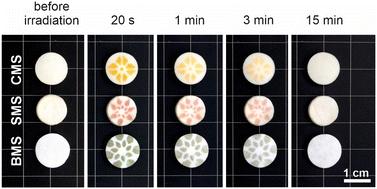
The photochromic properties and charge transfer processes were studied in novel Eu-doped M3MgSi2O8 (M = Ca, Sr, Ba) compounds. These materials exhibit vivid color changes upon irradiation with UV light, resulting in orange, reddish-pink, and green colors. The introduction of europium ions enhances photochromic efficiency and shifts excitation peaks to lower energy ranges. Analysis of diffuse reflectance and electron paramagnetic resonance spectra reveals the formation of both paramagnetic and non-paramagnetic defects, with the dominant signals attributed to electron centers, likely F+-type centers. The Eu2+ → Eu3+ charge transfer during irradiation indicates that Eu2+ acts as a hole center. These findings contribute to a better understanding of the mechanisms underlying photochromism in these materials and highlight their potential for practical applications.
期刊介绍:
The Journal of Materials Chemistry is divided into three distinct sections, A, B, and C, each catering to specific applications of the materials under study:
Journal of Materials Chemistry A focuses primarily on materials intended for applications in energy and sustainability.
Journal of Materials Chemistry B specializes in materials designed for applications in biology and medicine.
Journal of Materials Chemistry C is dedicated to materials suitable for applications in optical, magnetic, and electronic devices.
Example topic areas within the scope of Journal of Materials Chemistry C are listed below. This list is neither exhaustive nor exclusive.
Bioelectronics
Conductors
Detectors
Dielectrics
Displays
Ferroelectrics
Lasers
LEDs
Lighting
Liquid crystals
Memory
Metamaterials
Multiferroics
Photonics
Photovoltaics
Semiconductors
Sensors
Single molecule conductors
Spintronics
Superconductors
Thermoelectrics
Topological insulators
Transistors



 京公网安备 11010802042870号
京ICP备2023020795号-1
京公网安备 11010802042870号
京ICP备2023020795号-1

 分享
分享
 求助内容:
求助内容: 应助结果提醒方式:
 扫码关注我们
