Omar M. Al-Janabi, Seyed Behnam Jazayeri, Michelle A. Toruno, Yamama M. Mahmood, Sherief Ghozy, Shadi Yaghi, Alejandro A. Rabinstein, David F. Kallmes
{"title":"Safety and efficacy of intravenous thrombolytic therapy in the extended window up to 24 hours: A systematic review and meta-analysis","authors":"Omar M. Al-Janabi, Seyed Behnam Jazayeri, Michelle A. Toruno, Yamama M. Mahmood, Sherief Ghozy, Shadi Yaghi, Alejandro A. Rabinstein, David F. Kallmes","doi":"10.1002/acn3.52239","DOIUrl":null,"url":null,"abstract":"<div>\n \n \n <section>\n \n <h3> Objective</h3>\n \n <p>About 25% of patients with acute ischemic stroke (AIS) present within the intravenous thrombolytic (IVT) therapeutic window of <4.5 h. This study is to elucidate the safety and efficacy of IVT in the extended therapeutic window (ETW) in patients with AIS.</p>\n </section>\n \n <section>\n \n <h3> Methods</h3>\n \n <p>Using PRISMA guidelines, a systematic review was conducted using PubMed, Embase, and Scopus. A rigorous risk of bias assessment was conducted using the RoB2 tool. Rates of excellent and good functional outcome (mRS 0–1 and mRS 0–2) at 90 days, symptomatic intracranial hemorrhage (sICH), and mortality at 90 days were pooled using generalized linear mixed model and compared with controls. Meta-analyses were conducted employing random-effect models with risk ratio (RR) and 95% confidence intervals (CIs). Subgroup analysis was performed to assess the effect of imaging modalities used for patient selection.</p>\n </section>\n \n <section>\n \n <h3> Results</h3>\n \n <p>Eight randomized controlled trials (<i>n</i> = 2221, 59% male) were included. At 90 days IVT showed higher rates of functional recovery: mRS 0–1: RR 1.21 95% CI 1.1–1.34, <i>p</i> < 0.001, and mRS 0–2: RR 1.11 95% CI 1.03–1.18, <i>p</i> = 0.004. Rate of mortality at 90 day was not different between groups: RR 1.17 95% CI 0.93–1.48, <i>p</i> = 0.17. However, the rate of sICH was higher among IVT group: RR 2.93 95% CI 1.53–5.6, <i>p</i> = 0.001. Subgroup analysis showed higher mRS 0–1 among patients who were selected based on perfusion imaging (<i>p</i> < 0.05).</p>\n </section>\n \n <section>\n \n <h3> Interpretation</h3>\n \n <p>The use of IVT in AIS in ETW is beneficial especially with the use of perfusion imaging for patients' selection.</p>\n </section>\n </div>","PeriodicalId":126,"journal":{"name":"Annals of Clinical and Translational Neurology","volume":"11 12","pages":"3310-3319"},"PeriodicalIF":3.9000,"publicationDate":"2024-10-29","publicationTypes":"Journal Article","fieldsOfStudy":null,"isOpenAccess":false,"openAccessPdf":"https://onlinelibrary.wiley.com/doi/epdf/10.1002/acn3.52239","citationCount":"0","resultStr":null,"platform":"Semanticscholar","paperid":null,"PeriodicalName":"Annals of Clinical and Translational Neurology","FirstCategoryId":"3","ListUrlMain":"https://onlinelibrary.wiley.com/doi/10.1002/acn3.52239","RegionNum":2,"RegionCategory":"医学","ArticlePicture":[],"TitleCN":null,"AbstractTextCN":null,"PMCID":null,"EPubDate":"","PubModel":"","JCR":"Q1","JCRName":"CLINICAL NEUROLOGY","Score":null,"Total":0}
引用次数: 0
Abstract
Objective
About 25% of patients with acute ischemic stroke (AIS) present within the intravenous thrombolytic (IVT) therapeutic window of <4.5 h. This study is to elucidate the safety and efficacy of IVT in the extended therapeutic window (ETW) in patients with AIS.
Methods
Using PRISMA guidelines, a systematic review was conducted using PubMed, Embase, and Scopus. A rigorous risk of bias assessment was conducted using the RoB2 tool. Rates of excellent and good functional outcome (mRS 0–1 and mRS 0–2) at 90 days, symptomatic intracranial hemorrhage (sICH), and mortality at 90 days were pooled using generalized linear mixed model and compared with controls. Meta-analyses were conducted employing random-effect models with risk ratio (RR) and 95% confidence intervals (CIs). Subgroup analysis was performed to assess the effect of imaging modalities used for patient selection.
Results
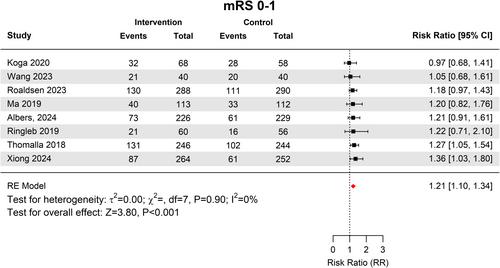
Eight randomized controlled trials (n = 2221, 59% male) were included. At 90 days IVT showed higher rates of functional recovery: mRS 0–1: RR 1.21 95% CI 1.1–1.34, p < 0.001, and mRS 0–2: RR 1.11 95% CI 1.03–1.18, p = 0.004. Rate of mortality at 90 day was not different between groups: RR 1.17 95% CI 0.93–1.48, p = 0.17. However, the rate of sICH was higher among IVT group: RR 2.93 95% CI 1.53–5.6, p = 0.001. Subgroup analysis showed higher mRS 0–1 among patients who were selected based on perfusion imaging (p < 0.05).
Interpretation
The use of IVT in AIS in ETW is beneficial especially with the use of perfusion imaging for patients' selection.
期刊介绍:
Annals of Clinical and Translational Neurology is a peer-reviewed journal for rapid dissemination of high-quality research related to all areas of neurology. The journal publishes original research and scholarly reviews focused on the mechanisms and treatments of diseases of the nervous system; high-impact topics in neurologic education; and other topics of interest to the clinical neuroscience community.



 京公网安备 11010802042870号
京ICP备2023020795号-1
京公网安备 11010802042870号
京ICP备2023020795号-1

 分享
分享
 求助内容:
求助内容: 应助结果提醒方式:
 扫码关注我们
