Francesco Motolese, Raffaele Dubbioso, Federico Ranieri, Vincenzo Di Lazzaro
{"title":"Neurophysiological biomarkers of Alzheimer's disease: In vivo evaluation of synaptic dysfunction","authors":"Francesco Motolese, Raffaele Dubbioso, Federico Ranieri, Vincenzo Di Lazzaro","doi":"10.1002/alz.14341","DOIUrl":null,"url":null,"abstract":"<p>The revised criteria for diagnosis and staging of Alzheimer's disease (AD)<span><sup>1</sup></span> update the 2018 Research Framework and reaffirm the concept of AD as a primary biological entity. These new criteria focus on biomarkers that represent distinct pathological processes, measurable in living individuals using neuroimaging and biofluid assays to track disease course. Specifically, the framework proposes three categories: core biomarkers of AD neuropathologic change, non-specific biomarkers of AD pathogenesis that are also involved in other brain diseases, and biomarkers of common non-AD co-pathologies.</p><p>The pathological changes in AD begin years before the manifestation of clinical symptoms<span><sup>2</sup></span> that emerge when brain damage surpasses an individually determined threshold. This latter is influenced by the individual cognitive reserve and brain resilience to abnormal protein deposition.</p><p>Despite the substantial advances outlined in these criteria, a significant gap remains between the biochemical and the structural changes driving AD pathogenesis and the corresponding dysfunction of neural networks which is correlated with cognitive impariment. Recent studies indicate that this gap can, at least partially, be filled by techniques that allow for the in vivo functional evaluation of cortical circuit excitability and plasticity. Over the past two decades, non-invasive neurophysiological techniques, namely transcranial magnetic stimulation (TMS) and electroencephalography (EEG), have been used as biomarkers of synaptic dysfunction and seem promising for evaluating the N (injury, dysfunction, or degeneration of neuropil) category.</p><p>In these updated criteria, the role of synaptic loss and dysfunction in neurodegeneration is highlighted, along with possible evaluation tools including positron emission tomography imaging, fluid biomarkers, and EEG. We would like to suggest that TMS may be an integral part of these tools, as TMS-based measures have achieved a significant level of maturity, offering insights into neuroplasticity and cortical connections at the level of specific neurotransmitters (Figure 1). These measures are becoming increasingly valuable for the characterization and differential diagnosis of dementia.<span><sup>3</sup></span></p><p>Notably, some researchers consider AD a “synaptopathy,” because synaptic dysfunction, driven primarily by amyloid—especially amyloid beta oligomers—and tau deposition, is detected in the early stage of the disease, preceding neurodegeneration and atrophy in the neocortex.<span><sup>4</sup></span></p><p>In support of this notion there is evidence that synaptic dysfunction correlates more closely with clinical symptoms than with pathological burden<span><sup>5</sup></span> and that altered synaptic function plays a key role in the clinical symptom heterogeneity of AD. Indeed, it is well documented that patients with similar levels of pathological burden can exhibit different degrees of cognitive impairment. This variability is thought to arise from individual compensatory mechanisms to brain damage, such as neural networks remodeling and plasticity changes, which, unsurprisingly, occur at the synaptic level.</p><p>In this context, TMS might also be useful as a tool for monitoring disease progression. In the early stages of AD, the neural network disruption, the subsequent excitation/inhibition imbalance in the neocortex, and the increase of cortical excitability can be evidenced by the reduction of motor thresholds.<span><sup>6</sup></span> As AD advances, various neurotransmitter circuits undergo alterations and these changes can be monitored through TMS protocols. For instance, deficit in central cholinergic circuit activity can be assessed in the AD early stage using a paired-pulse TMS protocol called short-latency afferent inhibition (SAI).<span><sup>7</sup></span> Notably, administration of anticholinesterase inhibitors, L-dopa, or dopamine agonists restore SAI.<span><sup>7</sup></span> Also, GABAA activity, tested by the paired-pulse TMS protocol short-interval intracortical inhibition (SICI), is reduced in AD patients with longer disease duration,<span><sup>8</sup></span> while there is an increase of glutamatergic activity, as tested by the intracortical facilitation (ICF) protocol, even though data regarding the latter are more debated.<span><sup>6, 7</sup></span> These measures might also assist in the differential diagnosis of dementia, as each form of dementia exhibits a distinct neurophysiological signature.<span><sup>6</sup></span> Deficits in synaptic plasticity, including impaired long-term potentiation (LTP) and enhanced long-term depression (LTD, particularly in the hippocampus) have also been shown, mostly in mouse models, to play a critical role in AD.<span><sup>9</sup></span> These synaptic abnormalities are associated with cognitive deficits and may underlie the epileptiform activity often observed in patients.<span><sup>9</sup></span> Repetitive TMS (rTMS) protocols have indeed provided evidence of impaired LTP-like plasticity in the human motor cortex and rTMS has been shown to improve cognitive performance in AD patients.<span><sup>10</sup></span></p><p>In real-world settings, predicting the progression of neurodegeneration, starting from the subjective complaint of cognitive impairment (CI) to mild CI and dementia, continues to be a challenge. Additionally, no biomarkers exist that can reflect the effects of therapeutic interventions in real time, as structural pathological changes take time to reverse. Neurophysiological tools offer significant potential as monitoring instruments due to their excellent time resolution, broad availability, and cost effectiveness.</p><p>We are entering a new era in the management of dementia, in which, thanks to a better understanding and greater accessibility of biomarkers, the diagnostic process has become more objective. These biomarkers allow for a precise characterization of the pathological profile of the individual affected by AD. In this context, multimodal assessment, which provides valuable information for a better-informed diagnosis and staging of AD, could be further strengthened by the inclusion of neurophysiological tools like TMS and EEG.</p><p>All authors contributed equally to the study.</p><p>All authors have no disclosures to report. Author disclosures are available in the supporting information.</p>","PeriodicalId":7471,"journal":{"name":"Alzheimer's & Dementia","volume":"20 12","pages":"9082-9084"},"PeriodicalIF":11.1000,"publicationDate":"2024-10-29","publicationTypes":"Journal Article","fieldsOfStudy":null,"isOpenAccess":false,"openAccessPdf":"https://www.ncbi.nlm.nih.gov/pmc/articles/PMC11667491/pdf/","citationCount":"0","resultStr":null,"platform":"Semanticscholar","paperid":null,"PeriodicalName":"Alzheimer's & Dementia","FirstCategoryId":"3","ListUrlMain":"https://alz-journals.onlinelibrary.wiley.com/doi/10.1002/alz.14341","RegionNum":1,"RegionCategory":"医学","ArticlePicture":[],"TitleCN":null,"AbstractTextCN":null,"PMCID":null,"EPubDate":"","PubModel":"","JCR":"Q1","JCRName":"CLINICAL NEUROLOGY","Score":null,"Total":0}
引用次数: 0
Abstract
The revised criteria for diagnosis and staging of Alzheimer's disease (AD)1 update the 2018 Research Framework and reaffirm the concept of AD as a primary biological entity. These new criteria focus on biomarkers that represent distinct pathological processes, measurable in living individuals using neuroimaging and biofluid assays to track disease course. Specifically, the framework proposes three categories: core biomarkers of AD neuropathologic change, non-specific biomarkers of AD pathogenesis that are also involved in other brain diseases, and biomarkers of common non-AD co-pathologies.
The pathological changes in AD begin years before the manifestation of clinical symptoms2 that emerge when brain damage surpasses an individually determined threshold. This latter is influenced by the individual cognitive reserve and brain resilience to abnormal protein deposition.
Despite the substantial advances outlined in these criteria, a significant gap remains between the biochemical and the structural changes driving AD pathogenesis and the corresponding dysfunction of neural networks which is correlated with cognitive impariment. Recent studies indicate that this gap can, at least partially, be filled by techniques that allow for the in vivo functional evaluation of cortical circuit excitability and plasticity. Over the past two decades, non-invasive neurophysiological techniques, namely transcranial magnetic stimulation (TMS) and electroencephalography (EEG), have been used as biomarkers of synaptic dysfunction and seem promising for evaluating the N (injury, dysfunction, or degeneration of neuropil) category.
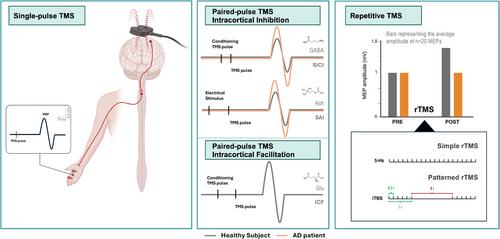
In these updated criteria, the role of synaptic loss and dysfunction in neurodegeneration is highlighted, along with possible evaluation tools including positron emission tomography imaging, fluid biomarkers, and EEG. We would like to suggest that TMS may be an integral part of these tools, as TMS-based measures have achieved a significant level of maturity, offering insights into neuroplasticity and cortical connections at the level of specific neurotransmitters (Figure 1). These measures are becoming increasingly valuable for the characterization and differential diagnosis of dementia.3
Notably, some researchers consider AD a “synaptopathy,” because synaptic dysfunction, driven primarily by amyloid—especially amyloid beta oligomers—and tau deposition, is detected in the early stage of the disease, preceding neurodegeneration and atrophy in the neocortex.4
In support of this notion there is evidence that synaptic dysfunction correlates more closely with clinical symptoms than with pathological burden5 and that altered synaptic function plays a key role in the clinical symptom heterogeneity of AD. Indeed, it is well documented that patients with similar levels of pathological burden can exhibit different degrees of cognitive impairment. This variability is thought to arise from individual compensatory mechanisms to brain damage, such as neural networks remodeling and plasticity changes, which, unsurprisingly, occur at the synaptic level.
In this context, TMS might also be useful as a tool for monitoring disease progression. In the early stages of AD, the neural network disruption, the subsequent excitation/inhibition imbalance in the neocortex, and the increase of cortical excitability can be evidenced by the reduction of motor thresholds.6 As AD advances, various neurotransmitter circuits undergo alterations and these changes can be monitored through TMS protocols. For instance, deficit in central cholinergic circuit activity can be assessed in the AD early stage using a paired-pulse TMS protocol called short-latency afferent inhibition (SAI).7 Notably, administration of anticholinesterase inhibitors, L-dopa, or dopamine agonists restore SAI.7 Also, GABAA activity, tested by the paired-pulse TMS protocol short-interval intracortical inhibition (SICI), is reduced in AD patients with longer disease duration,8 while there is an increase of glutamatergic activity, as tested by the intracortical facilitation (ICF) protocol, even though data regarding the latter are more debated.6, 7 These measures might also assist in the differential diagnosis of dementia, as each form of dementia exhibits a distinct neurophysiological signature.6 Deficits in synaptic plasticity, including impaired long-term potentiation (LTP) and enhanced long-term depression (LTD, particularly in the hippocampus) have also been shown, mostly in mouse models, to play a critical role in AD.9 These synaptic abnormalities are associated with cognitive deficits and may underlie the epileptiform activity often observed in patients.9 Repetitive TMS (rTMS) protocols have indeed provided evidence of impaired LTP-like plasticity in the human motor cortex and rTMS has been shown to improve cognitive performance in AD patients.10
In real-world settings, predicting the progression of neurodegeneration, starting from the subjective complaint of cognitive impairment (CI) to mild CI and dementia, continues to be a challenge. Additionally, no biomarkers exist that can reflect the effects of therapeutic interventions in real time, as structural pathological changes take time to reverse. Neurophysiological tools offer significant potential as monitoring instruments due to their excellent time resolution, broad availability, and cost effectiveness.
We are entering a new era in the management of dementia, in which, thanks to a better understanding and greater accessibility of biomarkers, the diagnostic process has become more objective. These biomarkers allow for a precise characterization of the pathological profile of the individual affected by AD. In this context, multimodal assessment, which provides valuable information for a better-informed diagnosis and staging of AD, could be further strengthened by the inclusion of neurophysiological tools like TMS and EEG.
All authors contributed equally to the study.
All authors have no disclosures to report. Author disclosures are available in the supporting information.
期刊介绍:
Alzheimer's & Dementia is a peer-reviewed journal that aims to bridge knowledge gaps in dementia research by covering the entire spectrum, from basic science to clinical trials to social and behavioral investigations. It provides a platform for rapid communication of new findings and ideas, optimal translation of research into practical applications, increasing knowledge across diverse disciplines for early detection, diagnosis, and intervention, and identifying promising new research directions. In July 2008, Alzheimer's & Dementia was accepted for indexing by MEDLINE, recognizing its scientific merit and contribution to Alzheimer's research.




 京公网安备 11010802042870号
京ICP备2023020795号-1
京公网安备 11010802042870号
京ICP备2023020795号-1

 分享
分享
 求助内容:
求助内容: 应助结果提醒方式:
 扫码关注我们
