Dingyi Yang , Qi Zeng , Kaiwen Tan , Haoyue Hou , Xingyuan Fang , Chenlong Guo , Hao Yuan , Tao Meng
{"title":"Lipase-entrapped colloidosomes with light-responsive wettability for efficient and recyclable Pickering interfacial biocatalysis†","authors":"Dingyi Yang , Qi Zeng , Kaiwen Tan , Haoyue Hou , Xingyuan Fang , Chenlong Guo , Hao Yuan , Tao Meng","doi":"10.1039/d4gc03982c","DOIUrl":null,"url":null,"abstract":"<div><div>Light-responsive Pickering interfacial biocatalysis (LPIB) is desirable because of its convenient catalyst recovery, product separation and clean external stimuli trigger. However, the recyclability of LPIB is still limited due to its enzyme inactivation. Herein, lipase-entrapped colloidosomes as particulate emulsifiers and biocatalysts were fabricated using the one-step co-assembly of lipases and TiO<sub>2</sub> nanoparticles (with light-responsive wettability). The obtained LPIB exhibited a 4.31-fold enhancement of enzyme activity compared with the traditional biphasic system. Impressively, the LPIB maintained nearly 90% of its initial enzyme activity even after 20 cycles, which is the highest among the currently reported LPIBs. It is attributed that the TiO<sub>2</sub> nanoparticle layer on the colloidosome surface reflects UV light, thus protecting the enzyme from photodegradation. This green platform can be widely applied to construct recyclable and efficient biphasic biocatalytic systems.</div></div>","PeriodicalId":78,"journal":{"name":"Green Chemistry","volume":"26 21","pages":"Pages 10824-10828"},"PeriodicalIF":9.2000,"publicationDate":"2024-09-18","publicationTypes":"Journal Article","fieldsOfStudy":null,"isOpenAccess":false,"openAccessPdf":"","citationCount":"0","resultStr":null,"platform":"Semanticscholar","paperid":null,"PeriodicalName":"Green Chemistry","FirstCategoryId":"92","ListUrlMain":"https://www.sciencedirect.com/org/science/article/pii/S1463926224008173","RegionNum":1,"RegionCategory":"化学","ArticlePicture":[],"TitleCN":null,"AbstractTextCN":null,"PMCID":null,"EPubDate":"2024/10/1 0:00:00","PubModel":"Epub","JCR":"Q1","JCRName":"CHEMISTRY, MULTIDISCIPLINARY","Score":null,"Total":0}
引用次数: 0
Abstract
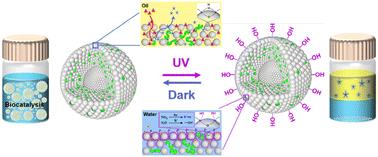
Light-responsive Pickering interfacial biocatalysis (LPIB) is desirable because of its convenient catalyst recovery, product separation and clean external stimuli trigger. However, the recyclability of LPIB is still limited due to its enzyme inactivation. Herein, lipase-entrapped colloidosomes as particulate emulsifiers and biocatalysts were fabricated using the one-step co-assembly of lipases and TiO2 nanoparticles (with light-responsive wettability). The obtained LPIB exhibited a 4.31-fold enhancement of enzyme activity compared with the traditional biphasic system. Impressively, the LPIB maintained nearly 90% of its initial enzyme activity even after 20 cycles, which is the highest among the currently reported LPIBs. It is attributed that the TiO2 nanoparticle layer on the colloidosome surface reflects UV light, thus protecting the enzyme from photodegradation. This green platform can be widely applied to construct recyclable and efficient biphasic biocatalytic systems.
期刊介绍:
Green Chemistry is a journal that provides a unique forum for the publication of innovative research on the development of alternative green and sustainable technologies. The scope of Green Chemistry is based on the definition proposed by Anastas and Warner (Green Chemistry: Theory and Practice, P T Anastas and J C Warner, Oxford University Press, Oxford, 1998), which defines green chemistry as the utilisation of a set of principles that reduces or eliminates the use or generation of hazardous substances in the design, manufacture and application of chemical products. Green Chemistry aims to reduce the environmental impact of the chemical enterprise by developing a technology base that is inherently non-toxic to living things and the environment. The journal welcomes submissions on all aspects of research relating to this endeavor and publishes original and significant cutting-edge research that is likely to be of wide general appeal. For a work to be published, it must present a significant advance in green chemistry, including a comparison with existing methods and a demonstration of advantages over those methods.



 京公网安备 11010802042870号
京ICP备2023020795号-1
京公网安备 11010802042870号
京ICP备2023020795号-1

 分享
分享
 求助内容:
求助内容: 应助结果提醒方式:
 扫码关注我们
