{"title":"Scalable synthesis of sulfonium and selenonium peptides for selective methyllysine reader crosslinking","authors":"Yingxiao Gao , Feng Feng , Mingxuan Wu","doi":"10.1016/j.tetlet.2024.155332","DOIUrl":null,"url":null,"abstract":"<div><div>Lysine methylation readers are an important class of proteins that bind site-specifically methylated proteins for downstream regulation. Chemical probes that crosslink lysine methylation readers are highly desired to investigate the proteins from cellular samples. We recently reported NleS<sup>+</sup>me2 (norleucine-ε-dimethylsulfonium) as dimethyllysine mimic selectively crosslinks corresponding methyllysine readers. Although the sulfonium tools exhibited great promise, the synthetic availability may limit broad applications. In order to incorporate the unnatural amino acid, <em><span>l</span></em>-Fmoc-NleSme-OH (Fmoc: fluorenyl methoxycarbonyl) was synthesized as an important building block for solid-phase peptide synthesis (SPPS) in the previous synthetic route. It took six steps with resolution of racemic mixture and radical mediated thiol-ene reaction. As a result, the synthesis was not scalable with only 4.4 % overall yield. Here we report a much-improved synthesis method so that diverse NleS<sup>+</sup>me2 peptides could be readily prepared. In addition, the new method enables preparation of selenonium peptides for methyllysine reader crosslinking. We thus believe this synthetic method will be widely used to prepare sulfonium and selenonium probes for site-selective crosslinking.</div></div>","PeriodicalId":438,"journal":{"name":"Tetrahedron Letters","volume":"151 ","pages":"Article 155332"},"PeriodicalIF":1.5000,"publicationDate":"2024-11-13","publicationTypes":"Journal Article","fieldsOfStudy":null,"isOpenAccess":false,"openAccessPdf":"","citationCount":"0","resultStr":null,"platform":"Semanticscholar","paperid":null,"PeriodicalName":"Tetrahedron Letters","FirstCategoryId":"92","ListUrlMain":"https://www.sciencedirect.com/science/article/pii/S0040403924004271","RegionNum":4,"RegionCategory":"化学","ArticlePicture":[],"TitleCN":null,"AbstractTextCN":null,"PMCID":null,"EPubDate":"2024/10/21 0:00:00","PubModel":"Epub","JCR":"Q3","JCRName":"CHEMISTRY, ORGANIC","Score":null,"Total":0}
引用次数: 0
Abstract
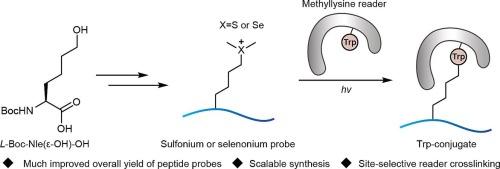
Lysine methylation readers are an important class of proteins that bind site-specifically methylated proteins for downstream regulation. Chemical probes that crosslink lysine methylation readers are highly desired to investigate the proteins from cellular samples. We recently reported NleS+me2 (norleucine-ε-dimethylsulfonium) as dimethyllysine mimic selectively crosslinks corresponding methyllysine readers. Although the sulfonium tools exhibited great promise, the synthetic availability may limit broad applications. In order to incorporate the unnatural amino acid, l-Fmoc-NleSme-OH (Fmoc: fluorenyl methoxycarbonyl) was synthesized as an important building block for solid-phase peptide synthesis (SPPS) in the previous synthetic route. It took six steps with resolution of racemic mixture and radical mediated thiol-ene reaction. As a result, the synthesis was not scalable with only 4.4 % overall yield. Here we report a much-improved synthesis method so that diverse NleS+me2 peptides could be readily prepared. In addition, the new method enables preparation of selenonium peptides for methyllysine reader crosslinking. We thus believe this synthetic method will be widely used to prepare sulfonium and selenonium probes for site-selective crosslinking.
期刊介绍:
Tetrahedron Letters provides maximum dissemination of outstanding developments in organic chemistry. The journal is published weekly and covers developments in techniques, structures, methods and conclusions in experimental and theoretical organic chemistry. Rapid publication of timely and significant research results enables researchers from all over the world to transmit quickly their new contributions to large, international audiences.




 京公网安备 11010802042870号
京ICP备2023020795号-1
京公网安备 11010802042870号
京ICP备2023020795号-1

 分享
分享
 求助内容:
求助内容: 应助结果提醒方式:
 扫码关注我们
