Jianhao Liu , Yangyang Zhao , Yinshui Liu , Xinping Zhou
{"title":"A non-contact thermocapillary driving system at the gas-liquid interface","authors":"Jianhao Liu , Yangyang Zhao , Yinshui Liu , Xinping Zhou","doi":"10.1016/j.surfin.2024.105288","DOIUrl":null,"url":null,"abstract":"<div><div>Non-contact driving technology is widely utilized in various fields due to its advantages of being non-contact, wear-free, and low noise. Thermocapillary driving is an effective approach for non-contact driving at gas-liquid interfaces. When a temperature gradient exists at the gas-liquid interface, it generates a surface tension gradient, which drives the movement of micro-objects at the interface. This research proposes a system that utilizes an array of thermoelectric coolers (TECs) as a heat source, which changes the local temperature at the gas-liquid interface and generates surface tension gradients for driving the movement of interface objects. Experimental results demonstrate that foam particles with a diameter of 0.5 mm can achieve a maximum moving speed of 2.1 mm/s. Furthermore, the system can control multiple micro-objects at the gas-liquid interface for self-assembly. We have also developed a miniature biomimetic water strider robot, this system can drive the robot to perform linear and turning movements at the gas-liquid interface. This system provides a novel approach for non-contact driving of gas-liquid interfaces.</div></div>","PeriodicalId":22081,"journal":{"name":"Surfaces and Interfaces","volume":"55 ","pages":"Article 105288"},"PeriodicalIF":6.3000,"publicationDate":"2024-10-16","publicationTypes":"Journal Article","fieldsOfStudy":null,"isOpenAccess":false,"openAccessPdf":"","citationCount":"0","resultStr":null,"platform":"Semanticscholar","paperid":null,"PeriodicalName":"Surfaces and Interfaces","FirstCategoryId":"88","ListUrlMain":"https://www.sciencedirect.com/science/article/pii/S2468023024014445","RegionNum":2,"RegionCategory":"材料科学","ArticlePicture":[],"TitleCN":null,"AbstractTextCN":null,"PMCID":null,"EPubDate":"","PubModel":"","JCR":"Q2","JCRName":"CHEMISTRY, PHYSICAL","Score":null,"Total":0}
引用次数: 0
Abstract
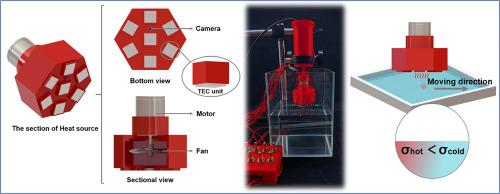
Non-contact driving technology is widely utilized in various fields due to its advantages of being non-contact, wear-free, and low noise. Thermocapillary driving is an effective approach for non-contact driving at gas-liquid interfaces. When a temperature gradient exists at the gas-liquid interface, it generates a surface tension gradient, which drives the movement of micro-objects at the interface. This research proposes a system that utilizes an array of thermoelectric coolers (TECs) as a heat source, which changes the local temperature at the gas-liquid interface and generates surface tension gradients for driving the movement of interface objects. Experimental results demonstrate that foam particles with a diameter of 0.5 mm can achieve a maximum moving speed of 2.1 mm/s. Furthermore, the system can control multiple micro-objects at the gas-liquid interface for self-assembly. We have also developed a miniature biomimetic water strider robot, this system can drive the robot to perform linear and turning movements at the gas-liquid interface. This system provides a novel approach for non-contact driving of gas-liquid interfaces.
期刊介绍:
The aim of the journal is to provide a respectful outlet for ''sound science'' papers in all research areas on surfaces and interfaces. We define sound science papers as papers that describe new and well-executed research, but that do not necessarily provide brand new insights or are merely a description of research results.
Surfaces and Interfaces publishes research papers in all fields of surface science which may not always find the right home on first submission to our Elsevier sister journals (Applied Surface, Surface and Coatings Technology, Thin Solid Films)



 京公网安备 11010802042870号
京ICP备2023020795号-1
京公网安备 11010802042870号
京ICP备2023020795号-1

 分享
分享
 求助内容:
求助内容: 应助结果提醒方式:
 扫码关注我们
