Yongmei Luo , Junqi Li , Chaoyi Chen , Wei Liu , Xiang Yan
{"title":"MnO2-decorated flexible carbon nanofibers with controllable hierarchical porous nanostructures for high energy density supercapacitors","authors":"Yongmei Luo , Junqi Li , Chaoyi Chen , Wei Liu , Xiang Yan","doi":"10.1016/j.surfin.2024.105248","DOIUrl":null,"url":null,"abstract":"<div><div>Constructing hierarchical porous structures and reducing material size enhance the electrochemical efficiency of porous carbon-based electrodes. In this study, ultrafine hierarchical porous carbon-based nanofibers were synthesized via electrospinning a blend of polyacrylonitrile, polymethyl methacrylate (PMMA), and zinc acetate dihydrate (ZAH), followed by pre-oxidation, carbonization, and acid washing. Adjusting the ZAH content allowed precise control of fiber diameters (300–600 nm) and promoted significant hierarchical porous structures, achieving an optimal mesopore to micropore ratio (1.65) and a high specific surface area (SSA) of 599 m²/g. MnO<sub>2</sub> nanosheets were in-situ modified on the carbon nanofibers, forming a hybrid electrode (MnO<sub>2</sub>@HPCNFs) with excellent flexibility, high SSA value, and rich pore structure. This electrode demonstrated a specific capacitance value equal to 1035 F/g at 0.5 A/g and maintained 80.7% capacitance at 10 A/g. The assembled asymmetric supercapacitor achieved an energy density of 54.81 Wh/kg. This study presents new possibilities for binder-free, self-supporting electrodes in electrochemical energy storage devices.</div></div>","PeriodicalId":22081,"journal":{"name":"Surfaces and Interfaces","volume":"55 ","pages":"Article 105248"},"PeriodicalIF":6.3000,"publicationDate":"2024-12-01","publicationTypes":"Journal Article","fieldsOfStudy":null,"isOpenAccess":false,"openAccessPdf":"","citationCount":"0","resultStr":null,"platform":"Semanticscholar","paperid":null,"PeriodicalName":"Surfaces and Interfaces","FirstCategoryId":"88","ListUrlMain":"https://www.sciencedirect.com/science/article/pii/S2468023024014044","RegionNum":2,"RegionCategory":"材料科学","ArticlePicture":[],"TitleCN":null,"AbstractTextCN":null,"PMCID":null,"EPubDate":"2024/10/10 0:00:00","PubModel":"Epub","JCR":"Q2","JCRName":"CHEMISTRY, PHYSICAL","Score":null,"Total":0}
引用次数: 0
Abstract
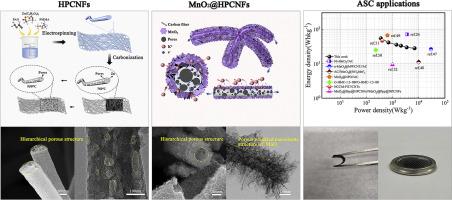
Constructing hierarchical porous structures and reducing material size enhance the electrochemical efficiency of porous carbon-based electrodes. In this study, ultrafine hierarchical porous carbon-based nanofibers were synthesized via electrospinning a blend of polyacrylonitrile, polymethyl methacrylate (PMMA), and zinc acetate dihydrate (ZAH), followed by pre-oxidation, carbonization, and acid washing. Adjusting the ZAH content allowed precise control of fiber diameters (300–600 nm) and promoted significant hierarchical porous structures, achieving an optimal mesopore to micropore ratio (1.65) and a high specific surface area (SSA) of 599 m²/g. MnO2 nanosheets were in-situ modified on the carbon nanofibers, forming a hybrid electrode (MnO2@HPCNFs) with excellent flexibility, high SSA value, and rich pore structure. This electrode demonstrated a specific capacitance value equal to 1035 F/g at 0.5 A/g and maintained 80.7% capacitance at 10 A/g. The assembled asymmetric supercapacitor achieved an energy density of 54.81 Wh/kg. This study presents new possibilities for binder-free, self-supporting electrodes in electrochemical energy storage devices.
期刊介绍:
The aim of the journal is to provide a respectful outlet for ''sound science'' papers in all research areas on surfaces and interfaces. We define sound science papers as papers that describe new and well-executed research, but that do not necessarily provide brand new insights or are merely a description of research results.
Surfaces and Interfaces publishes research papers in all fields of surface science which may not always find the right home on first submission to our Elsevier sister journals (Applied Surface, Surface and Coatings Technology, Thin Solid Films)




 京公网安备 11010802042870号
京ICP备2023020795号-1
京公网安备 11010802042870号
京ICP备2023020795号-1

 分享
分享
 求助内容:
求助内容: 应助结果提醒方式:
 扫码关注我们
