Anna A. Kuznetsova, Vadim V. Yanshole, Mikhail V. Il'in, Alexander S. Novikov, Dmitrii S. Bolotin, Maxim N. Sokolov and Pavel A. Abramov
{"title":"Chalcogen bonds provide supramolecular association of beta-octamolybdate and chalconium cations†","authors":"Anna A. Kuznetsova, Vadim V. Yanshole, Mikhail V. Il'in, Alexander S. Novikov, Dmitrii S. Bolotin, Maxim N. Sokolov and Pavel A. Abramov","doi":"10.1039/D4QI02258K","DOIUrl":null,"url":null,"abstract":"<p >The interactions of triple σ-(Q<small><sup>IV</sup></small>)-hole donating chalconium cations ([Q(bPh)R]<small><sup>+</sup></small>, when Q = S, Se, and Te) with nucleophilic beta-octamolybdate ([β-Mo<small><sub>8</sub></small>O<small><sub>26</sub></small>]<small><sup>4−</sup></small>) result in supramolecular association. The main focus of such assembly is on σ-(Q<small><sup>IV</sup></small>)-hole recognition by the molybdate in cations with a biphenyl aromatic fragment. This leads to a remarkable diversity of the association patterns producing: (i) neutral 4 : 1 {[Q(bPh)R]<small><sub>4</sub></small>[β-Mo<small><sub>8</sub></small>O<small><sub>26</sub></small>]} complexes with cations stacked by π–π interactions; (ii) (Bu<small><sub>4</sub></small>N)<small><sup>+</sup></small>, [Q(bPh)R]<small><sup>+</sup></small> and [β-Mo<small><sub>8</sub></small>O<small><sub>26</sub></small>]<small><sup>4−</sup></small> complexes of 2 : 2 : 1 stoichiometry with π–π interactions; (iii) (Bu<small><sub>4</sub></small>N)<small><sup>+</sup></small>, [Q(bPh)R]<small><sup>+</sup></small> and [β-Mo<small><sub>8</sub></small>O<small><sub>26</sub></small>]<small><sup>4−</sup></small> complexes of a 2 : 2 : 1 stoichiometry without π–π interactions; and (iv) {[Q(bPh)R]<small><sub>2</sub></small>}<small><sub>2</sub></small>[β-Mo<small><sub>8</sub></small>O<small><sub>26</sub></small>] salts with π–π stacked cations but lacking any (Q<small><sup>IV</sup></small>)⋯O interactions. Moreover, interactions in the system can drive the reorganization of [β-Mo<small><sub>8</sub></small>O<small><sub>26</sub></small>]<small><sup>4−</sup></small> into [α-Mo<small><sub>8</sub></small>O<small><sub>26</sub></small>]<small><sup>4−</sup></small>. The halogen-bonded (Q<small><sup>IV</sup></small>)⋯O {(Q(bPh)R)<small><sub><em>x</em></sub></small>[β-Mo<small><sub>8</sub></small>O<small><sub>26</sub></small>]<small><sup>4−</sup></small>} (<em>x</em> = 2 and 4) assemblies, π–π stacked cationic dimers {(Q(bPh)R)<small><sub>2</sub></small>}<small><sup>2+</sup></small> and complicated associates based on both types of interactions have been the subjects of crystallographic and computational studies.</p>","PeriodicalId":79,"journal":{"name":"Inorganic Chemistry Frontiers","volume":" 24","pages":" 8902-8915"},"PeriodicalIF":6.4000,"publicationDate":"2024-10-29","publicationTypes":"Journal Article","fieldsOfStudy":null,"isOpenAccess":false,"openAccessPdf":"","citationCount":"0","resultStr":null,"platform":"Semanticscholar","paperid":null,"PeriodicalName":"Inorganic Chemistry Frontiers","FirstCategoryId":"92","ListUrlMain":"https://pubs.rsc.org/en/content/articlelanding/2024/qi/d4qi02258k","RegionNum":1,"RegionCategory":"化学","ArticlePicture":[],"TitleCN":null,"AbstractTextCN":null,"PMCID":null,"EPubDate":"","PubModel":"","JCR":"Q1","JCRName":"CHEMISTRY, INORGANIC & NUCLEAR","Score":null,"Total":0}
引用次数: 0
Abstract
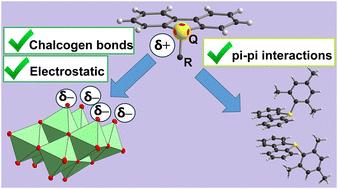
The interactions of triple σ-(QIV)-hole donating chalconium cations ([Q(bPh)R]+, when Q = S, Se, and Te) with nucleophilic beta-octamolybdate ([β-Mo8O26]4−) result in supramolecular association. The main focus of such assembly is on σ-(QIV)-hole recognition by the molybdate in cations with a biphenyl aromatic fragment. This leads to a remarkable diversity of the association patterns producing: (i) neutral 4 : 1 {[Q(bPh)R]4[β-Mo8O26]} complexes with cations stacked by π–π interactions; (ii) (Bu4N)+, [Q(bPh)R]+ and [β-Mo8O26]4− complexes of 2 : 2 : 1 stoichiometry with π–π interactions; (iii) (Bu4N)+, [Q(bPh)R]+ and [β-Mo8O26]4− complexes of a 2 : 2 : 1 stoichiometry without π–π interactions; and (iv) {[Q(bPh)R]2}2[β-Mo8O26] salts with π–π stacked cations but lacking any (QIV)⋯O interactions. Moreover, interactions in the system can drive the reorganization of [β-Mo8O26]4− into [α-Mo8O26]4−. The halogen-bonded (QIV)⋯O {(Q(bPh)R)x[β-Mo8O26]4−} (x = 2 and 4) assemblies, π–π stacked cationic dimers {(Q(bPh)R)2}2+ and complicated associates based on both types of interactions have been the subjects of crystallographic and computational studies.



 京公网安备 11010802042870号
京ICP备2023020795号-1
京公网安备 11010802042870号
京ICP备2023020795号-1

 分享
分享
 求助内容:
求助内容: 应助结果提醒方式:
 扫码关注我们
