Deepti Tewari, Arturo Gutierrez, Jason Croy, Venkat Srinivasan
{"title":"Designing Particle Morphologies for Materials with Solid Transport Limitations: A Case Study of Lithium and Manganese Rich Cathode Oxides","authors":"Deepti Tewari, Arturo Gutierrez, Jason Croy, Venkat Srinivasan","doi":"10.1021/acs.chemmater.3c02411","DOIUrl":null,"url":null,"abstract":"A lithium and manganese rich nickel–manganese–cobalt oxide (LMR-NMC) cathode is a promising candidate for next-generation batteries due to its high specific capacity, low cost, and low cobalt content. However, the material suffers from poor rate capability due to the diffusion limitations of lithium in the cathode particles. Understanding the material performance requires careful control of the morphology of the cathode particles, taking into account the primary and agglomerated diffusion pathways and the presence of pores, some of which could be closed from electrolyte infiltration. In this study, we use a microstructure-based mathematical model combined with experimental data to understand the role of the complex cathode particle morphology in the rate performance of the material. Scanning electron microscopy images of cathodes made under different synthesis conditions, which results in different agglomerate morphologies, serve as the input into the mathematical model. The model is then compared to rate data to understand the controlling parameters. The presence of intra-agglomerate closed pores results in a large agglomerate diffusion length in comparison to the ideal condition, where the primary particles are agglomerated in an open and dispersed manner such that the entire interfacial area is available for electrochemical reaction. Smaller primary and agglomerate diffusion lengths result in better electrochemical performance. This points us toward designing the morphology of the cathode particles to compensate for the diffusion limitation of LMR-NMC while maximizing the density.","PeriodicalId":33,"journal":{"name":"Chemistry of Materials","volume":"18 1","pages":""},"PeriodicalIF":7.0000,"publicationDate":"2024-10-29","publicationTypes":"Journal Article","fieldsOfStudy":null,"isOpenAccess":false,"openAccessPdf":"","citationCount":"0","resultStr":null,"platform":"Semanticscholar","paperid":null,"PeriodicalName":"Chemistry of Materials","FirstCategoryId":"88","ListUrlMain":"https://doi.org/10.1021/acs.chemmater.3c02411","RegionNum":2,"RegionCategory":"材料科学","ArticlePicture":[],"TitleCN":null,"AbstractTextCN":null,"PMCID":null,"EPubDate":"","PubModel":"","JCR":"Q2","JCRName":"CHEMISTRY, PHYSICAL","Score":null,"Total":0}
引用次数: 0
Abstract
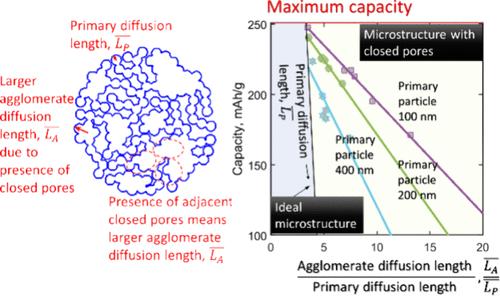
A lithium and manganese rich nickel–manganese–cobalt oxide (LMR-NMC) cathode is a promising candidate for next-generation batteries due to its high specific capacity, low cost, and low cobalt content. However, the material suffers from poor rate capability due to the diffusion limitations of lithium in the cathode particles. Understanding the material performance requires careful control of the morphology of the cathode particles, taking into account the primary and agglomerated diffusion pathways and the presence of pores, some of which could be closed from electrolyte infiltration. In this study, we use a microstructure-based mathematical model combined with experimental data to understand the role of the complex cathode particle morphology in the rate performance of the material. Scanning electron microscopy images of cathodes made under different synthesis conditions, which results in different agglomerate morphologies, serve as the input into the mathematical model. The model is then compared to rate data to understand the controlling parameters. The presence of intra-agglomerate closed pores results in a large agglomerate diffusion length in comparison to the ideal condition, where the primary particles are agglomerated in an open and dispersed manner such that the entire interfacial area is available for electrochemical reaction. Smaller primary and agglomerate diffusion lengths result in better electrochemical performance. This points us toward designing the morphology of the cathode particles to compensate for the diffusion limitation of LMR-NMC while maximizing the density.
期刊介绍:
The journal Chemistry of Materials focuses on publishing original research at the intersection of materials science and chemistry. The studies published in the journal involve chemistry as a prominent component and explore topics such as the design, synthesis, characterization, processing, understanding, and application of functional or potentially functional materials. The journal covers various areas of interest, including inorganic and organic solid-state chemistry, nanomaterials, biomaterials, thin films and polymers, and composite/hybrid materials. The journal particularly seeks papers that highlight the creation or development of innovative materials with novel optical, electrical, magnetic, catalytic, or mechanical properties. It is essential that manuscripts on these topics have a primary focus on the chemistry of materials and represent a significant advancement compared to prior research. Before external reviews are sought, submitted manuscripts undergo a review process by a minimum of two editors to ensure their appropriateness for the journal and the presence of sufficient evidence of a significant advance that will be of broad interest to the materials chemistry community.



 京公网安备 11010802042870号
京ICP备2023020795号-1
京公网安备 11010802042870号
京ICP备2023020795号-1

 分享
分享
 求助内容:
求助内容: 应助结果提醒方式:
 扫码关注我们
