{"title":"Adsorption Kinetics Studies for Groundwater Remediation: A Study on Environmental and Economic Sustainability","authors":"Amir Detho, Aeslina Abdul Kadir, Asif Ali Memon","doi":"10.1007/s11270-024-07595-3","DOIUrl":null,"url":null,"abstract":"<div><p>This study investigates the potential of neem seed waste as an adsorbent for reducing total dissolved solids (TDS), hardness, calcium, and magnesium concentration in groundwater. Groundwater samples were collected from various locations within Quaid-e-Awam University of Engineering, Science and Technology (QUEST) and Nawabshah city. The objective of this research is to optimize the use of neem seed powder for removal of TDS, hardness, calcium, and magnesium concentration and physicochemical parameters from groundwater samples. Different dosages (0.5, 1.0 1.5, 2.0, 2.5, 5.0, and 10.0 g) and retention speed (0, 50, 100, 125, 150, 175, 200) were tested to optimize the treatment process. At a neem seed powder dosage of 2.0 g, a notable reduction in TDS was observed, with values of 48% for S1, 45% for S2, 52% for S3, and 58% for S4, respectively. Additionally, under a retention speed of 150 rpm, a significant decrease in TDS concentrations was recorded, with reductions of 72%, 65%, 79%, and 62% for S1, S2, S3, and S4, respectively. These results underscore the adsorbent's efficiency. Characterization techniques such as FESEM and FTIR were employed to understand the adsorption mechanism. The neem seed powder exhibited a considerable surface area of 55.30 m<sup>2</sup>/g according to BET analysis. Kinetic adsorption analysis showed a good fit with the pseudo-second-order (PSO) model with R<sup>2</sup> values 0.9978, 0.9946, 0.9967, and 0.9954 for TDS, Hardness, Calcium, and Magnesium. A higher R-squared value indicates that the PSO model aligns more closely with the data compared to the pseudo-first-order (PFO) model. The adsorbent molecules undergo a chemical reaction between surface molecules and adsorbate. This indicates chemisorption of adsorbs molecule. The study concludes that neem seed powder is a viable option for TDS removal due to its cost-effectiveness and availability compared to other materials like sodium zeolite and kaolin. Future research could explore the applicability of neem seed powder for removing other contaminants in groundwater or provides valuable insights into utilizing agricultural waste for groundwater treatment, offering a sustainable solution to water quality challenges.</p></div>","PeriodicalId":808,"journal":{"name":"Water, Air, & Soil Pollution","volume":"235 12","pages":""},"PeriodicalIF":3.0000,"publicationDate":"2024-10-30","publicationTypes":"Journal Article","fieldsOfStudy":null,"isOpenAccess":false,"openAccessPdf":"","citationCount":"0","resultStr":null,"platform":"Semanticscholar","paperid":null,"PeriodicalName":"Water, Air, & Soil Pollution","FirstCategoryId":"6","ListUrlMain":"https://link.springer.com/article/10.1007/s11270-024-07595-3","RegionNum":4,"RegionCategory":"环境科学与生态学","ArticlePicture":[],"TitleCN":null,"AbstractTextCN":null,"PMCID":null,"EPubDate":"","PubModel":"","JCR":"Q2","JCRName":"ENVIRONMENTAL SCIENCES","Score":null,"Total":0}
引用次数: 0
Abstract
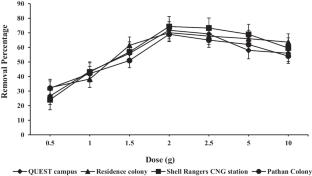
This study investigates the potential of neem seed waste as an adsorbent for reducing total dissolved solids (TDS), hardness, calcium, and magnesium concentration in groundwater. Groundwater samples were collected from various locations within Quaid-e-Awam University of Engineering, Science and Technology (QUEST) and Nawabshah city. The objective of this research is to optimize the use of neem seed powder for removal of TDS, hardness, calcium, and magnesium concentration and physicochemical parameters from groundwater samples. Different dosages (0.5, 1.0 1.5, 2.0, 2.5, 5.0, and 10.0 g) and retention speed (0, 50, 100, 125, 150, 175, 200) were tested to optimize the treatment process. At a neem seed powder dosage of 2.0 g, a notable reduction in TDS was observed, with values of 48% for S1, 45% for S2, 52% for S3, and 58% for S4, respectively. Additionally, under a retention speed of 150 rpm, a significant decrease in TDS concentrations was recorded, with reductions of 72%, 65%, 79%, and 62% for S1, S2, S3, and S4, respectively. These results underscore the adsorbent's efficiency. Characterization techniques such as FESEM and FTIR were employed to understand the adsorption mechanism. The neem seed powder exhibited a considerable surface area of 55.30 m2/g according to BET analysis. Kinetic adsorption analysis showed a good fit with the pseudo-second-order (PSO) model with R2 values 0.9978, 0.9946, 0.9967, and 0.9954 for TDS, Hardness, Calcium, and Magnesium. A higher R-squared value indicates that the PSO model aligns more closely with the data compared to the pseudo-first-order (PFO) model. The adsorbent molecules undergo a chemical reaction between surface molecules and adsorbate. This indicates chemisorption of adsorbs molecule. The study concludes that neem seed powder is a viable option for TDS removal due to its cost-effectiveness and availability compared to other materials like sodium zeolite and kaolin. Future research could explore the applicability of neem seed powder for removing other contaminants in groundwater or provides valuable insights into utilizing agricultural waste for groundwater treatment, offering a sustainable solution to water quality challenges.
期刊介绍:
Water, Air, & Soil Pollution is an international, interdisciplinary journal on all aspects of pollution and solutions to pollution in the biosphere. This includes chemical, physical and biological processes affecting flora, fauna, water, air and soil in relation to environmental pollution. Because of its scope, the subject areas are diverse and include all aspects of pollution sources, transport, deposition, accumulation, acid precipitation, atmospheric pollution, metals, aquatic pollution including marine pollution and ground water, waste water, pesticides, soil pollution, sewage, sediment pollution, forestry pollution, effects of pollutants on humans, vegetation, fish, aquatic species, micro-organisms, and animals, environmental and molecular toxicology applied to pollution research, biosensors, global and climate change, ecological implications of pollution and pollution models. Water, Air, & Soil Pollution also publishes manuscripts on novel methods used in the study of environmental pollutants, environmental toxicology, environmental biology, novel environmental engineering related to pollution, biodiversity as influenced by pollution, novel environmental biotechnology as applied to pollution (e.g. bioremediation), environmental modelling and biorestoration of polluted environments.
Articles should not be submitted that are of local interest only and do not advance international knowledge in environmental pollution and solutions to pollution. Articles that simply replicate known knowledge or techniques while researching a local pollution problem will normally be rejected without review. Submitted articles must have up-to-date references, employ the correct experimental replication and statistical analysis, where needed and contain a significant contribution to new knowledge. The publishing and editorial team sincerely appreciate your cooperation.
Water, Air, & Soil Pollution publishes research papers; review articles; mini-reviews; and book reviews.



 京公网安备 11010802042870号
京ICP备2023020795号-1
京公网安备 11010802042870号
京ICP备2023020795号-1

 分享
分享
 求助内容:
求助内容: 应助结果提醒方式:
 扫码关注我们
