Guang Yang, Katie Browning, Harry M Meyer, III, Yuanshun Li, Nathan R. Neale, Gabriel M. Veith, Jagjit Nanda
{"title":"Mitigating Calendar Aging in Si-NMC Batteries with Advanced Dual-Salt Glyme Electrolytes","authors":"Guang Yang, Katie Browning, Harry M Meyer, III, Yuanshun Li, Nathan R. Neale, Gabriel M. Veith, Jagjit Nanda","doi":"10.1021/acs.chemmater.4c00971","DOIUrl":null,"url":null,"abstract":"In addressing the critical challenge of calendar aging in silicon (Si)-based lithium-ion batteries, this study introduces a groundbreaking strategy utilizing glyme-type dual-salt electrolytes (lithium bis(trifluoromethanesulfonyl)imide [LiTFSI] and lithium difluoro(oxalato)borate [LiDFOB]). These electrolytes are demonstrated to significantly mitigate parasitic reactions and capacity loss in Si-NMC (lithium nickel manganese cobalt oxide) full cells, especially when compared with traditional carbonate-based electrolytes. Our exhaustive mechanistic analysis reveals that such electrolytes not only preserve the integrity of the Si anode but also improve the cathode/electrolyte interphases (CEI) through the formation of a conformal coating on the high-voltage cathode surface. This dual-salt approach, enhanced by the addition of a phosphate additive, effectively decelerates calendar aging, marking a substantial advance in the quest for durable and reliable Si-based energy storage technologies. The findings underscore the vital role of electrolyte composition in extending the calendar life of Si batteries, offering an alternative avenue toward maximizing the performance and longevity of next-generation Li–Si batteries.","PeriodicalId":33,"journal":{"name":"Chemistry of Materials","volume":"124 1","pages":""},"PeriodicalIF":7.1000,"publicationDate":"2024-10-29","publicationTypes":"Journal Article","fieldsOfStudy":null,"isOpenAccess":false,"openAccessPdf":"","citationCount":"0","resultStr":null,"platform":"Semanticscholar","paperid":null,"PeriodicalName":"Chemistry of Materials","FirstCategoryId":"88","ListUrlMain":"https://doi.org/10.1021/acs.chemmater.4c00971","RegionNum":2,"RegionCategory":"材料科学","ArticlePicture":[],"TitleCN":null,"AbstractTextCN":null,"PMCID":null,"EPubDate":"","PubModel":"","JCR":"Q2","JCRName":"CHEMISTRY, PHYSICAL","Score":null,"Total":0}
引用次数: 0
Abstract
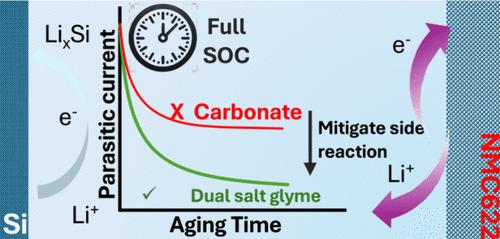
In addressing the critical challenge of calendar aging in silicon (Si)-based lithium-ion batteries, this study introduces a groundbreaking strategy utilizing glyme-type dual-salt electrolytes (lithium bis(trifluoromethanesulfonyl)imide [LiTFSI] and lithium difluoro(oxalato)borate [LiDFOB]). These electrolytes are demonstrated to significantly mitigate parasitic reactions and capacity loss in Si-NMC (lithium nickel manganese cobalt oxide) full cells, especially when compared with traditional carbonate-based electrolytes. Our exhaustive mechanistic analysis reveals that such electrolytes not only preserve the integrity of the Si anode but also improve the cathode/electrolyte interphases (CEI) through the formation of a conformal coating on the high-voltage cathode surface. This dual-salt approach, enhanced by the addition of a phosphate additive, effectively decelerates calendar aging, marking a substantial advance in the quest for durable and reliable Si-based energy storage technologies. The findings underscore the vital role of electrolyte composition in extending the calendar life of Si batteries, offering an alternative avenue toward maximizing the performance and longevity of next-generation Li–Si batteries.
期刊介绍:
The journal Chemistry of Materials focuses on publishing original research at the intersection of materials science and chemistry. The studies published in the journal involve chemistry as a prominent component and explore topics such as the design, synthesis, characterization, processing, understanding, and application of functional or potentially functional materials. The journal covers various areas of interest, including inorganic and organic solid-state chemistry, nanomaterials, biomaterials, thin films and polymers, and composite/hybrid materials. The journal particularly seeks papers that highlight the creation or development of innovative materials with novel optical, electrical, magnetic, catalytic, or mechanical properties. It is essential that manuscripts on these topics have a primary focus on the chemistry of materials and represent a significant advancement compared to prior research. Before external reviews are sought, submitted manuscripts undergo a review process by a minimum of two editors to ensure their appropriateness for the journal and the presence of sufficient evidence of a significant advance that will be of broad interest to the materials chemistry community.




 京公网安备 11010802042870号
京ICP备2023020795号-1
京公网安备 11010802042870号
京ICP备2023020795号-1

 分享
分享
 求助内容:
求助内容: 应助结果提醒方式:
 扫码关注我们
