S. Dinesh Kumar, Jin Kyeong Lee, Naveen Kumar Radhakrishnan, Jeong Kyu Bang, Byeongkwon Kim, Shubhash Chandra Chaudhary, Ajish Chelladurai, Byambasuren Ganbaatar, Eun Young Kim, Chul Won Lee, Sungtae Yang, Yangmee Kim, Song Yub Shin
{"title":"Antibacterial, Antibiofilm, and Anti-inflammatory Effects of a Novel Thrombin-Derived Peptide in Sepsis Models: Insights into Underlying Mechanisms","authors":"S. Dinesh Kumar, Jin Kyeong Lee, Naveen Kumar Radhakrishnan, Jeong Kyu Bang, Byeongkwon Kim, Shubhash Chandra Chaudhary, Ajish Chelladurai, Byambasuren Ganbaatar, Eun Young Kim, Chul Won Lee, Sungtae Yang, Yangmee Kim, Song Yub Shin","doi":"10.1021/acs.jmedchem.4c02157","DOIUrl":null,"url":null,"abstract":"We developed two short helical antimicrobial peptides, HVF18-a3 and its <span>d</span>-enantiomer, HVF18-a3-d, derived from the thrombin C-terminal peptide HVF18. These peptides exhibit potent antimicrobial activity against various bacteria by compromising both the outer and inner membranes, with low hemolytic activity. They are stable in the presence of physiological salts and human serum, exhibiting a low potential for developing drug resistance and excellent antibiofilm activity against Gram-negative bacteria. HVF18-a3-d also neutralized lipopolysaccharide (LPS) through direct binding interactions and suppressed the production of inflammatory cytokines through the inflammatory signaling pathway mediated by Toll-like receptor 4 in RAW264.7 cells stimulated with LPS. Both pre- and post-treatment with HVF18-a3-d significantly protected mice against fatal septic shock induced by carbapenem resistant <i>Acinetobacter baumannii</i>. These findings suggest HVF18-a3 and HVF18-a3-d are promising candidates for developing antibiotics against Gram-negative sepsis.","PeriodicalId":46,"journal":{"name":"Journal of Medicinal Chemistry","volume":"66 1","pages":""},"PeriodicalIF":6.8000,"publicationDate":"2024-10-30","publicationTypes":"Journal Article","fieldsOfStudy":null,"isOpenAccess":false,"openAccessPdf":"","citationCount":"0","resultStr":null,"platform":"Semanticscholar","paperid":null,"PeriodicalName":"Journal of Medicinal Chemistry","FirstCategoryId":"3","ListUrlMain":"https://doi.org/10.1021/acs.jmedchem.4c02157","RegionNum":1,"RegionCategory":"医学","ArticlePicture":[],"TitleCN":null,"AbstractTextCN":null,"PMCID":null,"EPubDate":"","PubModel":"","JCR":"Q1","JCRName":"CHEMISTRY, MEDICINAL","Score":null,"Total":0}
引用次数: 0
Abstract
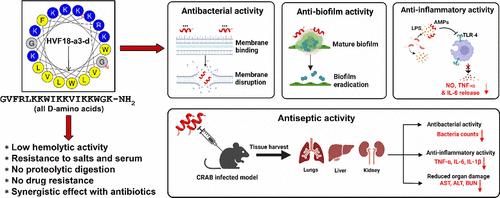
We developed two short helical antimicrobial peptides, HVF18-a3 and its d-enantiomer, HVF18-a3-d, derived from the thrombin C-terminal peptide HVF18. These peptides exhibit potent antimicrobial activity against various bacteria by compromising both the outer and inner membranes, with low hemolytic activity. They are stable in the presence of physiological salts and human serum, exhibiting a low potential for developing drug resistance and excellent antibiofilm activity against Gram-negative bacteria. HVF18-a3-d also neutralized lipopolysaccharide (LPS) through direct binding interactions and suppressed the production of inflammatory cytokines through the inflammatory signaling pathway mediated by Toll-like receptor 4 in RAW264.7 cells stimulated with LPS. Both pre- and post-treatment with HVF18-a3-d significantly protected mice against fatal septic shock induced by carbapenem resistant Acinetobacter baumannii. These findings suggest HVF18-a3 and HVF18-a3-d are promising candidates for developing antibiotics against Gram-negative sepsis.
期刊介绍:
The Journal of Medicinal Chemistry is a prestigious biweekly peer-reviewed publication that focuses on the multifaceted field of medicinal chemistry. Since its inception in 1959 as the Journal of Medicinal and Pharmaceutical Chemistry, it has evolved to become a cornerstone in the dissemination of research findings related to the design, synthesis, and development of therapeutic agents.
The Journal of Medicinal Chemistry is recognized for its significant impact in the scientific community, as evidenced by its 2022 impact factor of 7.3. This metric reflects the journal's influence and the importance of its content in shaping the future of drug discovery and development. The journal serves as a vital resource for chemists, pharmacologists, and other researchers interested in the molecular mechanisms of drug action and the optimization of therapeutic compounds.




 京公网安备 11010802042870号
京ICP备2023020795号-1
京公网安备 11010802042870号
京ICP备2023020795号-1

 分享
分享
 求助内容:
求助内容: 应助结果提醒方式:
 扫码关注我们
