{"title":"DBPR116, a Prodrug of BPRMU191, in Combination with Naltrexone as a Safer Opioid Analgesic Than Morphine via Peripheral Administration","authors":"Shu-Yu Lin, Yung-Chiao Chang, Ya-Wen Tien, Yu-Hsien Kuo, Hsiao-Fu Chang, Li-Chin Ou, Ya-Ping Chen, Kuei-Hua Chang, Ying-Ting Hsu, Yu-Chen Huang, Chen-Ming Yang, Ping-Yee Law, Jing-Hua Xi, Pao-Luh Tao, Horace H. Loh, Teng-Kuang Yeh, Hong Zhuang, Hsing-Pang Hsieh, Chuan Shih, Chiung-Tong Chen, Shiu-Hwa Yeh, Shau-Hua Ueng","doi":"10.1021/acs.jmedchem.4c02107","DOIUrl":null,"url":null,"abstract":"The development of opioid analgesics with reduced adverse effects is an unmet need. In a previous study, we discovered a unique combination of BPRMU191 and morphinan antagonists that produced potent antinociception with reduced adverse effects after central administration (intrathecal or intracerebroventricular). BPRMU191/naltrexone exhibits notable <i>in vitro</i> and <i>in vivo</i> pharmacological properties. However, the poor blood–brain barrier penetrative ability of BPRMU191 restricts its clinical application. In this study, we utilized a prodrug strategy to deliver sufficient brain concentrations of BPRMU191 and selected compound <b>2</b> (DBPR116) with the best physicochemical and pharmacological properties among other <i>in vivo</i> active prodrugs. The <i>in vivo</i> pharmacological studies of compound <b>2</b>/naltrexone, including thermally stimulated pain, cancer pain, constipation, sedation, psychological dependence, heart rate, and respiratory frequency measurements, demonstrated that it was a safer opioid analgesic than morphine in pain control.","PeriodicalId":46,"journal":{"name":"Journal of Medicinal Chemistry","volume":"44 1","pages":""},"PeriodicalIF":6.8000,"publicationDate":"2024-10-29","publicationTypes":"Journal Article","fieldsOfStudy":null,"isOpenAccess":false,"openAccessPdf":"","citationCount":"0","resultStr":null,"platform":"Semanticscholar","paperid":null,"PeriodicalName":"Journal of Medicinal Chemistry","FirstCategoryId":"3","ListUrlMain":"https://doi.org/10.1021/acs.jmedchem.4c02107","RegionNum":1,"RegionCategory":"医学","ArticlePicture":[],"TitleCN":null,"AbstractTextCN":null,"PMCID":null,"EPubDate":"","PubModel":"","JCR":"Q1","JCRName":"CHEMISTRY, MEDICINAL","Score":null,"Total":0}
引用次数: 0
Abstract
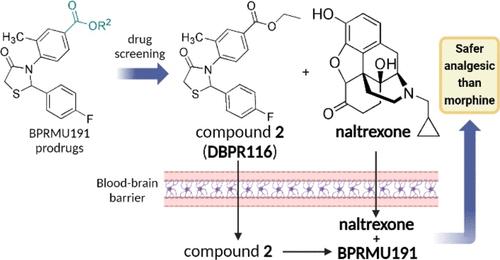
The development of opioid analgesics with reduced adverse effects is an unmet need. In a previous study, we discovered a unique combination of BPRMU191 and morphinan antagonists that produced potent antinociception with reduced adverse effects after central administration (intrathecal or intracerebroventricular). BPRMU191/naltrexone exhibits notable in vitro and in vivo pharmacological properties. However, the poor blood–brain barrier penetrative ability of BPRMU191 restricts its clinical application. In this study, we utilized a prodrug strategy to deliver sufficient brain concentrations of BPRMU191 and selected compound 2 (DBPR116) with the best physicochemical and pharmacological properties among other in vivo active prodrugs. The in vivo pharmacological studies of compound 2/naltrexone, including thermally stimulated pain, cancer pain, constipation, sedation, psychological dependence, heart rate, and respiratory frequency measurements, demonstrated that it was a safer opioid analgesic than morphine in pain control.
期刊介绍:
The Journal of Medicinal Chemistry is a prestigious biweekly peer-reviewed publication that focuses on the multifaceted field of medicinal chemistry. Since its inception in 1959 as the Journal of Medicinal and Pharmaceutical Chemistry, it has evolved to become a cornerstone in the dissemination of research findings related to the design, synthesis, and development of therapeutic agents.
The Journal of Medicinal Chemistry is recognized for its significant impact in the scientific community, as evidenced by its 2022 impact factor of 7.3. This metric reflects the journal's influence and the importance of its content in shaping the future of drug discovery and development. The journal serves as a vital resource for chemists, pharmacologists, and other researchers interested in the molecular mechanisms of drug action and the optimization of therapeutic compounds.



 京公网安备 11010802042870号
京ICP备2023020795号-1
京公网安备 11010802042870号
京ICP备2023020795号-1

 分享
分享
 求助内容:
求助内容: 应助结果提醒方式:
 扫码关注我们
