Xiangdi Zeng, Zi Wang, Meng He, Wanpeng Lu, Wenyuan Huang, Bing An, Jiangnan Li, Mufan Li, Ben F. Spencer, Sarah J. Day, Floriana Tuna, Eric J. L. McInnes, Martin Schröder and Sihai Yang
{"title":"A novel cerium-based metal–organic framework supported Pd catalyst for semi-hydrogenation of phenylacetylene†","authors":"Xiangdi Zeng, Zi Wang, Meng He, Wanpeng Lu, Wenyuan Huang, Bing An, Jiangnan Li, Mufan Li, Ben F. Spencer, Sarah J. Day, Floriana Tuna, Eric J. L. McInnes, Martin Schröder and Sihai Yang","doi":"10.1039/D4QI02225D","DOIUrl":null,"url":null,"abstract":"<p >Phenylacetylene is a detrimental impurity in the polymerisation of styrene, capable of poisoning catalysts even at ppm levels and significantly degrading the quality of polystyrene. The semi-hydrogenation of phenylacetylene to styrene instead of ethylbenzene is, therefore, an important industrial process. We report a novel cerium(<small>IV</small>)-based metal–organic framework (denoted as Ce-bptc), which comprises {Ce<small><sub>6</sub></small>} clusters bridged by biphenyl-3,3′,5,5′-tetracarboxylate linkers. Ce-bptc serves as an ideal support for palladium nanoparticles and the Pd@Ce-bptc catalyst demonstrates excellent catalytic performance for semi-hydrogenation of phenylacetylene, achieving a selectivity of 93% towards styrene on full conversion under ambient conditions with excellent reusability. <em>In situ</em> synchrotron X-ray powder diffraction and electron paramagnetic resonance spectroscopy reveal the binding domains of phenylacetylene within Ce-bptc, and details of the reaction mechanism are discussed.</p>","PeriodicalId":79,"journal":{"name":"Inorganic Chemistry Frontiers","volume":" 1","pages":" 138-143"},"PeriodicalIF":6.4000,"publicationDate":"2024-10-31","publicationTypes":"Journal Article","fieldsOfStudy":null,"isOpenAccess":false,"openAccessPdf":"https://pubs.rsc.org/en/content/articlepdf/2025/qi/d4qi02225d?page=search","citationCount":"0","resultStr":null,"platform":"Semanticscholar","paperid":null,"PeriodicalName":"Inorganic Chemistry Frontiers","FirstCategoryId":"92","ListUrlMain":"https://pubs.rsc.org/en/content/articlelanding/2025/qi/d4qi02225d","RegionNum":1,"RegionCategory":"化学","ArticlePicture":[],"TitleCN":null,"AbstractTextCN":null,"PMCID":null,"EPubDate":"","PubModel":"","JCR":"Q1","JCRName":"CHEMISTRY, INORGANIC & NUCLEAR","Score":null,"Total":0}
引用次数: 0
Abstract
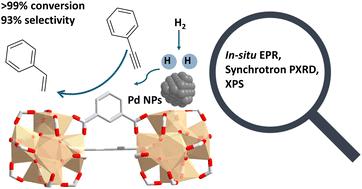
Phenylacetylene is a detrimental impurity in the polymerisation of styrene, capable of poisoning catalysts even at ppm levels and significantly degrading the quality of polystyrene. The semi-hydrogenation of phenylacetylene to styrene instead of ethylbenzene is, therefore, an important industrial process. We report a novel cerium(IV)-based metal–organic framework (denoted as Ce-bptc), which comprises {Ce6} clusters bridged by biphenyl-3,3′,5,5′-tetracarboxylate linkers. Ce-bptc serves as an ideal support for palladium nanoparticles and the Pd@Ce-bptc catalyst demonstrates excellent catalytic performance for semi-hydrogenation of phenylacetylene, achieving a selectivity of 93% towards styrene on full conversion under ambient conditions with excellent reusability. In situ synchrotron X-ray powder diffraction and electron paramagnetic resonance spectroscopy reveal the binding domains of phenylacetylene within Ce-bptc, and details of the reaction mechanism are discussed.




 京公网安备 11010802042870号
京ICP备2023020795号-1
京公网安备 11010802042870号
京ICP备2023020795号-1

 分享
分享
 求助内容:
求助内容: 应助结果提醒方式:
 扫码关注我们
