Angelo Aguilar, Jiuling Yang, Yangbing Li, Donna McEachern, Liyue Huang, Stevenchoukry Razzouk, Shaomeng Wang
{"title":"Discovery of MD-265: A Potent MDM2 Degrader That Achieves Complete Tumor Regression and Improves Long-Term Survival of Mice with Leukemia.","authors":"Angelo Aguilar, Jiuling Yang, Yangbing Li, Donna McEachern, Liyue Huang, Stevenchoukry Razzouk, Shaomeng Wang","doi":"10.1021/acs.jmedchem.4c01818","DOIUrl":null,"url":null,"abstract":"<p><p>MDM2 has been pursued as an attractive therapeutic target for human cancers. Herein, we describe our discovery of MD-265 as a promising PROTAC MDM2 degrader and extensive <i>in vitro</i> and <i>in vivo</i> evaluations of its therapeutic potential and mechanism of action. MD-265 effectively depleted MDM2 protein in cancer cells at concentrations as low as 1 nM, leading to strong activation of p53 in cancer cells carrying wild-type p53. It selectively inhibited the growth of wild-type p53 leukemia cell lines and showed no activity in mutated p53 lines. MD-265 achieved persistent tumor regression in a leukemia xenograft model without causing any signs of toxicity and dramatically improved survival of mice in a disseminated leukemia model even with a weekly administration. MD-265 displayed an excellent intravenous PK profile in mice, rats, and dogs. MD-265 is a promising MDM2 degrader for advanced preclinical development for the treatment of human cancers.</p>","PeriodicalId":46,"journal":{"name":"Journal of Medicinal Chemistry","volume":" ","pages":"19503-19518"},"PeriodicalIF":6.8000,"publicationDate":"2024-11-14","publicationTypes":"Journal Article","fieldsOfStudy":null,"isOpenAccess":false,"openAccessPdf":"https://www.ncbi.nlm.nih.gov/pmc/articles/PMC12077404/pdf/","citationCount":"0","resultStr":null,"platform":"Semanticscholar","paperid":null,"PeriodicalName":"Journal of Medicinal Chemistry","FirstCategoryId":"3","ListUrlMain":"https://doi.org/10.1021/acs.jmedchem.4c01818","RegionNum":1,"RegionCategory":"医学","ArticlePicture":[],"TitleCN":null,"AbstractTextCN":null,"PMCID":null,"EPubDate":"2024/10/31 0:00:00","PubModel":"Epub","JCR":"Q1","JCRName":"CHEMISTRY, MEDICINAL","Score":null,"Total":0}
引用次数: 0
Abstract
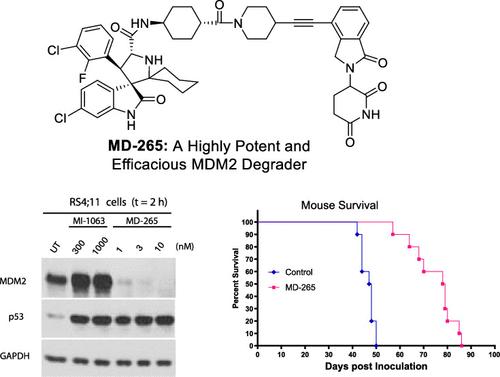
MDM2 has been pursued as an attractive therapeutic target for human cancers. Herein, we describe our discovery of MD-265 as a promising PROTAC MDM2 degrader and extensive in vitro and in vivo evaluations of its therapeutic potential and mechanism of action. MD-265 effectively depleted MDM2 protein in cancer cells at concentrations as low as 1 nM, leading to strong activation of p53 in cancer cells carrying wild-type p53. It selectively inhibited the growth of wild-type p53 leukemia cell lines and showed no activity in mutated p53 lines. MD-265 achieved persistent tumor regression in a leukemia xenograft model without causing any signs of toxicity and dramatically improved survival of mice in a disseminated leukemia model even with a weekly administration. MD-265 displayed an excellent intravenous PK profile in mice, rats, and dogs. MD-265 is a promising MDM2 degrader for advanced preclinical development for the treatment of human cancers.
期刊介绍:
The Journal of Medicinal Chemistry is a prestigious biweekly peer-reviewed publication that focuses on the multifaceted field of medicinal chemistry. Since its inception in 1959 as the Journal of Medicinal and Pharmaceutical Chemistry, it has evolved to become a cornerstone in the dissemination of research findings related to the design, synthesis, and development of therapeutic agents.
The Journal of Medicinal Chemistry is recognized for its significant impact in the scientific community, as evidenced by its 2022 impact factor of 7.3. This metric reflects the journal's influence and the importance of its content in shaping the future of drug discovery and development. The journal serves as a vital resource for chemists, pharmacologists, and other researchers interested in the molecular mechanisms of drug action and the optimization of therapeutic compounds.



 京公网安备 11010802042870号
京ICP备2023020795号-1
京公网安备 11010802042870号
京ICP备2023020795号-1

 分享
分享
 求助内容:
求助内容: 应助结果提醒方式:
 扫码关注我们
