Sohyun Woo, Tae-Min Kim, Yousuk Kim, Seorin Jeong, Eunsuk Kim
{"title":"Inter- and Intraspecific Competition in Invasive Lactuca serriola and Co-Occurring Weedy Plant Species","authors":"Sohyun Woo, Tae-Min Kim, Yousuk Kim, Seorin Jeong, Eunsuk Kim","doi":"10.1002/ece3.70496","DOIUrl":null,"url":null,"abstract":"<p>While invasive success of alien plant species is often attributed to their superior competitive abilities, it is also suggested that competitive ability depends on the target species of competition and resource availability. In addition, it remains unclear whether invaders and co-occurring plants in the introduced area exhibit distinctive inter- and intraspecific competitive intensities. This study aimed to evaluate the competitive ability of a successful invader, <i>Lactuca serriola</i>, through a combination of field surveys and a growth chamber experiment. First, we assessed biodiversity and the biomass of co-occurring plants in both <i>L. serriola</i>-invaded and uninvaded plots across nine sites in South Korea. Subsequently, a pairwise competition experiment was conducted between <i>L. serriola</i> and three weedy plant species commonly found in the invaded plots, <i>Chenopodium album</i>, <i>Erigeron canadensis</i>, and <i>Oenothera biennis,</i> under differential nutrient levels. Diversity indices of plant communities and the biomass of most co-occurring plants showed no significant difference between invaded and uninvaded plots. <i>L. serriola</i> and testing weedy plants exhibited mutually negative effects on biomass when grown together in the same pot, with the intensity of interspecific competition being comparable across nutrient treatments. Notably, intraspecific competition of <i>L. serriola</i> was weaker than testing weedy plants, particularly manifest in the high-nutrient treatment. The results of both field and growth-chamber studies demonstrated that <i>L. serriola</i> was not a particularly strong competitor compared to its neighboring weedy plants. Its successful invasion can be partially attributed to its weak intraspecific competition intensity, which potentially facilitate successful establishment with high density.</p>","PeriodicalId":11467,"journal":{"name":"Ecology and Evolution","volume":"14 10","pages":""},"PeriodicalIF":2.3000,"publicationDate":"2024-10-29","publicationTypes":"Journal Article","fieldsOfStudy":null,"isOpenAccess":false,"openAccessPdf":"https://www.ncbi.nlm.nih.gov/pmc/articles/PMC11522139/pdf/","citationCount":"0","resultStr":null,"platform":"Semanticscholar","paperid":null,"PeriodicalName":"Ecology and Evolution","FirstCategoryId":"99","ListUrlMain":"https://onlinelibrary.wiley.com/doi/10.1002/ece3.70496","RegionNum":2,"RegionCategory":"生物学","ArticlePicture":[],"TitleCN":null,"AbstractTextCN":null,"PMCID":null,"EPubDate":"","PubModel":"","JCR":"Q2","JCRName":"ECOLOGY","Score":null,"Total":0}
引用次数: 0
Abstract
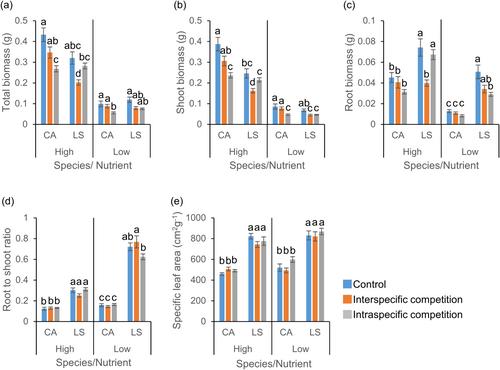
While invasive success of alien plant species is often attributed to their superior competitive abilities, it is also suggested that competitive ability depends on the target species of competition and resource availability. In addition, it remains unclear whether invaders and co-occurring plants in the introduced area exhibit distinctive inter- and intraspecific competitive intensities. This study aimed to evaluate the competitive ability of a successful invader, Lactuca serriola, through a combination of field surveys and a growth chamber experiment. First, we assessed biodiversity and the biomass of co-occurring plants in both L. serriola-invaded and uninvaded plots across nine sites in South Korea. Subsequently, a pairwise competition experiment was conducted between L. serriola and three weedy plant species commonly found in the invaded plots, Chenopodium album, Erigeron canadensis, and Oenothera biennis, under differential nutrient levels. Diversity indices of plant communities and the biomass of most co-occurring plants showed no significant difference between invaded and uninvaded plots. L. serriola and testing weedy plants exhibited mutually negative effects on biomass when grown together in the same pot, with the intensity of interspecific competition being comparable across nutrient treatments. Notably, intraspecific competition of L. serriola was weaker than testing weedy plants, particularly manifest in the high-nutrient treatment. The results of both field and growth-chamber studies demonstrated that L. serriola was not a particularly strong competitor compared to its neighboring weedy plants. Its successful invasion can be partially attributed to its weak intraspecific competition intensity, which potentially facilitate successful establishment with high density.
期刊介绍:
Ecology and Evolution is the peer reviewed journal for rapid dissemination of research in all areas of ecology, evolution and conservation science. The journal gives priority to quality research reports, theoretical or empirical, that develop our understanding of organisms and their diversity, interactions between them, and the natural environment.
Ecology and Evolution gives prompt and equal consideration to papers reporting theoretical, experimental, applied and descriptive work in terrestrial and aquatic environments. The journal will consider submissions across taxa in areas including but not limited to micro and macro ecological and evolutionary processes, characteristics of and interactions between individuals, populations, communities and the environment, physiological responses to environmental change, population genetics and phylogenetics, relatedness and kin selection, life histories, systematics and taxonomy, conservation genetics, extinction, speciation, adaption, behaviour, biodiversity, species abundance, macroecology, population and ecosystem dynamics, and conservation policy.



 京公网安备 11010802042870号
京ICP备2023020795号-1
京公网安备 11010802042870号
京ICP备2023020795号-1

 分享
分享
 求助内容:
求助内容: 应助结果提醒方式:
 扫码关注我们
