Roy Khalaf, Connor Prosty, Christine McCusker, Adam Bretholz, Mohammed Kaouache, Ann E Clarke, Moshe Ben-Shoshan
{"title":"Diagnostic Accuracy of Tryptase Levels for Pediatric Anaphylaxis: A Case-Control Study.","authors":"Roy Khalaf, Connor Prosty, Christine McCusker, Adam Bretholz, Mohammed Kaouache, Ann E Clarke, Moshe Ben-Shoshan","doi":"10.1159/000541883","DOIUrl":null,"url":null,"abstract":"<p><strong>Introduction: </strong>Anaphylaxis is a severe allergic reaction which can be difficult to diagnose. Two strategies evaluating changes in tryptase levels were proposed for diagnosing anaphylaxis. Strategy 1 established a threshold of tryptase levels during reaction exceeding 2 ng/mL + 1.2* (baseline tryptase levels) as a rule for detecting anaphylaxis, while strategy 2 established the ratio of tryptase levels during reaction versus baseline tryptase exceeding a threshold of 1.685. We aimed to compare the diagnostic test accuracy of the two strategies in pediatric anaphylaxis.</p><p><strong>Methods: </strong>We conducted a case-control study. Cases consisted of 89 patients with anaphylaxis who had reaction tryptase and subsequent baseline tryptase measured. Controls consisted of 25 patients with chronic urticaria who had two tryptase measurements. Sensitivity and specificity for each of the strategies were computed and compared using McNemar test. The area under the curve (AUC) between the two strategies was compared using the DeLong test.</p><p><strong>Results: </strong>The sensitivity and specificity for strategy 1 was 53.3% and 95.0%, respectively. For strategy 2, the sensitivity and specificity was 54.4% and 85.0%, respectively. There was no significant difference between both strategies' sensitivity and specificity. The Delong test determined that the AUC was significantly (p < 0.05) higher for strategy 1 (0.69) than strategy 2 (0.64).</p><p><strong>Conclusion: </strong>The Delong test determined that strategy 1 was slightly better in validating anaphylaxis diagnosis than strategy 2. However, both strategies demonstrated a low sensitivity <55%.</p><p><strong>Introduction: </strong>Anaphylaxis is a severe allergic reaction which can be difficult to diagnose. Two strategies evaluating changes in tryptase levels were proposed for diagnosing anaphylaxis. Strategy 1 established a threshold of tryptase levels during reaction exceeding 2 ng/mL + 1.2* (baseline tryptase levels) as a rule for detecting anaphylaxis, while strategy 2 established the ratio of tryptase levels during reaction versus baseline tryptase exceeding a threshold of 1.685. We aimed to compare the diagnostic test accuracy of the two strategies in pediatric anaphylaxis.</p><p><strong>Methods: </strong>We conducted a case-control study. Cases consisted of 89 patients with anaphylaxis who had reaction tryptase and subsequent baseline tryptase measured. Controls consisted of 25 patients with chronic urticaria who had two tryptase measurements. Sensitivity and specificity for each of the strategies were computed and compared using McNemar test. The area under the curve (AUC) between the two strategies was compared using the DeLong test.</p><p><strong>Results: </strong>The sensitivity and specificity for strategy 1 was 53.3% and 95.0%, respectively. For strategy 2, the sensitivity and specificity was 54.4% and 85.0%, respectively. There was no significant difference between both strategies' sensitivity and specificity. The Delong test determined that the AUC was significantly (p < 0.05) higher for strategy 1 (0.69) than strategy 2 (0.64).</p><p><strong>Conclusion: </strong>The Delong test determined that strategy 1 was slightly better in validating anaphylaxis diagnosis than strategy 2. However, both strategies demonstrated a low sensitivity <55%.</p>","PeriodicalId":13652,"journal":{"name":"International Archives of Allergy and Immunology","volume":" ","pages":"311-318"},"PeriodicalIF":1.8000,"publicationDate":"2025-01-01","publicationTypes":"Journal Article","fieldsOfStudy":null,"isOpenAccess":false,"openAccessPdf":"https://www.ncbi.nlm.nih.gov/pmc/articles/PMC11939830/pdf/","citationCount":"0","resultStr":null,"platform":"Semanticscholar","paperid":null,"PeriodicalName":"International Archives of Allergy and Immunology","FirstCategoryId":"3","ListUrlMain":"https://doi.org/10.1159/000541883","RegionNum":4,"RegionCategory":"医学","ArticlePicture":[],"TitleCN":null,"AbstractTextCN":null,"PMCID":null,"EPubDate":"2024/10/30 0:00:00","PubModel":"Epub","JCR":"Q3","JCRName":"ALLERGY","Score":null,"Total":0}
引用次数: 0
Abstract
Introduction: Anaphylaxis is a severe allergic reaction which can be difficult to diagnose. Two strategies evaluating changes in tryptase levels were proposed for diagnosing anaphylaxis. Strategy 1 established a threshold of tryptase levels during reaction exceeding 2 ng/mL + 1.2* (baseline tryptase levels) as a rule for detecting anaphylaxis, while strategy 2 established the ratio of tryptase levels during reaction versus baseline tryptase exceeding a threshold of 1.685. We aimed to compare the diagnostic test accuracy of the two strategies in pediatric anaphylaxis.
Methods: We conducted a case-control study. Cases consisted of 89 patients with anaphylaxis who had reaction tryptase and subsequent baseline tryptase measured. Controls consisted of 25 patients with chronic urticaria who had two tryptase measurements. Sensitivity and specificity for each of the strategies were computed and compared using McNemar test. The area under the curve (AUC) between the two strategies was compared using the DeLong test.
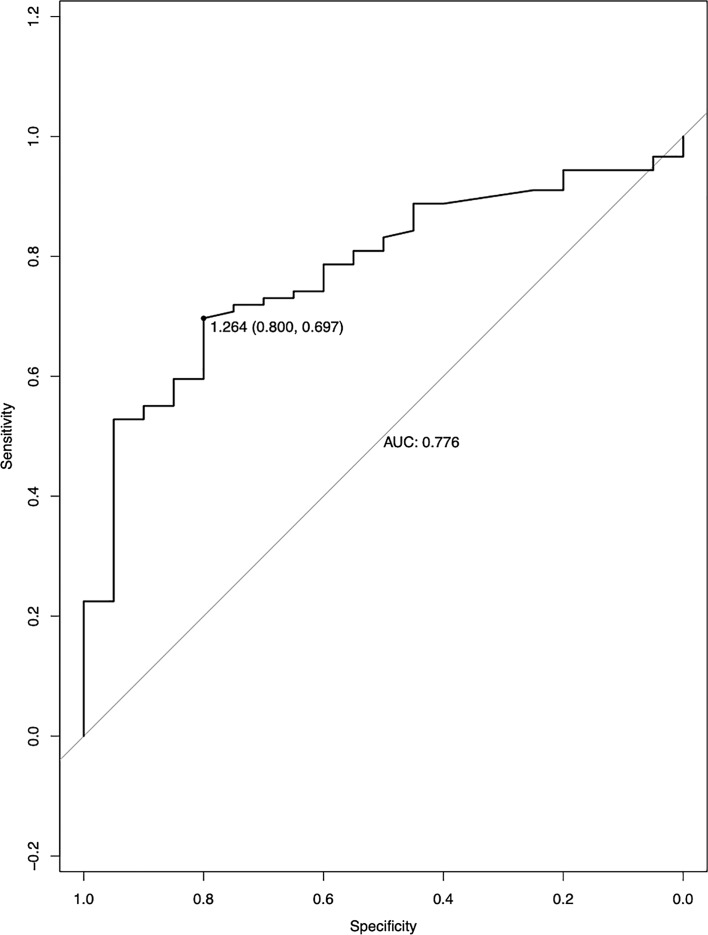
Results: The sensitivity and specificity for strategy 1 was 53.3% and 95.0%, respectively. For strategy 2, the sensitivity and specificity was 54.4% and 85.0%, respectively. There was no significant difference between both strategies' sensitivity and specificity. The Delong test determined that the AUC was significantly (p < 0.05) higher for strategy 1 (0.69) than strategy 2 (0.64).
Conclusion: The Delong test determined that strategy 1 was slightly better in validating anaphylaxis diagnosis than strategy 2. However, both strategies demonstrated a low sensitivity <55%.
Introduction: Anaphylaxis is a severe allergic reaction which can be difficult to diagnose. Two strategies evaluating changes in tryptase levels were proposed for diagnosing anaphylaxis. Strategy 1 established a threshold of tryptase levels during reaction exceeding 2 ng/mL + 1.2* (baseline tryptase levels) as a rule for detecting anaphylaxis, while strategy 2 established the ratio of tryptase levels during reaction versus baseline tryptase exceeding a threshold of 1.685. We aimed to compare the diagnostic test accuracy of the two strategies in pediatric anaphylaxis.
Methods: We conducted a case-control study. Cases consisted of 89 patients with anaphylaxis who had reaction tryptase and subsequent baseline tryptase measured. Controls consisted of 25 patients with chronic urticaria who had two tryptase measurements. Sensitivity and specificity for each of the strategies were computed and compared using McNemar test. The area under the curve (AUC) between the two strategies was compared using the DeLong test.
Results: The sensitivity and specificity for strategy 1 was 53.3% and 95.0%, respectively. For strategy 2, the sensitivity and specificity was 54.4% and 85.0%, respectively. There was no significant difference between both strategies' sensitivity and specificity. The Delong test determined that the AUC was significantly (p < 0.05) higher for strategy 1 (0.69) than strategy 2 (0.64).
Conclusion: The Delong test determined that strategy 1 was slightly better in validating anaphylaxis diagnosis than strategy 2. However, both strategies demonstrated a low sensitivity <55%.
期刊介绍:
''International Archives of Allergy and Immunology'' provides a forum for basic and clinical research in modern molecular and cellular allergology and immunology. Appearing monthly, the journal publishes original work in the fields of allergy, immunopathology, immunogenetics, immunopharmacology, immunoendocrinology, tumor immunology, mucosal immunity, transplantation and immunology of infectious and connective tissue diseases.



 京公网安备 11010802042870号
京ICP备2023020795号-1
京公网安备 11010802042870号
京ICP备2023020795号-1

 分享
分享
 求助内容:
求助内容: 应助结果提醒方式:
 扫码关注我们
