Hendrik T. Weitz, Julia Ettich, Puyan Rafii, Christoph Wittich, Laura Schultz, Nils C. Frank, Denise Heise, Matthias Krusche, Juliane Lokau, Christoph Garbers, Kristina Behnke, Doreen M. Floss, Harald Kolmar, Jens M. Moll, Jürgen Scheller
{"title":"Interleukin-11 receptor is an alternative α-receptor for interleukin-6 and the chimeric cytokine IC7","authors":"Hendrik T. Weitz, Julia Ettich, Puyan Rafii, Christoph Wittich, Laura Schultz, Nils C. Frank, Denise Heise, Matthias Krusche, Juliane Lokau, Christoph Garbers, Kristina Behnke, Doreen M. Floss, Harald Kolmar, Jens M. Moll, Jürgen Scheller","doi":"10.1111/febs.17309","DOIUrl":null,"url":null,"abstract":"<p>The cytokine interleukin 6 (IL-6) signals via the IL-6 α-receptor (IL-6Rα or IL-6R) in complex with the gp130 β-receptor. Cell type restricted expression of the IL-6R limits the action of IL-6 mainly to hepatocytes and some immune cells. Here, we show that IL-6 also binds to the IL-11 α receptor (IL-11Rα or IL-11R) and induces signaling via IL-11R:gp130 complexes, albeit with a lower affinity compared to IL-11. Antagonistic antibodies directed against IL-11R, but not IL-6R, inhibit IL-6 signaling via IL-11R:gp130 receptor complexes. Notably, IL-11 did not cross-react with IL-6R. IL-11R has also been identified as an alternative α receptor for the CNTF/IL-6-derived chimeric cytokine IC7, which has recently been shown to induce weight loss in mice. Accordingly, the effects of therapeutic monoclonal antibodies against IL-6 or IL-6R, which both block IL-6 signaling, may be slightly different. These findings provide new insights into IL-6 signaling and therefore offer new potential therapeutic intervention options in the future.</p>","PeriodicalId":94226,"journal":{"name":"The FEBS journal","volume":"292 3","pages":"523-536"},"PeriodicalIF":4.2000,"publicationDate":"2024-10-29","publicationTypes":"Journal Article","fieldsOfStudy":null,"isOpenAccess":false,"openAccessPdf":"https://onlinelibrary.wiley.com/doi/epdf/10.1111/febs.17309","citationCount":"0","resultStr":null,"platform":"Semanticscholar","paperid":null,"PeriodicalName":"The FEBS journal","FirstCategoryId":"1085","ListUrlMain":"https://febs.onlinelibrary.wiley.com/doi/10.1111/febs.17309","RegionNum":0,"RegionCategory":null,"ArticlePicture":[],"TitleCN":null,"AbstractTextCN":null,"PMCID":null,"EPubDate":"","PubModel":"","JCR":"","JCRName":"","Score":null,"Total":0}
引用次数: 0
Abstract
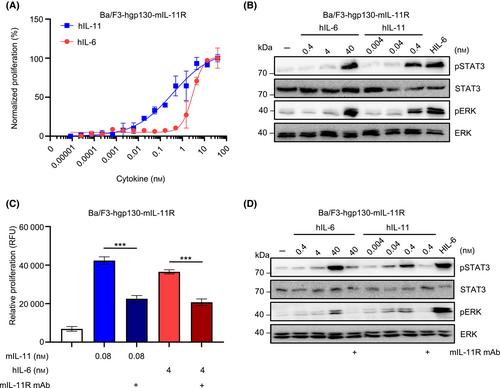
The cytokine interleukin 6 (IL-6) signals via the IL-6 α-receptor (IL-6Rα or IL-6R) in complex with the gp130 β-receptor. Cell type restricted expression of the IL-6R limits the action of IL-6 mainly to hepatocytes and some immune cells. Here, we show that IL-6 also binds to the IL-11 α receptor (IL-11Rα or IL-11R) and induces signaling via IL-11R:gp130 complexes, albeit with a lower affinity compared to IL-11. Antagonistic antibodies directed against IL-11R, but not IL-6R, inhibit IL-6 signaling via IL-11R:gp130 receptor complexes. Notably, IL-11 did not cross-react with IL-6R. IL-11R has also been identified as an alternative α receptor for the CNTF/IL-6-derived chimeric cytokine IC7, which has recently been shown to induce weight loss in mice. Accordingly, the effects of therapeutic monoclonal antibodies against IL-6 or IL-6R, which both block IL-6 signaling, may be slightly different. These findings provide new insights into IL-6 signaling and therefore offer new potential therapeutic intervention options in the future.





 京公网安备 11010802042870号
京ICP备2023020795号-1
京公网安备 11010802042870号
京ICP备2023020795号-1

 分享
分享

 求助内容:
求助内容: 应助结果提醒方式:
 扫码关注我们
