Diana Roberta Pereira Grandizoli, Letícia Oba Sakae, Ana Luísa Meira Renzo, Sávio José Cardoso Bezerra, Samira Helena Niemeyer, Taís Scaramucci
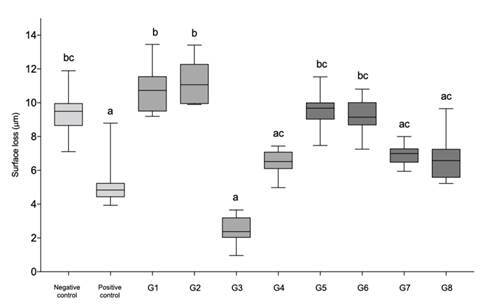
{"title":"The Effect of Actives in Desensitizing and Conventional Mouth Rinses Against Dentin Erosive Wear.","authors":"Diana Roberta Pereira Grandizoli, Letícia Oba Sakae, Ana Luísa Meira Renzo, Sávio José Cardoso Bezerra, Samira Helena Niemeyer, Taís Scaramucci","doi":"10.1590/0103-6440202405500","DOIUrl":null,"url":null,"abstract":"<p><p>This study evaluated the effect of actives present in conventional and desensitizing mouth rinses on the control of dentin erosive tooth wear. Two hundred and seventy dentin specimens from human molars were prepared. The specimens were randomly allocated into 10 experimental groups (n=10): 4 corresponding to desensitizing mouth rinses, 4 to conventional mouth rinses, a negative control group (C-: distilled water), and a positive control group (C+: 500 ppm fluoride plus 800 ppm tin mouth rinse). Specimens were subjected to an erosion-abrasion cycling model: 5 min immersion in 0.3% citric acid and 60 min exposure to artificial saliva. This procedure was repeated 4x/day for 5 days. Immediately after the first and last erosive challenges, the specimens were brushed with a slurry of fluoride toothpaste for 15 s, with a total of 2 min exposure to the slurry. Afterward, the specimens were exposed to the mouth rinses. Dentin surface loss (SL, in µm) was determined by optical profilometry. Data were statistically analyzed by using Kruskal-Wallis and Dunn's tests (α=0.05). The only mouth rinses that presented significantly lower dentin SL than the C- was a desensitizing one containing sodium fluoride (220 ppm F-) with dipotassium oxalate (1.4%) and the C+ (p<0.001 and p=0.013, respectively), without significant differences between them (p>0.05). Dentin SL of the other groups did not significantly differ from the C- (p>0.05). The combination of sodium fluoride with dipotassium oxalate in a desensitizing mouth rinse showed a promising result against dentin erosive wear, matching the protection offered by a fluoride/tin mouth rinse.</p>","PeriodicalId":101363,"journal":{"name":"Brazilian dental journal","volume":"35 ","pages":"e245500"},"PeriodicalIF":0.0000,"publicationDate":"2024-10-28","publicationTypes":"Journal Article","fieldsOfStudy":null,"isOpenAccess":false,"openAccessPdf":"https://www.ncbi.nlm.nih.gov/pmc/articles/PMC11520502/pdf/","citationCount":"0","resultStr":null,"platform":"Semanticscholar","paperid":null,"PeriodicalName":"Brazilian dental journal","FirstCategoryId":"1085","ListUrlMain":"https://doi.org/10.1590/0103-6440202405500","RegionNum":0,"RegionCategory":null,"ArticlePicture":[],"TitleCN":null,"AbstractTextCN":null,"PMCID":null,"EPubDate":"2024/1/1 0:00:00","PubModel":"eCollection","JCR":"","JCRName":"","Score":null,"Total":0}
引用次数: 0
Abstract
This study evaluated the effect of actives present in conventional and desensitizing mouth rinses on the control of dentin erosive tooth wear. Two hundred and seventy dentin specimens from human molars were prepared. The specimens were randomly allocated into 10 experimental groups (n=10): 4 corresponding to desensitizing mouth rinses, 4 to conventional mouth rinses, a negative control group (C-: distilled water), and a positive control group (C+: 500 ppm fluoride plus 800 ppm tin mouth rinse). Specimens were subjected to an erosion-abrasion cycling model: 5 min immersion in 0.3% citric acid and 60 min exposure to artificial saliva. This procedure was repeated 4x/day for 5 days. Immediately after the first and last erosive challenges, the specimens were brushed with a slurry of fluoride toothpaste for 15 s, with a total of 2 min exposure to the slurry. Afterward, the specimens were exposed to the mouth rinses. Dentin surface loss (SL, in µm) was determined by optical profilometry. Data were statistically analyzed by using Kruskal-Wallis and Dunn's tests (α=0.05). The only mouth rinses that presented significantly lower dentin SL than the C- was a desensitizing one containing sodium fluoride (220 ppm F-) with dipotassium oxalate (1.4%) and the C+ (p<0.001 and p=0.013, respectively), without significant differences between them (p>0.05). Dentin SL of the other groups did not significantly differ from the C- (p>0.05). The combination of sodium fluoride with dipotassium oxalate in a desensitizing mouth rinse showed a promising result against dentin erosive wear, matching the protection offered by a fluoride/tin mouth rinse.



 京公网安备 11010802042870号
京ICP备2023020795号-1
京公网安备 11010802042870号
京ICP备2023020795号-1

 分享
分享

 求助内容:
求助内容: 应助结果提醒方式:
 扫码关注我们
