A Comparative Study on the Sustainable Management of Phenolic Content and Antioxidant Residues from Waste Tamarind and Litchi Shells through Optimized Extraction Methods
Ram Kumar Deshmukh, Shefali Tripathi, Lokesh Kumar and Kirtiraj K. Gaikwad*,
{"title":"A Comparative Study on the Sustainable Management of Phenolic Content and Antioxidant Residues from Waste Tamarind and Litchi Shells through Optimized Extraction Methods","authors":"Ram Kumar Deshmukh, Shefali Tripathi, Lokesh Kumar and Kirtiraj K. Gaikwad*, ","doi":"10.1021/acssusresmgt.4c00328","DOIUrl":null,"url":null,"abstract":"<p >The growing global emphasis on sustainability and waste reduction has led to a thorough investigation of agricultural by-products, especially those containing valuable bioactive chemicals. The study was conducted to optimize solvent and extraction methods to compare tamarind and litchi shell extracts’ total phenolic contents and antioxidant capacities. The extracts were evaluated for the total phenolic content (TPC) and antioxidant activity using various assays from maceration, microwave-assisted extraction (MAE), and ultrasound-assisted extraction (UAE). The litchi shell extract TPC was highest for MAE with 29.93 ± 0.21 mg of GAE/g of DW for acetone:water (50:50; v/v) followed by UAE with 27.41 ± 0.09 mg of GAE/g of DW, whereas 16.90 ± 0.15 mg of GAE/g of DW TPC was reported, which is 43.54 and 38.34% higher than the values from maceration. The tamarind shell has contradictorily the highest TPC of 29.40 ± 0.15 mg of GAE/g of DW in maceration compared to MAE and UAE. With a mixture of methanol, water, and acetic acid, the MAE technique demonstrated the highest diphenyl-2-picrylhydrazyl (DPPH) antioxidant activity (94.86%), followed by 94.78% with a methanol/water combination. The greatest ferric-reducing ability of plasma (FRAP) value of 6.60 mg of TE/g for acetone:water in maceration was observed for 2,2-azino-bis-3-ethylbenzothiazoline-6-sulfonic acid (ABTS) values varying between 0.824 and 0.974 mg of TE/g for all extraction techniques. A moderately positive correlation was observed in the TPC and different antioxidant assays. A strong positive correlation was noticed between the extraction method and the antioxidant activity of litchi and tamarind shell extracts. The study concludes that the optimized extraction method can obtain high-quality extracts from tamarind and litchi shells that can potentially be used as natural antioxidants in various applications.</p>","PeriodicalId":100015,"journal":{"name":"ACS Sustainable Resource Management","volume":"1 10","pages":"2304–2313 2304–2313"},"PeriodicalIF":0.0000,"publicationDate":"2024-10-14","publicationTypes":"Journal Article","fieldsOfStudy":null,"isOpenAccess":false,"openAccessPdf":"","citationCount":"0","resultStr":null,"platform":"Semanticscholar","paperid":null,"PeriodicalName":"ACS Sustainable Resource Management","FirstCategoryId":"1085","ListUrlMain":"https://pubs.acs.org/doi/10.1021/acssusresmgt.4c00328","RegionNum":0,"RegionCategory":null,"ArticlePicture":[],"TitleCN":null,"AbstractTextCN":null,"PMCID":null,"EPubDate":"","PubModel":"","JCR":"","JCRName":"","Score":null,"Total":0}
引用次数: 0
Abstract
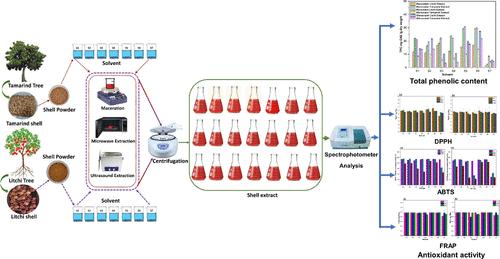
The growing global emphasis on sustainability and waste reduction has led to a thorough investigation of agricultural by-products, especially those containing valuable bioactive chemicals. The study was conducted to optimize solvent and extraction methods to compare tamarind and litchi shell extracts’ total phenolic contents and antioxidant capacities. The extracts were evaluated for the total phenolic content (TPC) and antioxidant activity using various assays from maceration, microwave-assisted extraction (MAE), and ultrasound-assisted extraction (UAE). The litchi shell extract TPC was highest for MAE with 29.93 ± 0.21 mg of GAE/g of DW for acetone:water (50:50; v/v) followed by UAE with 27.41 ± 0.09 mg of GAE/g of DW, whereas 16.90 ± 0.15 mg of GAE/g of DW TPC was reported, which is 43.54 and 38.34% higher than the values from maceration. The tamarind shell has contradictorily the highest TPC of 29.40 ± 0.15 mg of GAE/g of DW in maceration compared to MAE and UAE. With a mixture of methanol, water, and acetic acid, the MAE technique demonstrated the highest diphenyl-2-picrylhydrazyl (DPPH) antioxidant activity (94.86%), followed by 94.78% with a methanol/water combination. The greatest ferric-reducing ability of plasma (FRAP) value of 6.60 mg of TE/g for acetone:water in maceration was observed for 2,2-azino-bis-3-ethylbenzothiazoline-6-sulfonic acid (ABTS) values varying between 0.824 and 0.974 mg of TE/g for all extraction techniques. A moderately positive correlation was observed in the TPC and different antioxidant assays. A strong positive correlation was noticed between the extraction method and the antioxidant activity of litchi and tamarind shell extracts. The study concludes that the optimized extraction method can obtain high-quality extracts from tamarind and litchi shells that can potentially be used as natural antioxidants in various applications.



 京公网安备 11010802042870号
京ICP备2023020795号-1
京公网安备 11010802042870号
京ICP备2023020795号-1

 分享
分享

 求助内容:
求助内容: 应助结果提醒方式:
 扫码关注我们
