Sheng Peng , Junjie Zou , Tangyang Pu , Heng Wang , Ruonan Wang , Xiaoyu Tian , Sheng Liu , Qiang Cao
{"title":"Femtosecond laser-induced plasma-assisted backward deposition of robustly adherent porous carbon films on glass substrates","authors":"Sheng Peng , Junjie Zou , Tangyang Pu , Heng Wang , Ruonan Wang , Xiaoyu Tian , Sheng Liu , Qiang Cao","doi":"10.1016/j.surfin.2024.105304","DOIUrl":null,"url":null,"abstract":"<div><div>The simple and rapid production and transfer of high-quality carbon materials are crucial for the flexible and efficient fabrication of carbon-based electronic devices. Recently, a laser-assisted transfer method combining laser-induced carbonization and transfer printing was demonstrated for the one-step preparation and transfer of patterned laser-induced carbon films to transparent substrates. However, this method is limited by insufficient robustness and weak adhesion of the carbon film post-transfer. Herein, we developed a non-contact laser-induced plasma-assisted deposition method to deposit robustly adherent porous carbon films on glass substrates. By well-adjusting the laser parameters and inserting spacers with adjustable thickness, laser-induced plasma ablation replaced direct laser ablation during femtosecond laser scanning of the substrate-polyimide-carrier sandwich structure, resulting in micro-channels with a carbon-glass recast layer instead of easily peelable flakes on the glass substrate. This hierarchical structure significantly enhances the adhesion between the laser-induced carbon film and the glass substrate, ensuring outstanding stability of the deposited carbon film under various adhesion tests. Furthermore, compared to carbon films prepared by the laser-assisted transfer method, the obtained carbon films are hydrophilic, low-resistance, and porous, facilitating the fabrication of energy storage devices. To demonstrate its practical application, a planar carbon-based micro-supercapacitor was fabricated on glass, exhibiting excellent electrochemical and cycling performance.</div></div>","PeriodicalId":22081,"journal":{"name":"Surfaces and Interfaces","volume":"55 ","pages":"Article 105304"},"PeriodicalIF":6.3000,"publicationDate":"2024-12-01","publicationTypes":"Journal Article","fieldsOfStudy":null,"isOpenAccess":false,"openAccessPdf":"","citationCount":"0","resultStr":null,"platform":"Semanticscholar","paperid":null,"PeriodicalName":"Surfaces and Interfaces","FirstCategoryId":"88","ListUrlMain":"https://www.sciencedirect.com/science/article/pii/S2468023024014603","RegionNum":2,"RegionCategory":"材料科学","ArticlePicture":[],"TitleCN":null,"AbstractTextCN":null,"PMCID":null,"EPubDate":"2024/10/28 0:00:00","PubModel":"Epub","JCR":"Q2","JCRName":"CHEMISTRY, PHYSICAL","Score":null,"Total":0}
引用次数: 0
Abstract
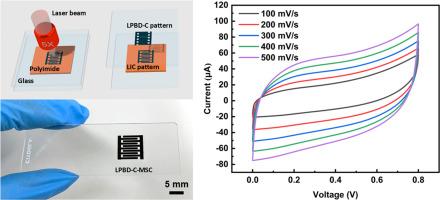
The simple and rapid production and transfer of high-quality carbon materials are crucial for the flexible and efficient fabrication of carbon-based electronic devices. Recently, a laser-assisted transfer method combining laser-induced carbonization and transfer printing was demonstrated for the one-step preparation and transfer of patterned laser-induced carbon films to transparent substrates. However, this method is limited by insufficient robustness and weak adhesion of the carbon film post-transfer. Herein, we developed a non-contact laser-induced plasma-assisted deposition method to deposit robustly adherent porous carbon films on glass substrates. By well-adjusting the laser parameters and inserting spacers with adjustable thickness, laser-induced plasma ablation replaced direct laser ablation during femtosecond laser scanning of the substrate-polyimide-carrier sandwich structure, resulting in micro-channels with a carbon-glass recast layer instead of easily peelable flakes on the glass substrate. This hierarchical structure significantly enhances the adhesion between the laser-induced carbon film and the glass substrate, ensuring outstanding stability of the deposited carbon film under various adhesion tests. Furthermore, compared to carbon films prepared by the laser-assisted transfer method, the obtained carbon films are hydrophilic, low-resistance, and porous, facilitating the fabrication of energy storage devices. To demonstrate its practical application, a planar carbon-based micro-supercapacitor was fabricated on glass, exhibiting excellent electrochemical and cycling performance.
期刊介绍:
The aim of the journal is to provide a respectful outlet for ''sound science'' papers in all research areas on surfaces and interfaces. We define sound science papers as papers that describe new and well-executed research, but that do not necessarily provide brand new insights or are merely a description of research results.
Surfaces and Interfaces publishes research papers in all fields of surface science which may not always find the right home on first submission to our Elsevier sister journals (Applied Surface, Surface and Coatings Technology, Thin Solid Films)



 京公网安备 11010802042870号
京ICP备2023020795号-1
京公网安备 11010802042870号
京ICP备2023020795号-1

 分享
分享
 求助内容:
求助内容: 应助结果提醒方式:
 扫码关注我们
