Huining Zhang , Lihong Tian , Zongqian Zhang , Jianping Han , Zhiguo Wu , Zhiqiang Wei , Shaofeng Wang , Yang Cao , Seng Zhang , Yue Zhang
{"title":"Effective degradation of phenol by in-situ photocatalytic-Fenton-like technology with BiVO4/Bi2WO6/Ti3C2 QDs","authors":"Huining Zhang , Lihong Tian , Zongqian Zhang , Jianping Han , Zhiguo Wu , Zhiqiang Wei , Shaofeng Wang , Yang Cao , Seng Zhang , Yue Zhang","doi":"10.1016/j.surfin.2024.105315","DOIUrl":null,"url":null,"abstract":"<div><div>Photocatalytically coupled Fenton-like is an environmentally promising technology for water treatment. In this work, BiVO<sub>4</sub>/Bi<sub>2</sub>WO<sub>6</sub>/Ti<sub>3</sub>C<sub>2</sub> QDs composite photocatalysts (BBT) were prepared by hydrothermal and calcination methods to construct an in situ photocatalytic Fenton-like system. The photocatalytic degradation experiments were carried out under xenon lamp irradiation with phenol as the target pollutant. The BBT-2 photocatalyst could degrade 78.0% of phenol in 180 min. Compared with the catalyst without Ti<sub>3</sub>C<sub>2</sub> QDs doping, the degradation efficiency was improved by 14%. The H<sub>2</sub>O<sub>2</sub> yield of the BBT-2 catalyst reached 48.7 μM in the same time. Free radical trapping experiments showed that the BBT photocatalysts generated H<sub>2</sub>O<sub>2</sub> by two-electron reduction of oxygen and hole oxidation of water. In addition, h<sup>+</sup> and H<sub>2</sub>O<sub>2</sub> play important roles in the phenol photocatalytic process during the degradation of phenol, and a possible reaction mechanism has been proposed. In this work, the combination of photocatalysis and Fenton-like reaction provides a solution for the green and sustainable degradation of highly toxic, difficult-to-degrade organic pollutants.</div></div>","PeriodicalId":22081,"journal":{"name":"Surfaces and Interfaces","volume":"55 ","pages":"Article 105315"},"PeriodicalIF":6.3000,"publicationDate":"2024-12-01","publicationTypes":"Journal Article","fieldsOfStudy":null,"isOpenAccess":false,"openAccessPdf":"","citationCount":"0","resultStr":null,"platform":"Semanticscholar","paperid":null,"PeriodicalName":"Surfaces and Interfaces","FirstCategoryId":"88","ListUrlMain":"https://www.sciencedirect.com/science/article/pii/S2468023024014718","RegionNum":2,"RegionCategory":"材料科学","ArticlePicture":[],"TitleCN":null,"AbstractTextCN":null,"PMCID":null,"EPubDate":"2024/10/30 0:00:00","PubModel":"Epub","JCR":"Q2","JCRName":"CHEMISTRY, PHYSICAL","Score":null,"Total":0}
引用次数: 0
Abstract
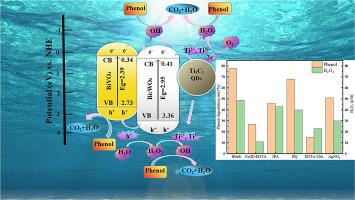
Photocatalytically coupled Fenton-like is an environmentally promising technology for water treatment. In this work, BiVO4/Bi2WO6/Ti3C2 QDs composite photocatalysts (BBT) were prepared by hydrothermal and calcination methods to construct an in situ photocatalytic Fenton-like system. The photocatalytic degradation experiments were carried out under xenon lamp irradiation with phenol as the target pollutant. The BBT-2 photocatalyst could degrade 78.0% of phenol in 180 min. Compared with the catalyst without Ti3C2 QDs doping, the degradation efficiency was improved by 14%. The H2O2 yield of the BBT-2 catalyst reached 48.7 μM in the same time. Free radical trapping experiments showed that the BBT photocatalysts generated H2O2 by two-electron reduction of oxygen and hole oxidation of water. In addition, h+ and H2O2 play important roles in the phenol photocatalytic process during the degradation of phenol, and a possible reaction mechanism has been proposed. In this work, the combination of photocatalysis and Fenton-like reaction provides a solution for the green and sustainable degradation of highly toxic, difficult-to-degrade organic pollutants.
期刊介绍:
The aim of the journal is to provide a respectful outlet for ''sound science'' papers in all research areas on surfaces and interfaces. We define sound science papers as papers that describe new and well-executed research, but that do not necessarily provide brand new insights or are merely a description of research results.
Surfaces and Interfaces publishes research papers in all fields of surface science which may not always find the right home on first submission to our Elsevier sister journals (Applied Surface, Surface and Coatings Technology, Thin Solid Films)




 京公网安备 11010802042870号
京ICP备2023020795号-1
京公网安备 11010802042870号
京ICP备2023020795号-1

 分享
分享
 求助内容:
求助内容: 应助结果提醒方式:
 扫码关注我们
