{"title":"Plants-extracts mediated CuS nanoparticles: An effective antibacterial agent","authors":"KM Srishti Barnwal , Yukti Gupta , Neena Jaggi","doi":"10.1016/j.surfin.2024.105326","DOIUrl":null,"url":null,"abstract":"<div><div>Antibacterial activity of plant-mediated synthesized CuS nanoparticles against gram-positive <em>Bacillus subtilis</em> and gram negative <em>Pseudomonas putida</em> is studied in this presented work. A facile hydrothermal approach was followed to synthesize spherical shaped CuS nanoparticles using flowers extract of <em>Tagetes patula</em> (S1), leaves extract of <em>Azadirachta indica</em> (S2), and bark extract of <em>Terminalia arjuna</em> (S3). Crystal phase identification, average crystallites size, surface morphology, absorbance spectra and energy band gap analyses of samples were further determined using XRD, SEM, and UV-DRS spectroscopy respectively. Furthermore, under irradiation of visible light, antibacterial activity of marigold flowers mediated (S1), neem leaves mediated (S2), and arjuna bark mediated (S3) CuS samples were studied. XRD data confirmed the marigold mediated CuS sample has relatively smaller crystallites size of 10.67 nm. The estimated band gap energies for respective S1, S2, and S3 samples are 174 eV, 175 eV, and 177 eV. The antibacterial analysis of S1 sample displays its excellent antibacterial activity with the formation of relatively large inhibition zones of 29 mm and 30 mm diameters, against <em>Bacillus subtilis</em> and <em>Pseudomonas putida</em> respectively. The demonstrated antibacterial activity of biocompatible CuS nanoparticles suggests their potential use in biomedical applications.</div></div>","PeriodicalId":22081,"journal":{"name":"Surfaces and Interfaces","volume":"55 ","pages":"Article 105326"},"PeriodicalIF":6.3000,"publicationDate":"2024-10-24","publicationTypes":"Journal Article","fieldsOfStudy":null,"isOpenAccess":false,"openAccessPdf":"","citationCount":"0","resultStr":null,"platform":"Semanticscholar","paperid":null,"PeriodicalName":"Surfaces and Interfaces","FirstCategoryId":"88","ListUrlMain":"https://www.sciencedirect.com/science/article/pii/S2468023024014822","RegionNum":2,"RegionCategory":"材料科学","ArticlePicture":[],"TitleCN":null,"AbstractTextCN":null,"PMCID":null,"EPubDate":"","PubModel":"","JCR":"Q2","JCRName":"CHEMISTRY, PHYSICAL","Score":null,"Total":0}
引用次数: 0
Abstract
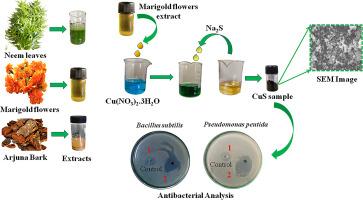
Antibacterial activity of plant-mediated synthesized CuS nanoparticles against gram-positive Bacillus subtilis and gram negative Pseudomonas putida is studied in this presented work. A facile hydrothermal approach was followed to synthesize spherical shaped CuS nanoparticles using flowers extract of Tagetes patula (S1), leaves extract of Azadirachta indica (S2), and bark extract of Terminalia arjuna (S3). Crystal phase identification, average crystallites size, surface morphology, absorbance spectra and energy band gap analyses of samples were further determined using XRD, SEM, and UV-DRS spectroscopy respectively. Furthermore, under irradiation of visible light, antibacterial activity of marigold flowers mediated (S1), neem leaves mediated (S2), and arjuna bark mediated (S3) CuS samples were studied. XRD data confirmed the marigold mediated CuS sample has relatively smaller crystallites size of 10.67 nm. The estimated band gap energies for respective S1, S2, and S3 samples are 174 eV, 175 eV, and 177 eV. The antibacterial analysis of S1 sample displays its excellent antibacterial activity with the formation of relatively large inhibition zones of 29 mm and 30 mm diameters, against Bacillus subtilis and Pseudomonas putida respectively. The demonstrated antibacterial activity of biocompatible CuS nanoparticles suggests their potential use in biomedical applications.
期刊介绍:
The aim of the journal is to provide a respectful outlet for ''sound science'' papers in all research areas on surfaces and interfaces. We define sound science papers as papers that describe new and well-executed research, but that do not necessarily provide brand new insights or are merely a description of research results.
Surfaces and Interfaces publishes research papers in all fields of surface science which may not always find the right home on first submission to our Elsevier sister journals (Applied Surface, Surface and Coatings Technology, Thin Solid Films)



 京公网安备 11010802042870号
京ICP备2023020795号-1
京公网安备 11010802042870号
京ICP备2023020795号-1

 分享
分享
 求助内容:
求助内容: 应助结果提醒方式:
 扫码关注我们
