{"title":"Crack path analysis of spent nuclear fuel cladding using the strain energy-based Dijkstra algorithm","authors":"Jee A Baik, Jung Jin Kim","doi":"10.1016/j.nucengdes.2024.113661","DOIUrl":null,"url":null,"abstract":"<div><div>The integrity of spent fuel cladding is crucial for preventing the release of radioactive materials, which pose significant risks to public safety and the environment. However, accurately predicting cracks in cladding tubes remains a challenge. This study proposes a novel method for predicting crack paths in spent nuclear fuel cladding tubes using the Dijkstra algorithm, based on strain energy. In this method, cladding images are segmented into cladding and hydride pixels, followed by a finite element analysis to calculate the strain energy. The Dijkstra algorithm utilizes this strain energy data from hydrides to predict crack paths in areas with low resistance to loading. The predicted path exhibited an accuracy of 92.78 % with respect to the initiation point of the actual crack path and was located within 200 μm of the actual crack path. The proposed method demonstrates a higher similarity to the actual crack path than conventional image-based methods. These results suggest that the safety assessment of spent nuclear fuel can be enhanced, enabling the development of effective management strategies for spent nuclear fuel.</div></div>","PeriodicalId":19170,"journal":{"name":"Nuclear Engineering and Design","volume":"429 ","pages":"Article 113661"},"PeriodicalIF":2.1000,"publicationDate":"2024-12-01","publicationTypes":"Journal Article","fieldsOfStudy":null,"isOpenAccess":false,"openAccessPdf":"","citationCount":"0","resultStr":null,"platform":"Semanticscholar","paperid":null,"PeriodicalName":"Nuclear Engineering and Design","FirstCategoryId":"5","ListUrlMain":"https://www.sciencedirect.com/science/article/pii/S0029549324007611","RegionNum":3,"RegionCategory":"工程技术","ArticlePicture":[],"TitleCN":null,"AbstractTextCN":null,"PMCID":null,"EPubDate":"2024/10/30 0:00:00","PubModel":"Epub","JCR":"Q1","JCRName":"NUCLEAR SCIENCE & TECHNOLOGY","Score":null,"Total":0}
引用次数: 0
Abstract
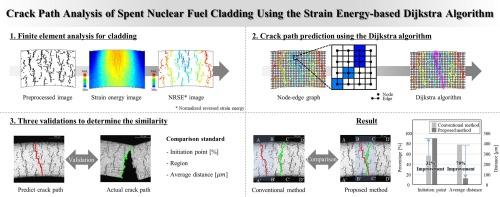
The integrity of spent fuel cladding is crucial for preventing the release of radioactive materials, which pose significant risks to public safety and the environment. However, accurately predicting cracks in cladding tubes remains a challenge. This study proposes a novel method for predicting crack paths in spent nuclear fuel cladding tubes using the Dijkstra algorithm, based on strain energy. In this method, cladding images are segmented into cladding and hydride pixels, followed by a finite element analysis to calculate the strain energy. The Dijkstra algorithm utilizes this strain energy data from hydrides to predict crack paths in areas with low resistance to loading. The predicted path exhibited an accuracy of 92.78 % with respect to the initiation point of the actual crack path and was located within 200 μm of the actual crack path. The proposed method demonstrates a higher similarity to the actual crack path than conventional image-based methods. These results suggest that the safety assessment of spent nuclear fuel can be enhanced, enabling the development of effective management strategies for spent nuclear fuel.
期刊介绍:
Nuclear Engineering and Design covers the wide range of disciplines involved in the engineering, design, safety and construction of nuclear fission reactors. The Editors welcome papers both on applied and innovative aspects and developments in nuclear science and technology.
Fundamentals of Reactor Design include:
• Thermal-Hydraulics and Core Physics
• Safety Analysis, Risk Assessment (PSA)
• Structural and Mechanical Engineering
• Materials Science
• Fuel Behavior and Design
• Structural Plant Design
• Engineering of Reactor Components
• Experiments
Aspects beyond fundamentals of Reactor Design covered:
• Accident Mitigation Measures
• Reactor Control Systems
• Licensing Issues
• Safeguard Engineering
• Economy of Plants
• Reprocessing / Waste Disposal
• Applications of Nuclear Energy
• Maintenance
• Decommissioning
Papers on new reactor ideas and developments (Generation IV reactors) such as inherently safe modular HTRs, High Performance LWRs/HWRs and LMFBs/GFR will be considered; Actinide Burners, Accelerator Driven Systems, Energy Amplifiers and other special designs of power and research reactors and their applications are also encouraged.




 京公网安备 11010802042870号
京ICP备2023020795号-1
京公网安备 11010802042870号
京ICP备2023020795号-1

 分享
分享
 求助内容:
求助内容: 应助结果提醒方式:
 扫码关注我们
