{"title":"Dibenzoxanthene-β-lactam hybrids as potential antioxidant and anticancer agents: Synthesis, biological evaluation, and docking study","authors":"Somayeh Ranjbari , Aliasghar Jarrahpour , Roghayeh Heiran , Saghi Sepehri , Sedigheh Kianpour , Younes Ghasemi","doi":"10.1016/j.molstruc.2024.140455","DOIUrl":null,"url":null,"abstract":"<div><div>In this study, we designed and synthesized a series of <em>β</em>-lactam compounds bearing 14-phenyl-14H-dibenzo[<em>a,j</em>]xanthene moiety attached to the N-1 position of the <em>β</em>-lactam ring through a [2 + 2] cycloaddition process. All the synthesized compounds have been characterized by elemental analysis, Fourier-transform infrared (FT-IR) and nuclear magnetic resonance (<sup>1</sup>H NMR and <sup>13</sup>C NMR) spectral analysis. These derivatives were evaluated for their anticancer and antioxidant activities. The <em>in vitro</em> anticancer activity of new compounds was examined against MCF-7 (breast cancer), HepG2 (liver hepatocellular carcinoma), and TC-1 (mouse lung epithelial) cell lines by 3-(4, 5-dimethylthiazolyl-2)-2, 5-diphenyltetrazolium bromide (MTT) assay. Notably, compounds <strong>4c, 4e</strong> and <strong>4 g</strong> demonstrated significant anticancer activity against TC-1 cell line. Additionally, compounds <strong>4c, 4f</strong> and <strong>4 g</strong> exhibited promising levels of efficacy against the MCF-7 cell line. The diphenylpicrylhydrazyl (DPPH) radical scavenging assay indicated that <strong>4</strong> <strong>h</strong> and <strong>4i</strong> are more potent antioxidant agents than the Vitamin C, while <strong>4a, 4b, 4c</strong>, and <strong>4j</strong> exhibited moderate antioxidant capabilities. Furthermore, the docking simulations are consistent with the biological assay results, indicating that the hybrids may bind to protein targets through hydrogen bonding and other nonvalent interactions.</div></div>","PeriodicalId":16414,"journal":{"name":"Journal of Molecular Structure","volume":"1322 ","pages":"Article 140455"},"PeriodicalIF":4.7000,"publicationDate":"2024-10-22","publicationTypes":"Journal Article","fieldsOfStudy":null,"isOpenAccess":false,"openAccessPdf":"","citationCount":"0","resultStr":null,"platform":"Semanticscholar","paperid":null,"PeriodicalName":"Journal of Molecular Structure","FirstCategoryId":"92","ListUrlMain":"https://www.sciencedirect.com/science/article/pii/S0022286024029636","RegionNum":2,"RegionCategory":"化学","ArticlePicture":[],"TitleCN":null,"AbstractTextCN":null,"PMCID":null,"EPubDate":"","PubModel":"","JCR":"Q2","JCRName":"CHEMISTRY, PHYSICAL","Score":null,"Total":0}
引用次数: 0
Abstract
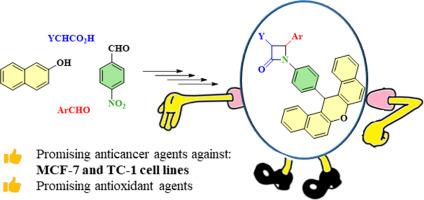
In this study, we designed and synthesized a series of β-lactam compounds bearing 14-phenyl-14H-dibenzo[a,j]xanthene moiety attached to the N-1 position of the β-lactam ring through a [2 + 2] cycloaddition process. All the synthesized compounds have been characterized by elemental analysis, Fourier-transform infrared (FT-IR) and nuclear magnetic resonance (1H NMR and 13C NMR) spectral analysis. These derivatives were evaluated for their anticancer and antioxidant activities. The in vitro anticancer activity of new compounds was examined against MCF-7 (breast cancer), HepG2 (liver hepatocellular carcinoma), and TC-1 (mouse lung epithelial) cell lines by 3-(4, 5-dimethylthiazolyl-2)-2, 5-diphenyltetrazolium bromide (MTT) assay. Notably, compounds 4c, 4e and 4 g demonstrated significant anticancer activity against TC-1 cell line. Additionally, compounds 4c, 4f and 4 g exhibited promising levels of efficacy against the MCF-7 cell line. The diphenylpicrylhydrazyl (DPPH) radical scavenging assay indicated that 4h and 4i are more potent antioxidant agents than the Vitamin C, while 4a, 4b, 4c, and 4j exhibited moderate antioxidant capabilities. Furthermore, the docking simulations are consistent with the biological assay results, indicating that the hybrids may bind to protein targets through hydrogen bonding and other nonvalent interactions.
期刊介绍:
The Journal of Molecular Structure is dedicated to the publication of full-length articles and review papers, providing important new structural information on all types of chemical species including:
• Stable and unstable molecules in all types of environments (vapour, molecular beam, liquid, solution, liquid crystal, solid state, matrix-isolated, surface-absorbed etc.)
• Chemical intermediates
• Molecules in excited states
• Biological molecules
• Polymers.
The methods used may include any combination of spectroscopic and non-spectroscopic techniques, for example:
• Infrared spectroscopy (mid, far, near)
• Raman spectroscopy and non-linear Raman methods (CARS, etc.)
• Electronic absorption spectroscopy
• Optical rotatory dispersion and circular dichroism
• Fluorescence and phosphorescence techniques
• Electron spectroscopies (PES, XPS), EXAFS, etc.
• Microwave spectroscopy
• Electron diffraction
• NMR and ESR spectroscopies
• Mössbauer spectroscopy
• X-ray crystallography
• Charge Density Analyses
• Computational Studies (supplementing experimental methods)
We encourage publications combining theoretical and experimental approaches. The structural insights gained by the studies should be correlated with the properties, activity and/ or reactivity of the molecule under investigation and the relevance of this molecule and its implications should be discussed.




 京公网安备 11010802042870号
京ICP备2023020795号-1
京公网安备 11010802042870号
京ICP备2023020795号-1

 分享
分享
 求助内容:
求助内容: 应助结果提醒方式:
 扫码关注我们
