Tao Liu , Xing Xing Zhuang , Wen Jia Zheng , Jia Rong Gao
{"title":"Integrative multi-omics and network pharmacology reveal the mechanisms of Fangji Huangqi Decoction in treating IgA nephropathy","authors":"Tao Liu , Xing Xing Zhuang , Wen Jia Zheng , Jia Rong Gao","doi":"10.1016/j.jep.2024.118996","DOIUrl":null,"url":null,"abstract":"<div><h3>Ethnopharmacological relevance</h3><div>Fangji Huangqi Decoction (FJHQD), a classical Chinese herbal formulation, has demonstrated significant clinical efficacy in the treatment of IgA nephropathy (IgAN), although its mechanisms remain poorly understood.</div></div><div><h3>Aim of the study</h3><div>This study aims to investigate the renal protective mechanisms of FJHQD using an integrated approach that combines transcriptomics, proteomics, and network pharmacology.</div></div><div><h3>Methods</h3><div>Renal glomerular structure changes were assessed via hematoxylin and eosin (H&E) and Masson staining. IgA expression in the glomeruli was quantified using immunofluorescence. Furthermore, the potential mechanisms underlying the effects of FJHQD were explored through a combined strategy of network pharmacology, transcriptomics, and proteomics. The expression of signaling pathway-related proteins was detected using Western blot.</div></div><div><h3>Results</h3><div>FJHQD inhibited mesangial cell proliferation and renal interstitial fibrosis, and significantly reduced excessive IgA deposition in the glomerular mesangium. Network pharmacology identified 113 important active components and 8 common active components in FJHQD, with quercetin, isorhamnetin, jaranol, and kaempferol having the highest number of target interactions. Integration of network pharmacology with multi-omics approaches revealed that 44 active components regulated numerous immune and inflammatory signaling pathways through 17 hub targets. These pathways include the Calcium signaling pathway, cAMP signaling pathway, Ras signaling pathway, MAPK signaling pathway, and PI3K-AKT signaling pathway. Subsequent in vivo experiments demonstrated that FJHQD effectively regulates the identified pathways in IgAN mice. Ultimately, molecular docking results further validated the reliability of the network pharmacology combined with multi-omics analyses.</div></div><div><h3>Conclusion</h3><div>The findings suggest that FJHQD exerts a renal protective effect, potentially through modulation of the Calcium signaling pathway, cAMP signaling pathway, Ras signaling pathway, MAPK signaling pathway, and PI3K-AKT signaling pathway. These insights offer valuable support for the clinical use of FJHQD and open new avenues for exploring the active compounds and molecular mechanisms of Traditional Chinese Medicines (TCMs).</div></div>","PeriodicalId":15761,"journal":{"name":"Journal of ethnopharmacology","volume":"337 ","pages":"Article 118996"},"PeriodicalIF":5.4000,"publicationDate":"2024-10-25","publicationTypes":"Journal Article","fieldsOfStudy":null,"isOpenAccess":false,"openAccessPdf":"","citationCount":"0","resultStr":null,"platform":"Semanticscholar","paperid":null,"PeriodicalName":"Journal of ethnopharmacology","FirstCategoryId":"3","ListUrlMain":"https://www.sciencedirect.com/science/article/pii/S0378874124012959","RegionNum":2,"RegionCategory":"医学","ArticlePicture":[],"TitleCN":null,"AbstractTextCN":null,"PMCID":null,"EPubDate":"","PubModel":"","JCR":"Q1","JCRName":"CHEMISTRY, MEDICINAL","Score":null,"Total":0}
引用次数: 0
Abstract
Ethnopharmacological relevance
Fangji Huangqi Decoction (FJHQD), a classical Chinese herbal formulation, has demonstrated significant clinical efficacy in the treatment of IgA nephropathy (IgAN), although its mechanisms remain poorly understood.
Aim of the study
This study aims to investigate the renal protective mechanisms of FJHQD using an integrated approach that combines transcriptomics, proteomics, and network pharmacology.
Methods
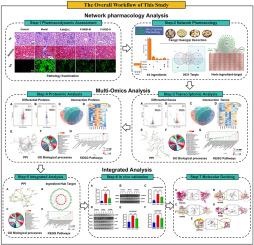
Renal glomerular structure changes were assessed via hematoxylin and eosin (H&E) and Masson staining. IgA expression in the glomeruli was quantified using immunofluorescence. Furthermore, the potential mechanisms underlying the effects of FJHQD were explored through a combined strategy of network pharmacology, transcriptomics, and proteomics. The expression of signaling pathway-related proteins was detected using Western blot.
Results
FJHQD inhibited mesangial cell proliferation and renal interstitial fibrosis, and significantly reduced excessive IgA deposition in the glomerular mesangium. Network pharmacology identified 113 important active components and 8 common active components in FJHQD, with quercetin, isorhamnetin, jaranol, and kaempferol having the highest number of target interactions. Integration of network pharmacology with multi-omics approaches revealed that 44 active components regulated numerous immune and inflammatory signaling pathways through 17 hub targets. These pathways include the Calcium signaling pathway, cAMP signaling pathway, Ras signaling pathway, MAPK signaling pathway, and PI3K-AKT signaling pathway. Subsequent in vivo experiments demonstrated that FJHQD effectively regulates the identified pathways in IgAN mice. Ultimately, molecular docking results further validated the reliability of the network pharmacology combined with multi-omics analyses.
Conclusion
The findings suggest that FJHQD exerts a renal protective effect, potentially through modulation of the Calcium signaling pathway, cAMP signaling pathway, Ras signaling pathway, MAPK signaling pathway, and PI3K-AKT signaling pathway. These insights offer valuable support for the clinical use of FJHQD and open new avenues for exploring the active compounds and molecular mechanisms of Traditional Chinese Medicines (TCMs).
期刊介绍:
The Journal of Ethnopharmacology is dedicated to the exchange of information and understandings about people''s use of plants, fungi, animals, microorganisms and minerals and their biological and pharmacological effects based on the principles established through international conventions. Early people confronted with illness and disease, discovered a wealth of useful therapeutic agents in the plant and animal kingdoms. The empirical knowledge of these medicinal substances and their toxic potential was passed on by oral tradition and sometimes recorded in herbals and other texts on materia medica. Many valuable drugs of today (e.g., atropine, ephedrine, tubocurarine, digoxin, reserpine) came into use through the study of indigenous remedies. Chemists continue to use plant-derived drugs (e.g., morphine, taxol, physostigmine, quinidine, emetine) as prototypes in their attempts to develop more effective and less toxic medicinals.




 京公网安备 11010802042870号
京ICP备2023020795号-1
京公网安备 11010802042870号
京ICP备2023020795号-1

 分享
分享
 求助内容:
求助内容: 应助结果提醒方式:
 扫码关注我们
