Yuvraj Vaishnav, Rohit K. Rai, Walid Al Maksoud, Fumitaka Takeiri, Shusaku Hayama, Hiroshi Yaguchi, Samy Ould-Chikh, Marcell Toth, Raza Ullah Shah Bacha, Bambar Davaasuren, Maxim Avdeev, Genki Kobayashi, Yoji Kobayashi
{"title":"Selective Hydride Interstitials Induced in a High-Entropy Lanthanide Oxyhydride","authors":"Yuvraj Vaishnav, Rohit K. Rai, Walid Al Maksoud, Fumitaka Takeiri, Shusaku Hayama, Hiroshi Yaguchi, Samy Ould-Chikh, Marcell Toth, Raza Ullah Shah Bacha, Bambar Davaasuren, Maxim Avdeev, Genki Kobayashi, Yoji Kobayashi","doi":"10.1021/acs.chemmater.4c01617","DOIUrl":null,"url":null,"abstract":"High-entropy materials have gained significant interest in many applications, but structural investigations of the effect on anions in the crystal structure are still scarce. Here, we study the effect of multicomponent cation disorder in the case of mixed-anion compounds. The distribution of mixed anions among various coordination sites is important given their implications for properties such as ionic conductivity and bulk diffusion in catalysis. Structural analysis in the fluorite-type (La,Ce,Pr,Nd,Y)H<sub>1.5</sub>O<sub>0.75</sub> reveals that the disordered cationic effects create new interstitial sites, occupied selectively by hydride despite oxide and hydride disorder in other compositions and sites. In contrast, single-lanthanide oxyhydrides of analogous anion content, such as LaH<sub>1.5</sub>O<sub>0.75</sub>, or SmH<sub>2</sub>O<sub>0.5</sub> lack the complex interstitial structure. Hydride ion conductivity measurements and bond valence sum energy maps show a considerably low activation energy of hydride migration due to the additional interstitial sites induced by high entropy. Such interstitials can be crucial in applications that involve hydride ion diffusion, such as ammonia synthesis catalysis and solid-state ionics, as further high-entropy compositions are explored.","PeriodicalId":33,"journal":{"name":"Chemistry of Materials","volume":"87 1","pages":""},"PeriodicalIF":7.0000,"publicationDate":"2024-10-31","publicationTypes":"Journal Article","fieldsOfStudy":null,"isOpenAccess":false,"openAccessPdf":"","citationCount":"0","resultStr":null,"platform":"Semanticscholar","paperid":null,"PeriodicalName":"Chemistry of Materials","FirstCategoryId":"88","ListUrlMain":"https://doi.org/10.1021/acs.chemmater.4c01617","RegionNum":2,"RegionCategory":"材料科学","ArticlePicture":[],"TitleCN":null,"AbstractTextCN":null,"PMCID":null,"EPubDate":"","PubModel":"","JCR":"Q2","JCRName":"CHEMISTRY, PHYSICAL","Score":null,"Total":0}
引用次数: 0
Abstract
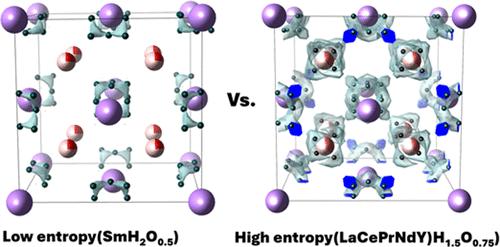
High-entropy materials have gained significant interest in many applications, but structural investigations of the effect on anions in the crystal structure are still scarce. Here, we study the effect of multicomponent cation disorder in the case of mixed-anion compounds. The distribution of mixed anions among various coordination sites is important given their implications for properties such as ionic conductivity and bulk diffusion in catalysis. Structural analysis in the fluorite-type (La,Ce,Pr,Nd,Y)H1.5O0.75 reveals that the disordered cationic effects create new interstitial sites, occupied selectively by hydride despite oxide and hydride disorder in other compositions and sites. In contrast, single-lanthanide oxyhydrides of analogous anion content, such as LaH1.5O0.75, or SmH2O0.5 lack the complex interstitial structure. Hydride ion conductivity measurements and bond valence sum energy maps show a considerably low activation energy of hydride migration due to the additional interstitial sites induced by high entropy. Such interstitials can be crucial in applications that involve hydride ion diffusion, such as ammonia synthesis catalysis and solid-state ionics, as further high-entropy compositions are explored.
期刊介绍:
The journal Chemistry of Materials focuses on publishing original research at the intersection of materials science and chemistry. The studies published in the journal involve chemistry as a prominent component and explore topics such as the design, synthesis, characterization, processing, understanding, and application of functional or potentially functional materials. The journal covers various areas of interest, including inorganic and organic solid-state chemistry, nanomaterials, biomaterials, thin films and polymers, and composite/hybrid materials. The journal particularly seeks papers that highlight the creation or development of innovative materials with novel optical, electrical, magnetic, catalytic, or mechanical properties. It is essential that manuscripts on these topics have a primary focus on the chemistry of materials and represent a significant advancement compared to prior research. Before external reviews are sought, submitted manuscripts undergo a review process by a minimum of two editors to ensure their appropriateness for the journal and the presence of sufficient evidence of a significant advance that will be of broad interest to the materials chemistry community.



 京公网安备 11010802042870号
京ICP备2023020795号-1
京公网安备 11010802042870号
京ICP备2023020795号-1

 分享
分享
 求助内容:
求助内容: 应助结果提醒方式:
 扫码关注我们
