Robert B. Allen, Darryl I. MacKenzie, Susan K. Wiser, Peter J. Bellingham, Lawrence E. Burrows, David A. Coomes
{"title":"A Growth–Survival Trade-Off Along an Elevation Gradient Is Altered by Earthquake Disturbance in a Monodominant Southern Beech Forest","authors":"Robert B. Allen, Darryl I. MacKenzie, Susan K. Wiser, Peter J. Bellingham, Lawrence E. Burrows, David A. Coomes","doi":"10.1002/ece3.70467","DOIUrl":null,"url":null,"abstract":"<p>Tree growth–survival relationships link two demographic processes that individually dictate the composition, structure and functioning of forest ecosystems. While these relationships vary intra-specifically, it remains unclear how this reflects environmental variation and disturbance. We examined the influence of a 700-m elevation gradient and an <i>Mw</i> = 6.7 earthquake on intra-specific variability in growth–survival relationships. We expected that survival models that incorporated recent growth would be better supported than those only using other factors known to influence tree survival. We used a permanent plot network that representatively sampled a monodominant <i>Nothofagus</i> forest in New Zealand's Southern Alps in 1974 and that was remeasured seven times through to 2009. The relationships were assessed using pre-earthquake growth and survival, pre-earthquake growth and post-earthquake survival (0–5 years post-earthquake), and post-earthquake growth and survival (5+ years post-earthquake). Survival was related to growth of 4504 trees on 216 plots using Bayesian modelling. We hypothesised there would be a positive, logistic relationship between growth and survival. Pre-earthquake, we found a positive, logarithmic growth–survival relationship at all elevations. At higher elevations, trees grew more slowly but had higher survival than trees at lower elevations, supporting our hypothesised demographic trade-off with elevation. The earthquake altered growth–survival relationships from those found pre-earthquake and 0–5 years post-earthquake survival held little relationship with growth. A strong, logarithmic growth–survival relationship developed 5+ years post-earthquake because of enhanced survival of fast-growing trees yet low survival of slow-growing trees. <i>Synthesis</i>. Our findings demonstrate a trend in growth–survival relationships along an elevation gradient. If we assume a gradual climate warming is the equivalent of a forest stand shifting to a lower elevation, then data from our pre-earthquake period suggest that tree growth–survival relationships at any elevation could adjust to faster growth and lower survival. We also show how these novel growth–survival relationships could be altered by periodic disturbance.</p>","PeriodicalId":11467,"journal":{"name":"Ecology and Evolution","volume":"14 11","pages":""},"PeriodicalIF":2.3000,"publicationDate":"2024-10-31","publicationTypes":"Journal Article","fieldsOfStudy":null,"isOpenAccess":false,"openAccessPdf":"https://onlinelibrary.wiley.com/doi/epdf/10.1002/ece3.70467","citationCount":"0","resultStr":null,"platform":"Semanticscholar","paperid":null,"PeriodicalName":"Ecology and Evolution","FirstCategoryId":"99","ListUrlMain":"https://onlinelibrary.wiley.com/doi/10.1002/ece3.70467","RegionNum":2,"RegionCategory":"生物学","ArticlePicture":[],"TitleCN":null,"AbstractTextCN":null,"PMCID":null,"EPubDate":"","PubModel":"","JCR":"Q2","JCRName":"ECOLOGY","Score":null,"Total":0}
引用次数: 0
Abstract
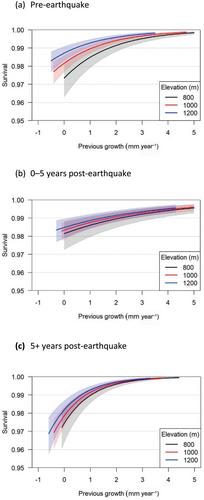
Tree growth–survival relationships link two demographic processes that individually dictate the composition, structure and functioning of forest ecosystems. While these relationships vary intra-specifically, it remains unclear how this reflects environmental variation and disturbance. We examined the influence of a 700-m elevation gradient and an Mw = 6.7 earthquake on intra-specific variability in growth–survival relationships. We expected that survival models that incorporated recent growth would be better supported than those only using other factors known to influence tree survival. We used a permanent plot network that representatively sampled a monodominant Nothofagus forest in New Zealand's Southern Alps in 1974 and that was remeasured seven times through to 2009. The relationships were assessed using pre-earthquake growth and survival, pre-earthquake growth and post-earthquake survival (0–5 years post-earthquake), and post-earthquake growth and survival (5+ years post-earthquake). Survival was related to growth of 4504 trees on 216 plots using Bayesian modelling. We hypothesised there would be a positive, logistic relationship between growth and survival. Pre-earthquake, we found a positive, logarithmic growth–survival relationship at all elevations. At higher elevations, trees grew more slowly but had higher survival than trees at lower elevations, supporting our hypothesised demographic trade-off with elevation. The earthquake altered growth–survival relationships from those found pre-earthquake and 0–5 years post-earthquake survival held little relationship with growth. A strong, logarithmic growth–survival relationship developed 5+ years post-earthquake because of enhanced survival of fast-growing trees yet low survival of slow-growing trees. Synthesis. Our findings demonstrate a trend in growth–survival relationships along an elevation gradient. If we assume a gradual climate warming is the equivalent of a forest stand shifting to a lower elevation, then data from our pre-earthquake period suggest that tree growth–survival relationships at any elevation could adjust to faster growth and lower survival. We also show how these novel growth–survival relationships could be altered by periodic disturbance.
期刊介绍:
Ecology and Evolution is the peer reviewed journal for rapid dissemination of research in all areas of ecology, evolution and conservation science. The journal gives priority to quality research reports, theoretical or empirical, that develop our understanding of organisms and their diversity, interactions between them, and the natural environment.
Ecology and Evolution gives prompt and equal consideration to papers reporting theoretical, experimental, applied and descriptive work in terrestrial and aquatic environments. The journal will consider submissions across taxa in areas including but not limited to micro and macro ecological and evolutionary processes, characteristics of and interactions between individuals, populations, communities and the environment, physiological responses to environmental change, population genetics and phylogenetics, relatedness and kin selection, life histories, systematics and taxonomy, conservation genetics, extinction, speciation, adaption, behaviour, biodiversity, species abundance, macroecology, population and ecosystem dynamics, and conservation policy.



 京公网安备 11010802042870号
京ICP备2023020795号-1
京公网安备 11010802042870号
京ICP备2023020795号-1

 分享
分享
 求助内容:
求助内容: 应助结果提醒方式:
 扫码关注我们
