Bei An, Xiaoqian Li, Yuan Lin, Fanfan Shang, Huijie He, Hairui Cai, Xiaoxiao Zeng, Weitong Wang, Shengchun Yang and Bin Wang
{"title":"Strontium-doped RuO2 electrocatalyst with abundant oxygen vacancies for boosting OER performance†","authors":"Bei An, Xiaoqian Li, Yuan Lin, Fanfan Shang, Huijie He, Hairui Cai, Xiaoxiao Zeng, Weitong Wang, Shengchun Yang and Bin Wang","doi":"10.1039/D4QI02070G","DOIUrl":null,"url":null,"abstract":"<p >The oxygen evolution reaction (OER) plays a crucial role as the anode reaction of electrolytic water splitting in various applications. To date, it is still a great challenge to develop highly active and durable electrocatalysts for acidic electrolytic water splitting. Herein, we highlight an effective strategy to regulate the oxidation state of Ru species and oxygen vacancies in RuO<small><sub>2</sub></small> by introducing Sr heteroatoms into its lattice based on the principle of charge equilibrium. The as-prepared Sr<small><sub>0.1</sub></small>RuO<small><sub><em>x</em></sub></small> catalyst exhibits excellent OER activity with an overpotential of 201 mV at a current density of 10 mA cm<small><sup>−2</sup></small>, which is attributed to the higher proportion of Ru<small><sup>4+</sup></small> induced by Sr doping. Moreover, both experimental and theoretical calculations revealed that the introduced oxygen vacancies inhibited the overoxidation of Ru to Ru<small><sup><em>n</em>>4+</sup></small> during the OER process, thus enhancing the stability of Sr<small><sub>0.1</sub></small>RuO<small><sub><em>x</em></sub></small>. Therefore, the PEM electrolyzer using Sr<small><sub>0.1</sub></small>RuO<small><sub><em>x</em></sub></small> as the anode catalyst can be operated for 240 hours at 10 mA cm<small><sup>−2</sup></small> without obvious attenuation. This work presents an effective strategy to regulate the structure of OER electrocatalysts with excellent performance.</p>","PeriodicalId":79,"journal":{"name":"Inorganic Chemistry Frontiers","volume":" 24","pages":" 8935-8944"},"PeriodicalIF":6.4000,"publicationDate":"2024-11-02","publicationTypes":"Journal Article","fieldsOfStudy":null,"isOpenAccess":false,"openAccessPdf":"","citationCount":"0","resultStr":null,"platform":"Semanticscholar","paperid":null,"PeriodicalName":"Inorganic Chemistry Frontiers","FirstCategoryId":"92","ListUrlMain":"https://pubs.rsc.org/en/content/articlelanding/2024/qi/d4qi02070g","RegionNum":1,"RegionCategory":"化学","ArticlePicture":[],"TitleCN":null,"AbstractTextCN":null,"PMCID":null,"EPubDate":"","PubModel":"","JCR":"Q1","JCRName":"CHEMISTRY, INORGANIC & NUCLEAR","Score":null,"Total":0}
引用次数: 0
Abstract
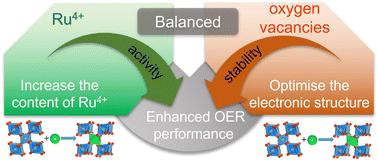
The oxygen evolution reaction (OER) plays a crucial role as the anode reaction of electrolytic water splitting in various applications. To date, it is still a great challenge to develop highly active and durable electrocatalysts for acidic electrolytic water splitting. Herein, we highlight an effective strategy to regulate the oxidation state of Ru species and oxygen vacancies in RuO2 by introducing Sr heteroatoms into its lattice based on the principle of charge equilibrium. The as-prepared Sr0.1RuOx catalyst exhibits excellent OER activity with an overpotential of 201 mV at a current density of 10 mA cm−2, which is attributed to the higher proportion of Ru4+ induced by Sr doping. Moreover, both experimental and theoretical calculations revealed that the introduced oxygen vacancies inhibited the overoxidation of Ru to Run>4+ during the OER process, thus enhancing the stability of Sr0.1RuOx. Therefore, the PEM electrolyzer using Sr0.1RuOx as the anode catalyst can be operated for 240 hours at 10 mA cm−2 without obvious attenuation. This work presents an effective strategy to regulate the structure of OER electrocatalysts with excellent performance.




 京公网安备 11010802042870号
京ICP备2023020795号-1
京公网安备 11010802042870号
京ICP备2023020795号-1

 分享
分享
 求助内容:
求助内容: 应助结果提醒方式:
 扫码关注我们
