{"title":"Toward Optimal Pilot Spacing and Power Control in Multi-Antenna Systems Operating Over Non-Stationary Rician Aging Channels","authors":"Sajad Daei;Gábor Fodor;Mikael Skoglund;Miklós Telek","doi":"10.1109/TCOMM.2024.3490500","DOIUrl":null,"url":null,"abstract":"Several previous works have addressed the inherent trade-off between allocating resources in the power and time domains to pilot and data signals in multiple input multiple output systems over block-fading channels. In particular, when the channel changes rapidly in time, channel aging degrades the performance in terms of spectral efficiency without proper pilot spacing and power control. Despite recognizing non-stationary stochastic processes as more accurate models for time-varying wireless channels, the problem of pilot spacing and power control in multi-antenna systems operating over non-stationary channels is not addressed in the literature. In this paper, we address this gap by introducing a refined first-order autoregressive model that exploits the inherent temporal correlations over non-stationary Rician aging channels. We design a multi-frame structure for data transmission that better reflects the non-stationary fading environment than previously developed single-frame structures. Subsequently, to determine the optimal pilot spacing and power control within this multi-frame structure, we develop an optimization framework and an efficient algorithm based on maximizing a deterministic equivalent expression for the spectral efficiency, demonstrating its generality by encompassing previous channel aging results. Our numerical results indicate the efficacy of the proposed method in terms of spectral efficiency gains over the single frame structure.","PeriodicalId":13041,"journal":{"name":"IEEE Transactions on Communications","volume":"73 6","pages":"3761-3777"},"PeriodicalIF":8.3000,"publicationDate":"2024-11-01","publicationTypes":"Journal Article","fieldsOfStudy":null,"isOpenAccess":false,"openAccessPdf":"","citationCount":"0","resultStr":null,"platform":"Semanticscholar","paperid":null,"PeriodicalName":"IEEE Transactions on Communications","FirstCategoryId":"94","ListUrlMain":"https://ieeexplore.ieee.org/document/10741213/","RegionNum":2,"RegionCategory":"计算机科学","ArticlePicture":[],"TitleCN":null,"AbstractTextCN":null,"PMCID":null,"EPubDate":"","PubModel":"","JCR":"Q1","JCRName":"ENGINEERING, ELECTRICAL & ELECTRONIC","Score":null,"Total":0}
引用次数: 0
Abstract
Several previous works have addressed the inherent trade-off between allocating resources in the power and time domains to pilot and data signals in multiple input multiple output systems over block-fading channels. In particular, when the channel changes rapidly in time, channel aging degrades the performance in terms of spectral efficiency without proper pilot spacing and power control. Despite recognizing non-stationary stochastic processes as more accurate models for time-varying wireless channels, the problem of pilot spacing and power control in multi-antenna systems operating over non-stationary channels is not addressed in the literature. In this paper, we address this gap by introducing a refined first-order autoregressive model that exploits the inherent temporal correlations over non-stationary Rician aging channels. We design a multi-frame structure for data transmission that better reflects the non-stationary fading environment than previously developed single-frame structures. Subsequently, to determine the optimal pilot spacing and power control within this multi-frame structure, we develop an optimization framework and an efficient algorithm based on maximizing a deterministic equivalent expression for the spectral efficiency, demonstrating its generality by encompassing previous channel aging results. Our numerical results indicate the efficacy of the proposed method in terms of spectral efficiency gains over the single frame structure.
期刊介绍:
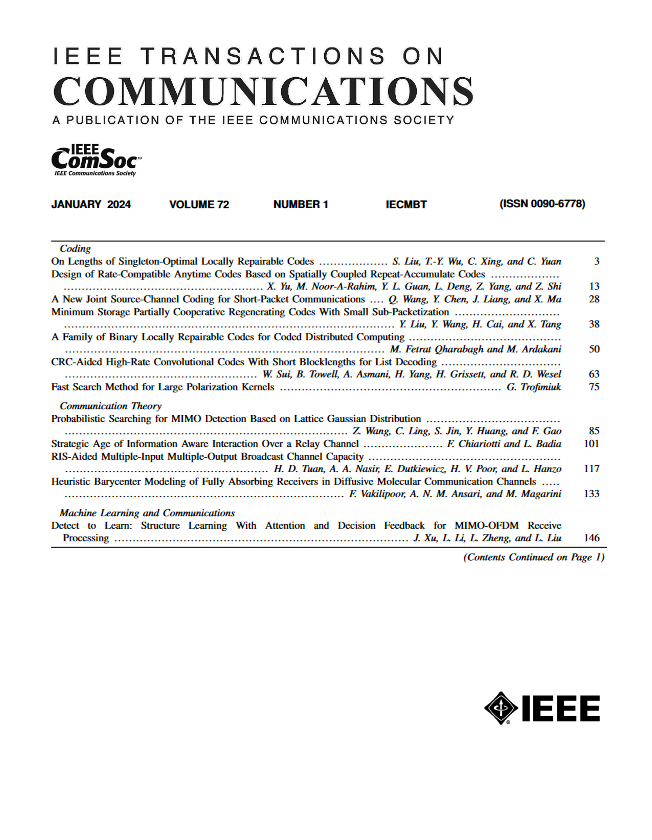
The IEEE Transactions on Communications is dedicated to publishing high-quality manuscripts that showcase advancements in the state-of-the-art of telecommunications. Our scope encompasses all aspects of telecommunications, including telephone, telegraphy, facsimile, and television, facilitated by electromagnetic propagation methods such as radio, wire, aerial, underground, coaxial, and submarine cables, as well as waveguides, communication satellites, and lasers. We cover telecommunications in various settings, including marine, aeronautical, space, and fixed station services, addressing topics such as repeaters, radio relaying, signal storage, regeneration, error detection and correction, multiplexing, carrier techniques, communication switching systems, data communications, and communication theory. Join us in advancing the field of telecommunications through groundbreaking research and innovation.



 京公网安备 11010802042870号
京ICP备2023020795号-1
京公网安备 11010802042870号
京ICP备2023020795号-1

 分享
分享
 求助内容:
求助内容: 应助结果提醒方式:
 扫码关注我们
