Simon Chan, Tasneem Khandaker, Yifu Li, Tim M Jackson, Hania Rahimi-Ardabili, Annie Ys Lau
{"title":"Translating primary care to telehealth: analysis of in-person paediatric consultations and role of carers.","authors":"Simon Chan, Tasneem Khandaker, Yifu Li, Tim M Jackson, Hania Rahimi-Ardabili, Annie Ys Lau","doi":"10.3399/BJGPO.2024.0030","DOIUrl":null,"url":null,"abstract":"<p><strong>Background: </strong>The usage of telehealth in general practice has risen substantially since the COVID-19 pandemic. Over this time frame, telehealth has provided care for all patient demographics, including the paediatric population (aged ≤18 years). However, the translatability of telehealth (that is, whether in-person tasks can be supported remotely via telehealth) rarely considers the paediatric population or their carers.</p><p><strong>Aim: </strong>To examine the degree of translatability to telehealth for in-person GP consultations on paediatric patients with consideration of the carers' roles.</p><p><strong>Design & setting: </strong>This study screened 281 videos of in-person GP consultations set within UK general practices, and 20 of them were eligible for analysis.</p><p><strong>Method: </strong>A secondary analysis of in-person GP consultations was undertaken to examine tasks, physical artefacts, examinations, and the interaction between carer, patient, and GP. A novel scoring method revolving around two key metrics, taking into consideration the carer, was designed to analyse whether the tasks performed can be supported via telehealth.</p><p><strong>Results: </strong>Analysis of 20 eligible consultations revealed 13 distinct physical examinations, 19 physical artefacts, and 17 clinical tasks. Of these 17 clinical tasks, 41% were deemed 'easily translatable to telehealth,' 29% 'moderately translatable with patient-provided equipment', 12% 'potentially translatable', and 18% 'currently untranslatable'. The average telehealth translatability score was 6.1/10, which suggests possible challenges with telehealth support. Regarding carer involvement, 90% of consultations involved collecting patient history, 70% placation of child, and 40% had physical support during examinations.</p><p><strong>Conclusion: </strong>Tasks performed during paediatric in-person GP consultations may not be easily translatable to telehealth and caution should be exercised when considering their translatability to telehealth.</p>","PeriodicalId":36541,"journal":{"name":"BJGP Open","volume":" ","pages":""},"PeriodicalIF":2.0000,"publicationDate":"2025-04-24","publicationTypes":"Journal Article","fieldsOfStudy":null,"isOpenAccess":false,"openAccessPdf":"https://www.ncbi.nlm.nih.gov/pmc/articles/PMC12138011/pdf/","citationCount":"0","resultStr":null,"platform":"Semanticscholar","paperid":null,"PeriodicalName":"BJGP Open","FirstCategoryId":"1085","ListUrlMain":"https://doi.org/10.3399/BJGPO.2024.0030","RegionNum":0,"RegionCategory":null,"ArticlePicture":[],"TitleCN":null,"AbstractTextCN":null,"PMCID":null,"EPubDate":"2025/4/1 0:00:00","PubModel":"Print","JCR":"Q2","JCRName":"PRIMARY HEALTH CARE","Score":null,"Total":0}
引用次数: 0
Abstract
Background: The usage of telehealth in general practice has risen substantially since the COVID-19 pandemic. Over this time frame, telehealth has provided care for all patient demographics, including the paediatric population (aged ≤18 years). However, the translatability of telehealth (that is, whether in-person tasks can be supported remotely via telehealth) rarely considers the paediatric population or their carers.
Aim: To examine the degree of translatability to telehealth for in-person GP consultations on paediatric patients with consideration of the carers' roles.
Design & setting: This study screened 281 videos of in-person GP consultations set within UK general practices, and 20 of them were eligible for analysis.
Method: A secondary analysis of in-person GP consultations was undertaken to examine tasks, physical artefacts, examinations, and the interaction between carer, patient, and GP. A novel scoring method revolving around two key metrics, taking into consideration the carer, was designed to analyse whether the tasks performed can be supported via telehealth.
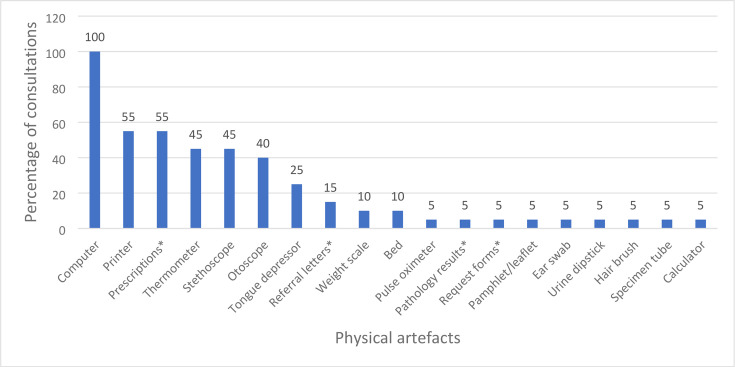
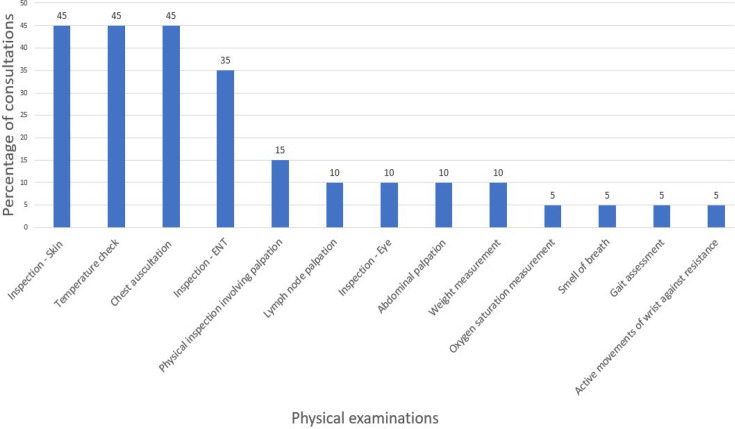
Results: Analysis of 20 eligible consultations revealed 13 distinct physical examinations, 19 physical artefacts, and 17 clinical tasks. Of these 17 clinical tasks, 41% were deemed 'easily translatable to telehealth,' 29% 'moderately translatable with patient-provided equipment', 12% 'potentially translatable', and 18% 'currently untranslatable'. The average telehealth translatability score was 6.1/10, which suggests possible challenges with telehealth support. Regarding carer involvement, 90% of consultations involved collecting patient history, 70% placation of child, and 40% had physical support during examinations.
Conclusion: Tasks performed during paediatric in-person GP consultations may not be easily translatable to telehealth and caution should be exercised when considering their translatability to telehealth.






 京公网安备 11010802042870号
京ICP备2023020795号-1
京公网安备 11010802042870号
京ICP备2023020795号-1

 分享
分享
 求助内容:
求助内容: 应助结果提醒方式:
 扫码关注我们
