{"title":"Clinical features and search for genetic determinants of postprandial hypoglycaemia.","authors":"Qian Ren, Xueyao Han, Siqian Gong, Simin Zhang, Tianhao Ba, Yilin Zhao, Yating Li, Yan'ai Wang, Xianghai Zhou, Yufeng Li, Linong Ji","doi":"10.1530/EC-24-0409","DOIUrl":null,"url":null,"abstract":"<p><strong>Objective: </strong>To test whether postprandial hypoglycaemia is an extreme and repeatable phenotype of glucose metabolism. We also explored the genetic determinants of this phenotype.</p><p><strong>Design and methods: </strong>We conducted this study using data from the Pinggu Metabolic Disease Study database (n = 3,345). We selected subjects after an oral glucose tolerance test (OGTT) (2 h glucose < 3 mmol/L) and compared their clinical features with those of subjects with normal glucose tolerance (NGT). In addition, we selected 75 subjects as a super-healthy control group. Whole-exome sequencing (WES) was performed on subjects with postprandial hypoglycaemic and super-healthy controls. We also evaluated several candidate genes believed to be important in pancreatic hypoglycaemia.</p><p><strong>Results: </strong>We found 13 participants (0.39%) who had an OGTT (2 h glucose < 3 mmol/L). Ten of these patients were men (76.9%). All 13 participants had insulin >3 μU/mL when postprandial blood glucose levels were <3 mmol/L. WES analysis identified one gene, paternally expressed 3 (PEG3), which had three rare mutations in four patients (30.8%). Minor allele frequencies of rare PEG3 mutations were significantly higher in subjects with postprandial hypoglycaemia than in super-healthy controls. Among the four subjects with PEG3 gene mutations, 71.4% were men, and their body mass index was significantly lower than that of the NGT group.</p><p><strong>Conclusions: </strong>Postprandial hypoglycaemia is an extreme and reproducible phenotype in the general population. PEG3 mutations may represent a potential genetic aetiology for postprandial hypoglycaemia. Further research with larger and more diverse populations and a broader genetic focus is needed to understand the genetic basis of postprandial hypoglycaemia.</p>","PeriodicalId":11634,"journal":{"name":"Endocrine Connections","volume":" ","pages":""},"PeriodicalIF":2.8000,"publicationDate":"2024-12-13","publicationTypes":"Journal Article","fieldsOfStudy":null,"isOpenAccess":false,"openAccessPdf":"https://www.ncbi.nlm.nih.gov/pmc/articles/PMC11728931/pdf/","citationCount":"0","resultStr":null,"platform":"Semanticscholar","paperid":null,"PeriodicalName":"Endocrine Connections","FirstCategoryId":"3","ListUrlMain":"https://doi.org/10.1530/EC-24-0409","RegionNum":3,"RegionCategory":"医学","ArticlePicture":[],"TitleCN":null,"AbstractTextCN":null,"PMCID":null,"EPubDate":"2025/1/1 0:00:00","PubModel":"Print","JCR":"Q3","JCRName":"ENDOCRINOLOGY & METABOLISM","Score":null,"Total":0}
引用次数: 0
Abstract
Objective: To test whether postprandial hypoglycaemia is an extreme and repeatable phenotype of glucose metabolism. We also explored the genetic determinants of this phenotype.
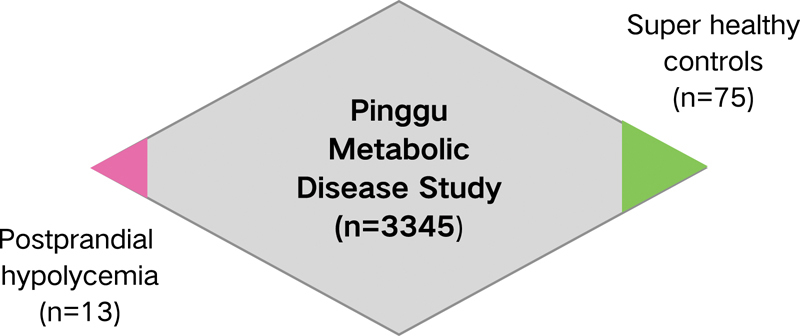
Design and methods: We conducted this study using data from the Pinggu Metabolic Disease Study database (n = 3,345). We selected subjects after an oral glucose tolerance test (OGTT) (2 h glucose < 3 mmol/L) and compared their clinical features with those of subjects with normal glucose tolerance (NGT). In addition, we selected 75 subjects as a super-healthy control group. Whole-exome sequencing (WES) was performed on subjects with postprandial hypoglycaemic and super-healthy controls. We also evaluated several candidate genes believed to be important in pancreatic hypoglycaemia.
Results: We found 13 participants (0.39%) who had an OGTT (2 h glucose < 3 mmol/L). Ten of these patients were men (76.9%). All 13 participants had insulin >3 μU/mL when postprandial blood glucose levels were <3 mmol/L. WES analysis identified one gene, paternally expressed 3 (PEG3), which had three rare mutations in four patients (30.8%). Minor allele frequencies of rare PEG3 mutations were significantly higher in subjects with postprandial hypoglycaemia than in super-healthy controls. Among the four subjects with PEG3 gene mutations, 71.4% were men, and their body mass index was significantly lower than that of the NGT group.
Conclusions: Postprandial hypoglycaemia is an extreme and reproducible phenotype in the general population. PEG3 mutations may represent a potential genetic aetiology for postprandial hypoglycaemia. Further research with larger and more diverse populations and a broader genetic focus is needed to understand the genetic basis of postprandial hypoglycaemia.
期刊介绍:
Endocrine Connections publishes original quality research and reviews in all areas of endocrinology, including papers that deal with non-classical tissues as source or targets of hormones and endocrine papers that have relevance to endocrine-related and intersecting disciplines and the wider biomedical community.




 京公网安备 11010802042870号
京ICP备2023020795号-1
京公网安备 11010802042870号
京ICP备2023020795号-1

 分享
分享
 求助内容:
求助内容: 应助结果提醒方式:
 扫码关注我们
