Nonalcoholic fatty liver disease is associated with ventricular arrhythmias and major cardiovascular events in patients with implantable cardioverter-defibrillators
Yuan Gao MD , Xiaoyao Li MD , Jiandu Yang MD , Zhuxin Zhang MD , Zhongli Chen MD , Sijin Wu MD , Xiang Cui PhD , Xuan Ma MD , Xiaogang Guo MD , Ruohan Chen MD , Qi Sun MD , Yan Dai MD , Shu Zhang MD , Keping Chen MD, FHRS
{"title":"Nonalcoholic fatty liver disease is associated with ventricular arrhythmias and major cardiovascular events in patients with implantable cardioverter-defibrillators","authors":"Yuan Gao MD , Xiaoyao Li MD , Jiandu Yang MD , Zhuxin Zhang MD , Zhongli Chen MD , Sijin Wu MD , Xiang Cui PhD , Xuan Ma MD , Xiaogang Guo MD , Ruohan Chen MD , Qi Sun MD , Yan Dai MD , Shu Zhang MD , Keping Chen MD, FHRS","doi":"10.1016/j.hrthm.2024.10.050","DOIUrl":null,"url":null,"abstract":"<div><h3>Background</h3><div>Patients with nonalcoholic fatty liver disease<span> (NAFLD) are at risk for cardiovascular diseases. Less is known about the relationship between NAFLD, ventricular arrhythmias (VAs), and cardiovascular events.</span></div></div><div><h3>Objective</h3><div>We sought to evaluate the association between NAFLD and VAs and major cardiovascular events in patients with implantable cardioverter-defibrillators (ICDs).</div></div><div><h3>Methods</h3><div><span>A total of 921 patients at high risk of sudden cardiac death who received ICDs were retrospectively analyzed. NAFLD is diagnosed by the presence of </span>hepatic steatosis<span> and lack of secondary causes of hepatic fat accumulation<span><span>. The primary end points were VAs, defined as sustained ventricular tachycardia and </span>ventricular fibrillation<span> documented by the device. The secondary end points were cardiac mortality, heart transplantation, and rehospitalization for heart failure.</span></span></span></div></div><div><h3>Results</h3><div>The prevalence of NAFLD in patients with ICDs was 24.2% (223/921). The mean age was 58.5 ± 12.7 years, and 25.7% were female. During the mean follow-up of 34.8 months, 272 (29.5%) patients achieved primary end points and 171 (18.6%) achieved secondary end points. Kaplan-Meier analysis revealed that NAFLD was associated with an increased risk of VAs (hazard ratio [HR], 3.90; 95% confidence interval [CI], 2.87–5.29; log-rank <em>P</em> < .0001) and secondary end points (HR, 2.04; 95% CI, 1.72–2.94; log-rank <em>P</em><span> < .0001). In adjusted Cox regression models, NAFLD was an independent risk factor for VAs (HR, 3.84; CI, 2.87–5.12; </span><em>P</em> < .001) and secondary end points (HR, 2.26; CI, 1.55–3.28; <em>P</em> < .001).</div></div><div><h3>Conclusion</h3><div>In our retrospective cohort, NAFLD is significantly associated with VAs and major cardiovascular events in patients with ICDs.</div></div>","PeriodicalId":12886,"journal":{"name":"Heart rhythm","volume":"22 9","pages":"Pages 2353-2360"},"PeriodicalIF":5.7000,"publicationDate":"2025-09-01","publicationTypes":"Journal Article","fieldsOfStudy":null,"isOpenAccess":false,"openAccessPdf":"","citationCount":"0","resultStr":null,"platform":"Semanticscholar","paperid":null,"PeriodicalName":"Heart rhythm","FirstCategoryId":"3","ListUrlMain":"https://www.sciencedirect.com/science/article/pii/S1547527124035112","RegionNum":2,"RegionCategory":"医学","ArticlePicture":[],"TitleCN":null,"AbstractTextCN":null,"PMCID":null,"EPubDate":"2024/10/28 0:00:00","PubModel":"Epub","JCR":"Q1","JCRName":"CARDIAC & CARDIOVASCULAR SYSTEMS","Score":null,"Total":0}
引用次数: 0
Abstract
Background
Patients with nonalcoholic fatty liver disease (NAFLD) are at risk for cardiovascular diseases. Less is known about the relationship between NAFLD, ventricular arrhythmias (VAs), and cardiovascular events.
Objective
We sought to evaluate the association between NAFLD and VAs and major cardiovascular events in patients with implantable cardioverter-defibrillators (ICDs).
Methods
A total of 921 patients at high risk of sudden cardiac death who received ICDs were retrospectively analyzed. NAFLD is diagnosed by the presence of hepatic steatosis and lack of secondary causes of hepatic fat accumulation. The primary end points were VAs, defined as sustained ventricular tachycardia and ventricular fibrillation documented by the device. The secondary end points were cardiac mortality, heart transplantation, and rehospitalization for heart failure.
Results
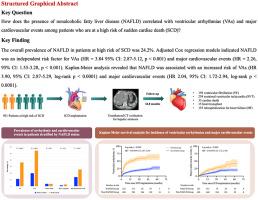
The prevalence of NAFLD in patients with ICDs was 24.2% (223/921). The mean age was 58.5 ± 12.7 years, and 25.7% were female. During the mean follow-up of 34.8 months, 272 (29.5%) patients achieved primary end points and 171 (18.6%) achieved secondary end points. Kaplan-Meier analysis revealed that NAFLD was associated with an increased risk of VAs (hazard ratio [HR], 3.90; 95% confidence interval [CI], 2.87–5.29; log-rank P < .0001) and secondary end points (HR, 2.04; 95% CI, 1.72–2.94; log-rank P < .0001). In adjusted Cox regression models, NAFLD was an independent risk factor for VAs (HR, 3.84; CI, 2.87–5.12; P < .001) and secondary end points (HR, 2.26; CI, 1.55–3.28; P < .001).
Conclusion
In our retrospective cohort, NAFLD is significantly associated with VAs and major cardiovascular events in patients with ICDs.
期刊介绍:
HeartRhythm, the official Journal of the Heart Rhythm Society and the Cardiac Electrophysiology Society, is a unique journal for fundamental discovery and clinical applicability.
HeartRhythm integrates the entire cardiac electrophysiology (EP) community from basic and clinical academic researchers, private practitioners, engineers, allied professionals, industry, and trainees, all of whom are vital and interdependent members of our EP community.
The Heart Rhythm Society is the international leader in science, education, and advocacy for cardiac arrhythmia professionals and patients, and the primary information resource on heart rhythm disorders. Its mission is to improve the care of patients by promoting research, education, and optimal health care policies and standards.



 京公网安备 11010802042870号
京ICP备2023020795号-1
京公网安备 11010802042870号
京ICP备2023020795号-1

 分享
分享
 求助内容:
求助内容: 应助结果提醒方式:
 扫码关注我们
