Enhancement of scratch resistance properties on the surface of photocurable 3D printed models through the integration of polysiloxane core–shell nanoparticles
Lulu Li , Na Li , Yangyang Xin , Zheng Mo , Shuyun Zhou , Chenghua Sun , Qingquan Tian , Xiaobo Chen , Shizhuo Xiao
{"title":"Enhancement of scratch resistance properties on the surface of photocurable 3D printed models through the integration of polysiloxane core–shell nanoparticles","authors":"Lulu Li , Na Li , Yangyang Xin , Zheng Mo , Shuyun Zhou , Chenghua Sun , Qingquan Tian , Xiaobo Chen , Shizhuo Xiao","doi":"10.1016/j.surfin.2024.105330","DOIUrl":null,"url":null,"abstract":"<div><div>Photocurable 3D printing technology has attracted widespread attention because of rapid formation speed and high printing accuracy, but photosensitive resin (PSR) materials with scratch resistance have become a difficult problem in 3D printing research. In this paper, polysiloxane core-shell nanoparticles (CSP) were prepared to achieve both reduced friction coefficient and enhanced mechanical properties. Compared with pure photosensitive resin, the 3D printed model with the optimal amount of 2.5 wt% CSP has a lower friction coefficient and wear rate, which are reduced by 77.6 % and 75.8 %, respectively, and the impact strength, tensile strength and elongation at break are increased by 25.7 %, 26.1 % and 40.1 %, respectively. The scratch resistance was evaluated by constant load scratch test and progressive load scratch test. The results showed that CSP significantly improved the scratch resistance of 3D printed models, and the penetration depth was continuously reduced from 175.5 μm to 128.3 μm under a load of 30 N. These findings indicate that CSP is a promising scratch-resistant additive for application, expanding the application range of photocurable 3D printing.</div></div>","PeriodicalId":22081,"journal":{"name":"Surfaces and Interfaces","volume":"55 ","pages":"Article 105330"},"PeriodicalIF":6.3000,"publicationDate":"2024-12-01","publicationTypes":"Journal Article","fieldsOfStudy":null,"isOpenAccess":false,"openAccessPdf":"","citationCount":"0","resultStr":null,"platform":"Semanticscholar","paperid":null,"PeriodicalName":"Surfaces and Interfaces","FirstCategoryId":"88","ListUrlMain":"https://www.sciencedirect.com/science/article/pii/S246802302401486X","RegionNum":2,"RegionCategory":"材料科学","ArticlePicture":[],"TitleCN":null,"AbstractTextCN":null,"PMCID":null,"EPubDate":"2024/10/24 0:00:00","PubModel":"Epub","JCR":"Q2","JCRName":"CHEMISTRY, PHYSICAL","Score":null,"Total":0}
引用次数: 0
Abstract
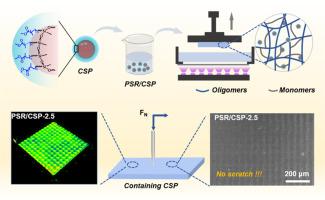
Photocurable 3D printing technology has attracted widespread attention because of rapid formation speed and high printing accuracy, but photosensitive resin (PSR) materials with scratch resistance have become a difficult problem in 3D printing research. In this paper, polysiloxane core-shell nanoparticles (CSP) were prepared to achieve both reduced friction coefficient and enhanced mechanical properties. Compared with pure photosensitive resin, the 3D printed model with the optimal amount of 2.5 wt% CSP has a lower friction coefficient and wear rate, which are reduced by 77.6 % and 75.8 %, respectively, and the impact strength, tensile strength and elongation at break are increased by 25.7 %, 26.1 % and 40.1 %, respectively. The scratch resistance was evaluated by constant load scratch test and progressive load scratch test. The results showed that CSP significantly improved the scratch resistance of 3D printed models, and the penetration depth was continuously reduced from 175.5 μm to 128.3 μm under a load of 30 N. These findings indicate that CSP is a promising scratch-resistant additive for application, expanding the application range of photocurable 3D printing.
期刊介绍:
The aim of the journal is to provide a respectful outlet for ''sound science'' papers in all research areas on surfaces and interfaces. We define sound science papers as papers that describe new and well-executed research, but that do not necessarily provide brand new insights or are merely a description of research results.
Surfaces and Interfaces publishes research papers in all fields of surface science which may not always find the right home on first submission to our Elsevier sister journals (Applied Surface, Surface and Coatings Technology, Thin Solid Films)




 京公网安备 11010802042870号
京ICP备2023020795号-1
京公网安备 11010802042870号
京ICP备2023020795号-1

 分享
分享
 求助内容:
求助内容: 应助结果提醒方式:
 扫码关注我们
